USD/CAD fails to reclaim the 20-DMA, though it remains positive and hovers around 1.2835
- The Canadian dollar gained 0.47% vs. the greenback in the week, which was soft throughout the whole week.
- The US Dollar Index reclaimed the 103.000 mark but ended the week with losses of 1.38%.
- USD/CAD Price Forecast: A daily close above the 20-DMA could pave the way for a move towards 1.3000.

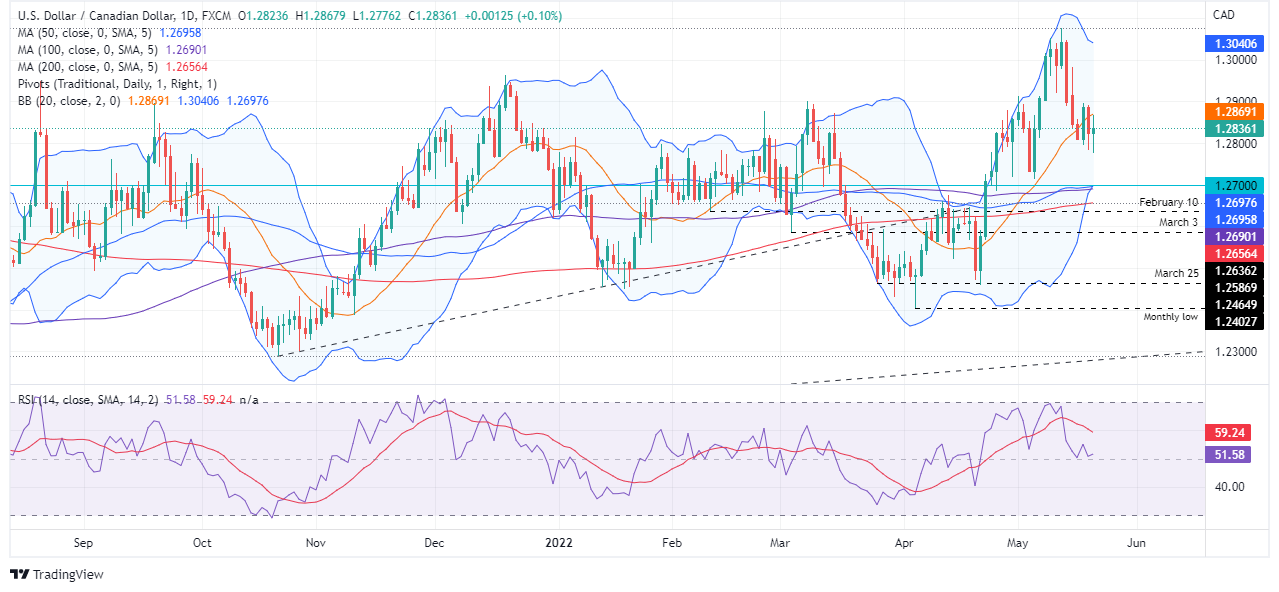
The USD/CAD is seesawing during the North American session and is recording minimal gains of 0.06% on Friday, after reaching a daily low below 1.2800, later reclaimed by USD/CAD bulls that struggled at the 20-DMA at around 1.2868. At the time of writing, the USD/CAD is trading at 1.2836.
The major benefitted from overall greenback strength, as the US Dollar Index, a measure of the greenback, rose more than 0.23% and is sitting at 103.060, a tailwind for the USD/CAD. Also, a dampened market mood increased appetite for safe-haven peers in the FX space, particularly the buck, while the JPY is the weakest on the week’s last trading day.
Reflection of the above-mentioned are the US equities plunging between 1.51% and 2.49%, reaching fresh 52-week lows. That despite investors’ cheered rate cut of 0.15% by the People Bank of China (PBoC), aimed to stimulate the Chinese economy, which is going to another Covid-19 outbreak that triggered more than one-month lockdowns in Shanghai.
Meanwhile, mixed economic data on the Canadian docket boosted the prospects of the Loonie, which gained 0.47% in the week. Canada’s inflation rate rose by 6.8%, hitting a 31-year high. Furthermore, on Thursday, Statistics Canada reported that prices paid by producers, also known as PPI, came in line with expectations, but Raw Materials skyrocketed to 38.4% y/y, higher than the 31% estimations.
Analysts at TD Securities wrote in a note that the report might keep the Bank of Canada under pressure to bring policy to neutral. They added that although “The Bank has already acknowledged that additional 50bp hikes are likely, today’s report is unlikely to tip the scales towards a 75bp hike.”
“We continue to look for the Bank to hike by 50bps in June and July to bring the overnight rate to 2.00%, before switching to 25bp hikes from Sept-Jan,” TD Securities analysts noted.
USD/CAD Price Forecast: Technical outlook
Friday’s price action shows that the USD/CAD tumbled below the 20-day moving average (DMA) at 1.2869, and albeit being positive in the session, USD/CAD buyers have been unable to reclaim the level. Still, it’s worth noting that the Relative Strenght Index (RSI), although it fell off the cliff from around 80 readings to 51.49, turned bullish, and is aiming higher, a signal that USD/CAD bulls remain in charge.
That said, the USD/CAD first resistance would be the 20-DMA at 1.2869. Break above would expose the 1.2900 mark, followed by the May 16 daily high at 1.2981, then the figure at 1.3000. On the flip side, the USD/CAD first support would be 1.2800. Once cleared, the next demand zone would be the April 29 daily low at 1.2718, followed by the confluence of the 50 and 100-DMA at 1.2695 and 1.2690, respectively.
Key Technical Levels
Author

Christian Borjon Valencia
FXStreet
Markets analyst, news editor, and trading instructor with over 14 years of experience across FX, commodities, US equity indices, and global macro markets.