|

USD/CAD declines after mixed US job report

  • USD/CAD retreats to 1.4305 after softer-than-expected US NFP data.
  • US Unemployment declined to 4% while hourly earnings remained stable.
  • Canadian unemployment falls to 6.6%, but remains above forecasts.

The USD/CAD pair pulled back to 1.4305 following the release of January's Nonfarm Payrolls (NFP) data, which fell significantly short of expectations. The report showed the US economy added just 143K jobs, well below the 307K forecast, triggering a pullback in the US Dollar. Meanwhile, the unemployment rate ticked down to 4%, aligning with market projections, while wage growth remained firm.

While the headline NFP figure disappointed, wage growth remained stable. Average hourly earnings rose by 0.5% month-over-month as expected, while the annual figure edged up to 4.1%, surpassing the 3.9% estimate. Additionally, the labor force participation rate improved slightly to 62.6% from 62.5%, suggesting continued resilience in employment metrics despite weaker hiring trends.

On the Canadian side, unemployment declined to 6.6%, improving from 6.8% but still exceeding the projected 6.7%. The data suggests that while job conditions in Canada have somewhat improved, lingering softness in the labor market could keep the Bank of Canada (BoC) cautious regarding future rate adjustments.

USD/CAD Technical outlook

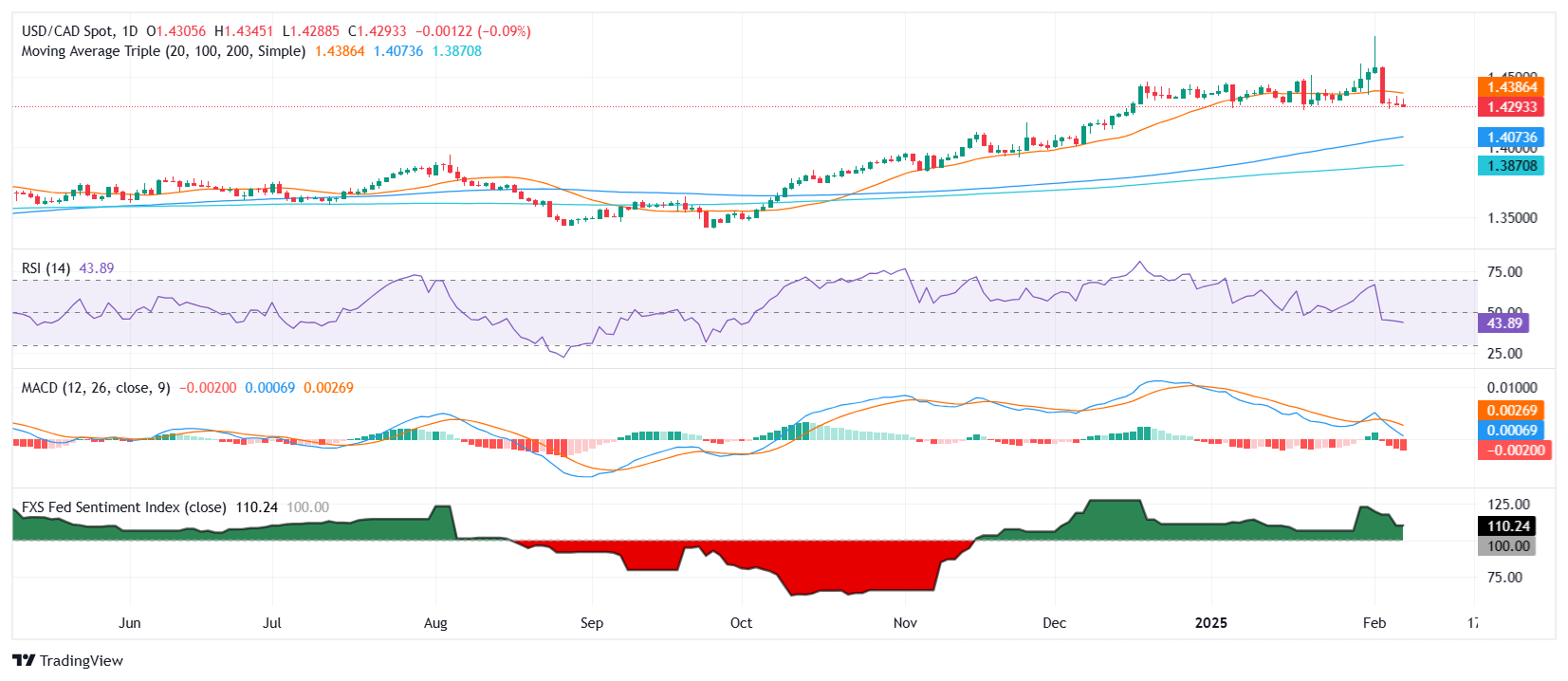
USD/CAD retraced to 1.4305, marking a moderate pullback but indicators including the Relative Strength Index (RSI) and Moving Average Convergence Divergence (MACD) look weak on the daily scale. The pair remains in an downtrend in the short-term after losing the 20-day Simple Moving Average (SMA), but buying pressure could persist if sellers fails to secure the 1.4300 support zone.
Author

Patricio Martín

Patricio is an economist from Argentina passionate about global finance and understanding the daily movements of the markets.


More from Patricio Martín
Share:

Markets move fast. We move first.

Orange Juice Newsletter brings you expert driven insights - not headlines. Every day on your inbox.

By subscribing you agree to our Terms and conditions.

Editor's Picks

EUR/USD stays bid above 1.1700 as risk flows dominate

EUR/USD posts small gains above 1.1700 in early European trading hours on Monday. The US Dollar remains broadly subdued amid a risk-on market profile, underpinning the pair. 

GBP/USD clings to recovery gains near 1.3400

GBP/USD is clinging to recovery gains near 1.3400 in early Europe on Monday. The pair capitalizes on an upbeat market mood and a steady US Dollar as traders digest the recent

 monetary policy decisions by the Fed and the BoE.

Gold hits fresh record highs above $4,400 amid renewed geopolitical woes

Gold is hitting fresh record highs above $4,400 early Monday, helped by renewed geopolitical tensions. Israel-Iran conflict and US-Venezuela headlines drive investors toward the traditional store of value, Gold. 

Bitcoin, Ethereum and Ripple eye breakout for fresh recovery

Bitcoin, Ethereum, and Ripple are approaching key technical levels at the time of writing on Monday as the broader crypto market stabilizes. Market participants are closely watching whether BTC, ETH, and XRP can sustain breakouts and achieve decisive daily closes above nearby resistance levels, which could signal the start of a short-term recovery.

De-dollarisation by design: Gold’s partner in the new system

You don’t need another 2008 for the system to reset. You just need enough nations to stop settling trade in dollars. And that’s already happening. "If gold is the anchor, what actually moves value in a post-dollar world?” It’s a question most gold investors overlook. We think in terms of storage and preservation, but in the new rails being built, settlement speed matters just as much as soundness of money.

Hyperliquid price forecast: Bullish interest builds amid user recovery

Hyperliquid (HYPE) trades at $25 at press time on Monday, holding the 3% gains from the previous day. The perpetual exchange sees a recovery in active users, while weekly fees collected decline to the lowest level so far this month.