US Treasuries steady despite political storm
Amid an electric political climate in Washington, US Bond markets are showing surprising stability. As US President Donald Trump stepped up the pressure on the Federal Reserve (Fed) and investors tried to decipher the implications of this institutional offensive, Treasury yields did not panic. A performance that both questions and reassures.
A market under stress, but not in crisis
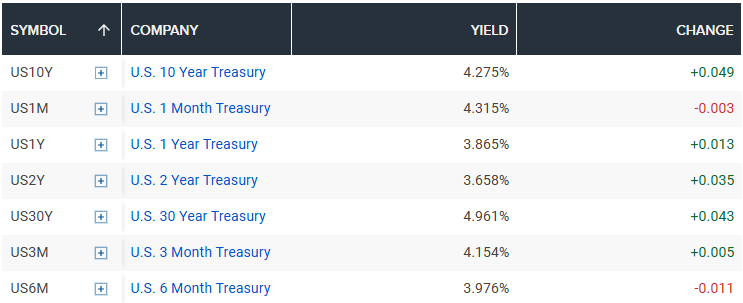
On Tuesday, the 30-year Treasury yield briefly approached 5%, before easing back to 4.96%. The 10-year, the global benchmark, hovers around 4.27%, down from 4.3% earlier today. The 2-year points to 3.65%, widening the gap with the 10-year to its widest since April, noted CNBC.
Source: CNBC
These adjustments show that volatility is under control. Investors are reacting to political events, but without triggering a mass exodus.
Trump and the Fed: A high-risk showdown
The tension stems from a spectacular gesture, US President Donald Trump announcing that he was sacking Lisa Cook, Fed Governor and respected figure on the Federal Open Market Committee (FOMC).
Legally questionable, this decision could trigger a legal battle, as Cook has already announced her intention to sue.
For the markets, the stakes are broader. President Trump wants to place a majority of his allies on the Board of Governors in order to steer short-term interest rates.
The idea of a Federal Reserve under political influence raises fears of a forced cut in key interest rates, to the detriment of the fight against inflation. In this scenario, long yields would rise, reflecting an increased risk premium on US debt.
An intriguing resilience
Despite these threats, the US Bond market remains resilient. Several factors explain this resilience:
- Treasury Bonds remain the ultimate safe-haven asset, even when domestic politics become tense.
- Global investors are still anticipating gradual disinflation, which is holding back the rise in yields.
- Finally, the prospect of an economic slowdown in the United States encourages investors to secure their portfolios by favouring sovereign debt.
The paradox is therefore as follows: The more uncertain the political situation, the stronger the demand for US debt, supporting prices and keeping Treasury yields under control.
The spectre of September
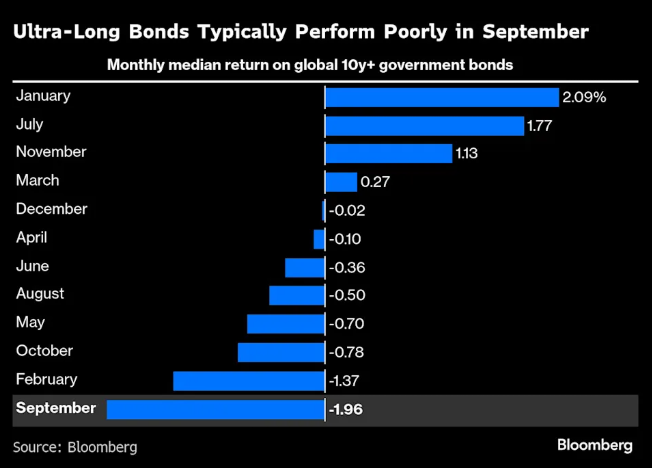
However, history reminds us that the current serenity may only be temporary. September is traditionally a difficult month for long-dated Bonds, notes Bloomberg, due to a surge in issuance and a repositioning of investors.
This year, the equation is even more complex. Rising budget deficits, stubborn inflation, international tensions and uncertainty over the next Federal Reserve meeting scheduled for mid-September.
If all these elements come together, the stability seen in recent days could be shattered. Some strategists see a risk of a "vicious circle": Rising public debt would push yields higher, exacerbating the fiscal burden and reinforcing investors' doubts.
Cautious vigilance
For the time being, the official line remains that of Treasury Secretary Scott Bessent: "The Bond market is calm", he asserted.
But behind this façade, operators know that the balance is fragile. The confrontation between Donald Trump and the Federal Reserve could permanently alter the perception of American risk, the beating heart of the global financial system.
In the meantime, Treasury yields remain the markets' compass, oscillating steadily but under constant tension. A deceptive lull that could, at the slightest political or economic misstep, give way to a new phase of turbulence.
Author

Ghiles Guezout
FXStreet
Ghiles Guezout is a Market Analyst with a strong background in stock market investments, trading, and cryptocurrencies. He combines fundamental and technical analysis skills to identify market opportunities.