US stock market slips despite Republicans inching closer to budget with major tax cuts
- US stocks descend for the second day in a row on Wednesday.
- House Republicans agree to $40K cap on SALT deduction.
- Jamie Dimon's pessimism sinks in as worries grow over tariffs.
- UNH stock sinks on kickback allegations, TGT sheds weight on falling comparable sales.

The US stock market slumped in its early going on Wednesday, a day after the S&P 500 declined for the first time in seven sessions. Rhetoric among Wall Street's leading lights reflects a general belief that the market is too optimistic about the effect of the Trump administration's tariffs and that higher prices have not yet carried through to economic and corporate data that will have a bearish consequence.
The Dow Jones Industrial Average (DJIA) opened about 0.7% lower, while the NASDAQ Composite and S&P 500 were both down more than half a percentage point. This is somewhat surprising since news on the fiscal front is that Republican lawmakers have agreed to lift the federal tax exemption on state and local taxes (SALT) to $40,000, a sticking point that had held up budget negotiations until now. President Donald Trump's budget bill carries with it a hefty tax cut for wealthy taxpayers, which should be a boon to the stock market.
UnitedHealth Group (UNH) is once again in the news for the wrong reasons. The Guardian reports that the largest private health insurer in the United States provided illegal kickbacks to nursing homes in order to keep insured patients out of the hospital even when necessary and to steer Medicare enrollees its way. UNH stock is trading about 5% lower on the news.
Target (TGT) stock fell more than 6% after quarterly earnings showed a -3.8% comparable sales decline.
Stock market outlook
JPMorgan CEO Jamie Dimon, always a bellwether for changing sentiment on Wall Street, told attendees that the stock market was exhibiting an "extraordinary amount of complacency" in the face of the Trump administration's tariffs. Dimon said Trump's tariff delays and pauses had pushed investors into an overly optimistic state that would crash once tariffs carry through to higher prices and lower spending in the economy.
US companies have largely withstood pressure to raise prices as they worked through large inventories built up before the tariffs came into place. Walmart's CEO said during its recent earnings call that prices would rise on some products at the end of this month, and both Apple (AAPL) and Microsoft (MSFT) have announced price increases to their respective iPhone and Xbox devices.
Stock trading volumes on Tuesday were about half their usual level, a sign that the market may be waking up after indices have climbed back to levels last seen prior to Trump's Liberation Day tariff announcement. Other bearish news includes Redfin announcing that US home prices in April fell for the first time on a monthly basis since September 2022. S&P 500 industrials saw short bets boosted in April for the third month in a row.
Dimon started the year by telling investors that worries over tariffs were overblown, but on Monday, he said that the full effect of tariffs could lead to a 10% market sell-off. This would place indices back toward their late April levels but not the depths seen at the start of that month. A week earlier, he said investors shouldn't discount the possibility of a recession either.
"If there's a recession, I don't know how big it will be or how long it will last. Hopefully, we'll avoid it, but I wouldn't take it off the table at this point," Dimon told Bloomberg.
S&P 500 market forecast
The S&P 500 is taking a breather again at the start of Wednesday trading. The market surged in six straight sessions through Monday, so a period of consolidation is unsurprising.
The index could move back to the 200-day Simple Moving Average (SMA) just below 5,800 or even the 50-day SMA below 5,600 if the pullback becomes more pronounced. One piece of evidence in favor of a pullback is that the Relative Strength Index (RSI) briefly hit the 70 overbought threshold on Monday, the first time it has done so since early December of last year. When it hit that level last December, the index trended lower over the next six weeks.
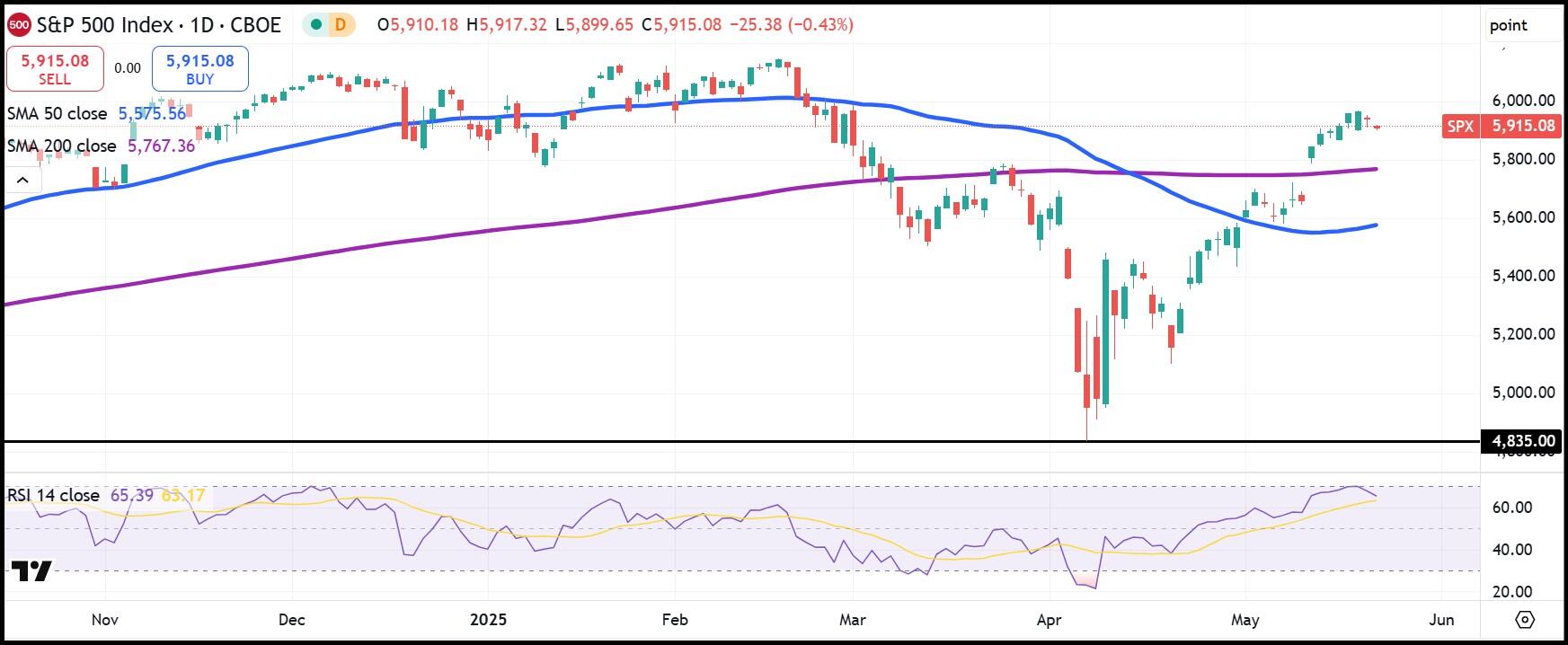
S&P 500 index daily chart
Author

Clay Webster
FXStreet
Clay Webster grew up in the US outside Buffalo, New York and Lancaster, Pennsylvania. He began investing after college following the 2008 financial crisis.