US stock market buckles Thursday as oil surges as much as 9%
- Oil (WTI) spikes above $81 on Thursday as Strait of Hormuz closure persists.
- China bans petroleum exports in sign that supply disruption might last.
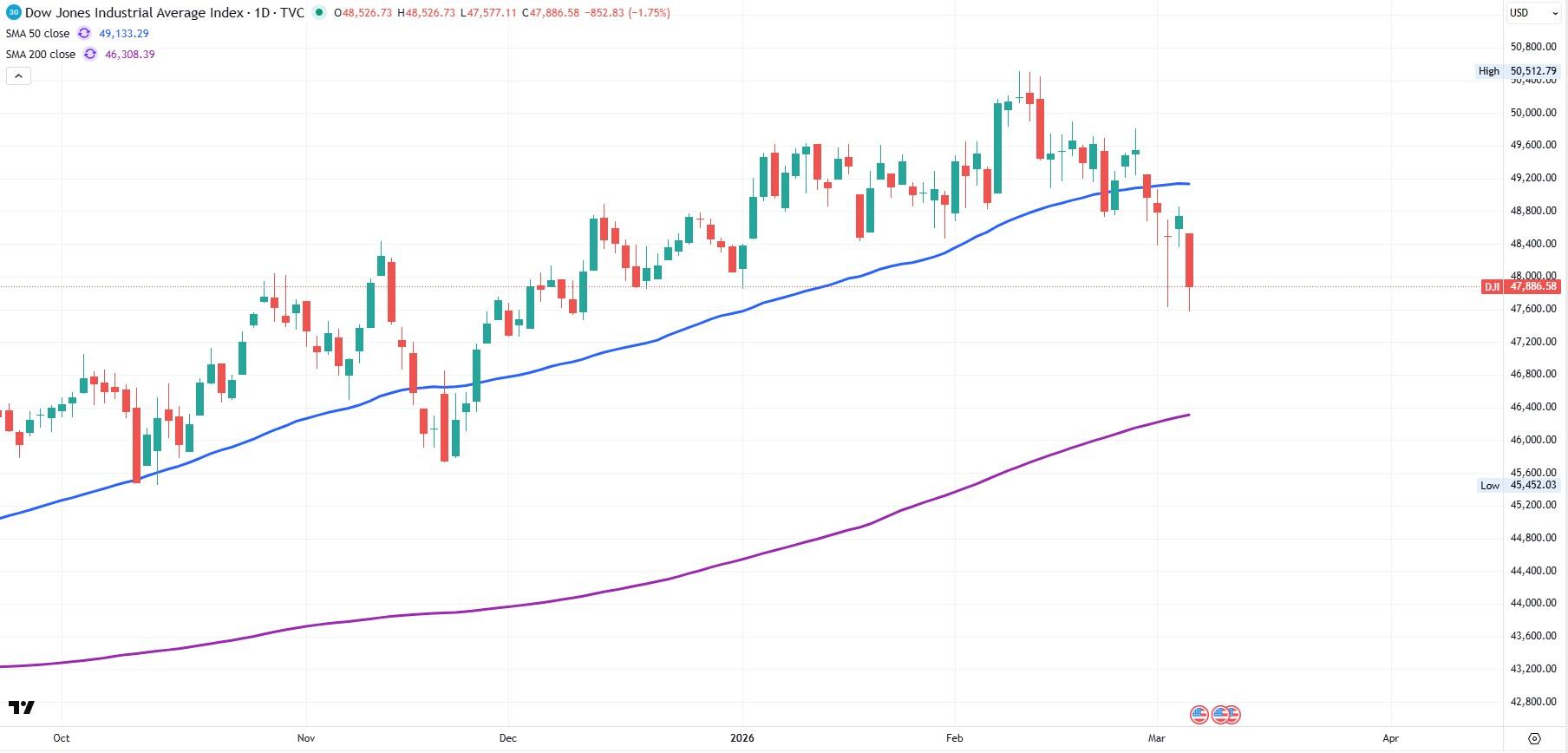
- Dow Jones sinks 2.25% by late afternoon.
- President Trump decides against resorting to petroleum reserve.
Already on the backfoot this morning, Thursday afternoon has seen US stocks shunted even lower as the price of Oil skyrocketed 9% due to the war with Iran. US Oil (WTI) reached a high of $81.64 on Thursday, its highest level since the summer of 2024, while Brent reached $85.85.
Higher oil prices are normally bad for the US consumer, and stocks took it on the chin with the Dow Jones Industrial Average (DJIA) slipping 2.25%, while the S&P 500 and NASDAQ both lost more than 1%.
Oil shock shows little sign of letting up
An Iranian missile attack on an Oil tanker in the Strait of Hormuz led to a fire onboard, forcing the US-flagged ship's crew to abandon it. President Donald Trump just stepped in on Wednesday to offer insurance to ships, which had lost their prior insurance due to the onset of Israel and the United States' bombing campaign against Iran, which began on Saturday.
Now in its sixth day, the war is showing signs that the hit to Oil supply, as well as natural gas, won't be a blip. Qatar has already shut down its LNG terminals this week, and approximately 150 tankers are stuck in the Persian Gulf. The Strait of Hormuz is a waterway connecting the Persian Gulf, where 20% of global oil supply transits, to the Indian Ocean and the wider world. Iran announced earlier in the week that no ships would be allowed to transit out of the Strait while the war persists.
In more signs that the war is putting a dent on supply, Exxon Mobil said it shipped its first cargo of gasoline to Australia on Thursday, and China banned petroleum exports in a sign that officials are worried about supply constraints. The Chinese government has ordered its two major energy companies, Sinopec and PetroChina, to completely halt exports of gasoline and diesel.
OPEC says it will raise output by over 200,000 barrels a day in April after already raising output this month by more than 400,000 barrels a day.
President Trump said he would not resort to releasing stocks from the government's emergency reserve yet.
A bad environment for stocks
Morgan Stanley was only telling investors on Wednesday, when the market righted itself after two sessions of heavy selling, to remain bullish.
“I think it’s a green light to take risks now,” said portfolio manager Phil Camporeale on CNBC.
That is not how things are looking on Thursday afternoon. The market is digesting that White House officials initially estimated the war would last "weeks" to Trump's declaration of "four to five weeks". Politico has reported that the Pentagon is making plans for a war that could last until September.
Typically, experts cite $100/barrel as the price level where an Oil price shock hurts the US consumer enough to cause a recession. So far, the price of WTI has risen about 20% since the war began on February 28.
Semiconductor stocks are largely lower as investors brace for possible disruptions to the export market. The US government is considering a plan to require all AI-related products from Nvidia (NVDA) and Advanced Micro Devices (AMD) to get export licenses. The Trump White House has been critical of exports to China, but the new policy would extend that scrutiny to all exports.
South Korea's stock market has slipped 20% this week due to the war following a breakneck rally over the past year. Politicians cite the higher Oil prices for leading to higher electricity prices that could hurt the country's semiconductor industry.
Author

Clay Webster
FXStreet
Clay Webster grew up in the US outside Buffalo, New York and Lancaster, Pennsylvania. He began investing after college following the 2008 financial crisis.