US Dollar holds steady as Trump’s Big Beautiful Bill passes Senate
- The US Dollar Index recovers modestly, halting a nine-day slide after hitting its lowest since February 2022.
- The Greenback posts its worst first-half performance since 1973, down over 10% in H1 2025.
- Senate passes Trump’s $3.3T fiscal bill, but markets show little reaction, focus shifts to House vote.

The US Dollar (USD) continues to face selling pressure, with the US Dollar Index (DXY) slipping to as low as 96.38, its weakest level since February 2022, during early trading on Tuesday.
However, the Greenback rebounded during the American session, with DXY last seen trading around 96.85, supported by better-than-expected US economic data. A stronger ISM Manufacturing PMI and firm JOLTS job openings report helped ease some bearish momentum, though overall sentiment remains cautious amid ongoing concerns over US fiscal stability, tariff uncertainty, and growing political pressure on the Federal Reserve (Fed).
The DXY has now ended the last six consecutive months in the red, declining over 10% in the first half of 2025 — its worst first-half performance since currencies began floating in 1973, with the second quarter alone marking its steepest quarterly drop since Q4 2022. The US Dollar weakened against all major G10 currencies during this period as investors sold off dollar-denominated assets.
Multiple key factors have driven the US Dollar’s sharp decline over the past quarter, but the Greenback’s weakness is primarily due to the unpredictable trade and economic policies of US President Donald Trump. His massive tax-and-spending proposal, known as the “One Big Beautiful Bill,” has made investors nervous. The bill, which includes permanent tax cuts and deep spending overhauls, is fueling concerns about fiscal instability and could add more than $3.3 trillion to the national debt.
Adding to the pressure, with the July 9 deadline looming, Trump’s push for sweeping tariffs is adding to uncertainty around global trade and economic policy. With less than a week to go, only a tentative agreement with the UK and a de-escalation with China have been reached, while talks with other key trading partners remain stalled. The US administration also appears to be retreating from its idea of “90 trade deals in 90 days”. Rather than securing comprehensive trade deals, the focus now seems to be shifting toward interim agreements, while retaining a 10% import tax that ultimately falls on US consumers.
Market movers: Rate cut bets, political pressure, and tariffs
- The Senate narrowly approved President Trump’s $3.3 trillion “One Big Beautiful Bill” after an intense vote-a-rama session, with Vice President J.D. Vance casting the tie-breaking vote. The 940-page bill includes permanent tax cuts, deep entitlement reforms, and a $5 trillion increase to the debt ceiling.
- The bill includes $4.5 trillion in tax cuts—extending Trump’s 2017 rates and introducing new breaks like zero taxes on tips—alongside $1.2 trillion in spending cuts, primarily targeting Medicaid and food stamp programs. It also features a $350 billion border security plan and rollbacks of green energy tax credits.
- The bill now returns to the House, where Speaker Mike Johnson has warned against major Senate changes. With time running short before Trump’s self-imposed Fourth of July deadline.
- The ISM Manufacturing PMI rose to 49.0 in June from 48.5 in May, slightly above the expected 48.8. While still below the 50 mark — signaling contraction — the data suggests a slower pace of decline in manufacturing activity. Meanwhile, job openings in the US surged by 374,000 to 7.769 million in May, the highest level since November 2024 and well above the consensus of 7.3 million, indicating continued labor market strength.
- Political interference continues to weigh on the US Dollar, as US President Donald Trump expanded his criticism beyond Fed Chair Jerome Powell to the entire Federal Reserve Board. On Monday, Trump called for an aggressive rate cut to “1% or better,” reigniting concerns about the central bank’s independence. Treasury Secretary Scott Bessent echoed the sentiment, saying Fed officials “seem a little frozen at the wheel” and suggesting they are hesitating in their policy response. He also downplayed inflation risks from tariffs, adding, “We have seen no inflation from tariffs,” which may signal pressure for further policy easing despite macro uncertainty.
- According to a report by BHH Marketview, US 2-year Treasury yields have dropped to a two-month low of 3.71% as Fed funds futures shift to price in deeper policy easing. Markets now expect the Fed to cut rates by 125 basis points over the next year, bringing the target range down to 3.00%–3.25%. In contrast, most other major central banks are nearing the end of their easing cycles. The report highlights that narrowing US–G6 2-year bond yield spreads could weigh further on the US Dollar.
- With less than a week to go, President Trump has made it clear he does not plan to extend the tariff pause beyond July 9. In an interview with Fox News Channel’s Sunday Morning Futures, Trump said letters will be sent to countries notifying them of new tariff rates if deals are not reached. “We’ll look at how a country treats us — are they good, are they not so good — some countries we don’t care, we’ll just send a high number out,” he said.
- Speaking at the ECB Forum on Central Banking, Fed Chair Jerome Powell reaffirmed a ‘wait-and-see’ approach to policy, emphasizing the importance of incoming data. Powell acknowledged that inflation may pick up over the summer but stressed the Fed’s willingness to remain patient. He also noted that a majority of Fed officials still expect it to be likely appropriate to cut rates later this year. While the tone was measured, the confirmation of easing bias helped reinforce expectations for a September rate cut, keeping the US Dollar under pressure.
Technical analysis: Greenback slips below wedge support
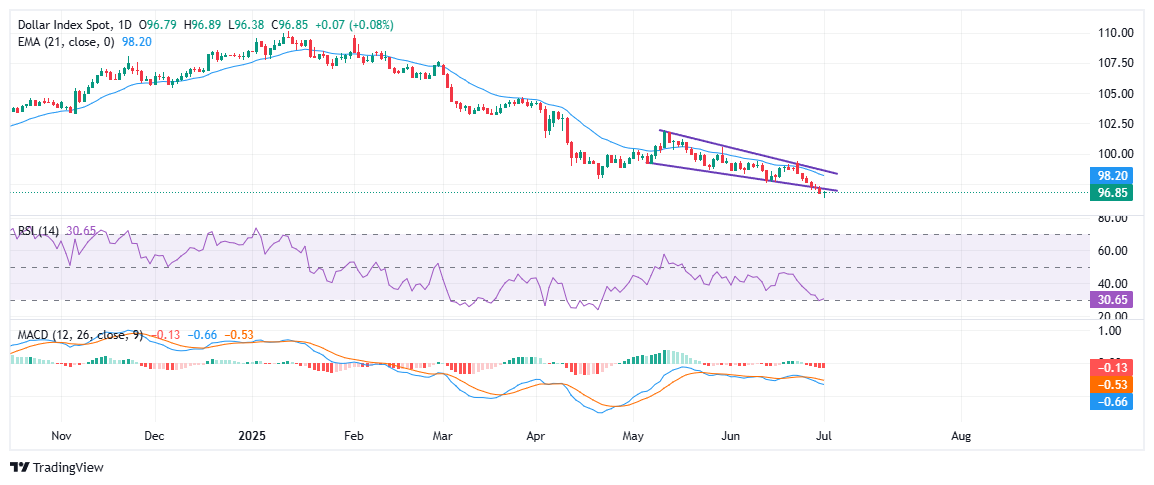
The US Dollar Index (DXY) continues to trade under sustained bearish pressure, recently breaking below the lower boundary of a descending wedge pattern that has guided price action since mid-May. The index is now hovering around 96.85 and retesting the lower boundary of the wedge after rebounding from the intraday low of 96.38, though it remains well below the 21-day Exponential Moving Average (EMA), currently at 98.20. This consistent rejection from the EMA highlights the strength of the prevailing downtrend. The breakdown from the wedge suggests a possible acceleration in bearish pressure, with no immediate signs of a reversal.
Momentum indicators further confirm the negative outlook. The Relative Strength Index (RSI) has dropped to 27.59, entering oversold territory, which could signal a potential short-term bounce, although it may also reflect the intensity of the current selling pressure. Meanwhile, the Moving Average Convergence Divergence (MACD) histogram remains in negative territory, with the MACD line widening below the signal line, reinforcing the bearish trend. Unless DXY can reclaim and hold above the 98.00–97.80 zone, the path of least resistance remains to the downside, with eyes now on the next key support around the 96.00 round level.
Author

Vishal Chaturvedi
FXStreet
I am a macro-focused research analyst with over four years of experience covering forex and commodities market. I enjoy breaking down complex economic trends and turning them into clear, actionable insights that help traders stay ahead of the curve.

















