US Dollar rips higher with Ukraine using UK Storm Shadow Missiles into Russia
- The US Dollar rallies after headlines come out that Ukraine is firing more missiles into Russia.
- Markets tumble and take a turn for the worse ahead of Nvidia earnings
- The US Dollar index trades up in the 106.50 area, still looking for support to bounce off from.

The US Dollar (USD) is rallying after headlines came out that Ukraine has launched UK Storm Shadow Missiles into Russia. The usage of those missiles opens the risk for Russian retaliations against Ukraine by using nuclear weapons. Overnight in the US session, markets reversed the initial concerns about the escalated situation between Russia and Ukraine after Russian President Vladimir Putin said he is open to a peace deal brokered by President-elect Donald Trump.
The US economic calendar is still rather empty on Wednesday, except for the weekly Mortgage Applications data. The focus shifts to the Federal Reserve (Fed), with four Fed speakers set to release comments for the markets. That December interest-rate cut remains in limbo, with traders unsure whether the Fed will stick to its previous commitment to cutting rates in December again.
Daily digest market movers: Risk with a knee jerk reaction
- Geopolitical headlines on Ukraine and Russia point to an easing of tensions after Russian President Vladimir Putin confirmed that he would be open to a ceasefire discussion with President-elect Donald Trump, Reuters reports.
- Later this Wednesday Bloomberg reported that Ukraine has used UK's Storm Shadow Missiles for targets in Russia.
- At 12:00 GMT, the Mortgage Bankers Association (MBA) released the weekly Mortgage Applications. This week’s number came in at 1.7% against last week’s numbers, which was an increase of 0.5%.
- Near 15:00 GMT, Federal Reserve Vice Chair for Supervision Michael Barr testifies about the oversight of prudential regulators before the House Financial Services Committee in Washington DC.
- Federal Reserve Governor Lisa Cook delivers a speech about the US economic outlook and monetary policy at the University of Virginia Department of Economics in Charlottesville, Virginia at 16:00 GMT.
- Near 17:15 GMT, Federal Reserve Governor Michelle Bowman delivers a speech about "approach to agency policymaking" at the Forum Club of the Palm Beaches in West Palm Beach, Florida.
- Federal Reserve Bank of Boston President Susan Collins delivers remarks and participates in a conversation at an event organized by the Ford School in Ann Arbor, Michigan at 21:00 GMT.
- Equities are taking a turn for the worse and are sliding lower after Ukraine launched UK missiles into Russia.
- The CME FedWatch Tool is pricing in another 25 basis points (bps) rate cut by the Fed at the December 18 meeting by 59.1%. A 40.9% chance is for rates to remain unchanged. While the rate-cut scenario is the most probable, traders have significantly pared back some of the rate-cut bets compared with a week ago.
- The US 10-year benchmark rate trades at 4.39%, sliding further away from the high printed on Friday at 4.50%.
US Dollar Index Technical Analysis: Ukraine testing Russia's nerves
The US Dollar Index (DXY) edges up slightly in the mid-106.00 region on the daily chart. Markets have let the dust settle on the geopolitical headlines from Tuesday and are eagerly awaiting the Nvidia earnings later this Wednesday. As Trump trade is starting to unwind, the DXY might need to look for lower support in order to attract buyers.
After a brief test and a firm rejection last Thursday, the 107.00 round level remains in play. A fresh yearly high has already been reached at 107.07, which is the static level to beat. Further up, a fresh two-year high could be reached if 107.35 is broken.
On the downside, a fresh set of support is coming live. The first level is 105.93, the closing from November 12. A touch lower, the pivotal 105.53 (April 11 high) should avoid any downturns towards 104.00.
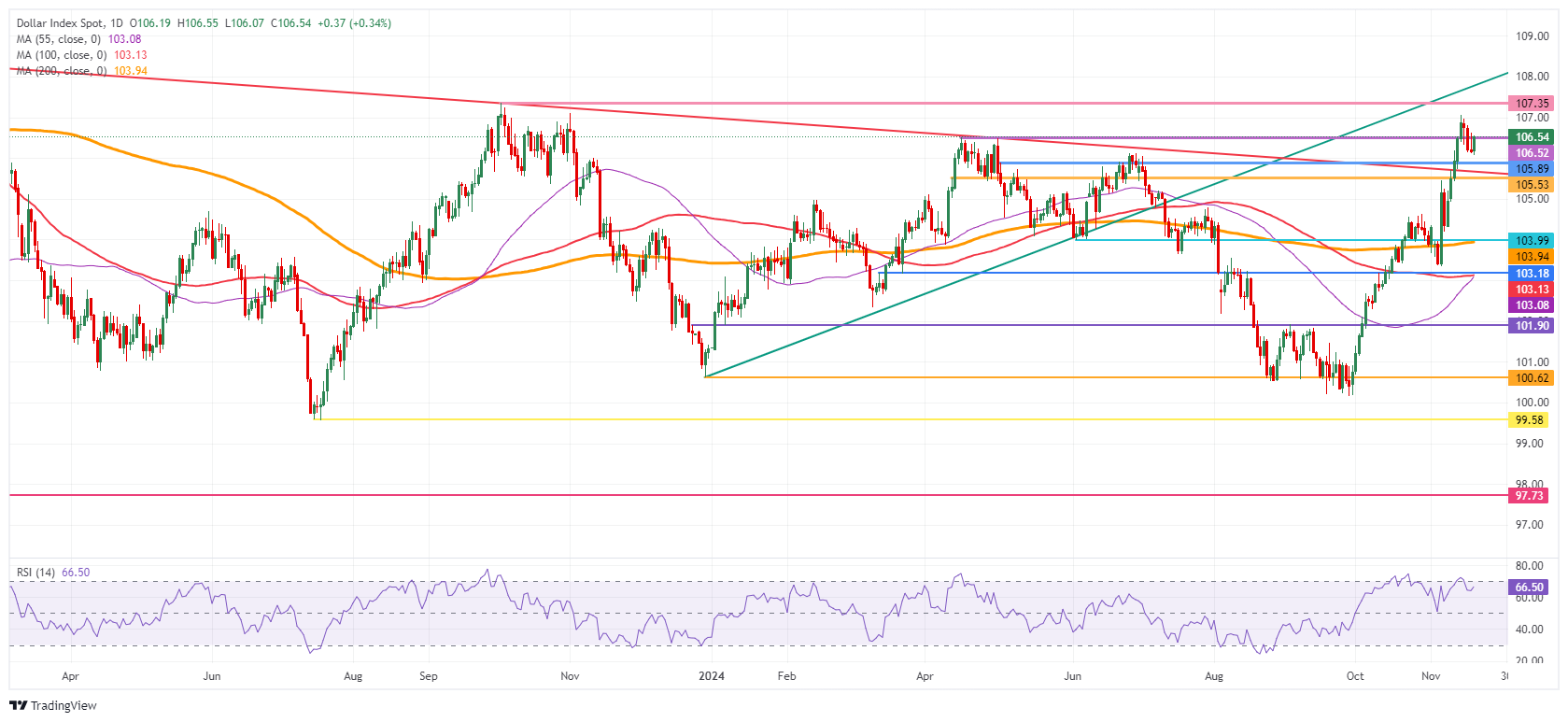
US Dollar Index: Daily Chart
Inflation FAQs
Inflation measures the rise in the price of a representative basket of goods and services. Headline inflation is usually expressed as a percentage change on a month-on-month (MoM) and year-on-year (YoY) basis. Core inflation excludes more volatile elements such as food and fuel which can fluctuate because of geopolitical and seasonal factors. Core inflation is the figure economists focus on and is the level targeted by central banks, which are mandated to keep inflation at a manageable level, usually around 2%.
The Consumer Price Index (CPI) measures the change in prices of a basket of goods and services over a period of time. It is usually expressed as a percentage change on a month-on-month (MoM) and year-on-year (YoY) basis. Core CPI is the figure targeted by central banks as it excludes volatile food and fuel inputs. When Core CPI rises above 2% it usually results in higher interest rates and vice versa when it falls below 2%. Since higher interest rates are positive for a currency, higher inflation usually results in a stronger currency. The opposite is true when inflation falls.
Although it may seem counter-intuitive, high inflation in a country pushes up the value of its currency and vice versa for lower inflation. This is because the central bank will normally raise interest rates to combat the higher inflation, which attract more global capital inflows from investors looking for a lucrative place to park their money.
Formerly, Gold was the asset investors turned to in times of high inflation because it preserved its value, and whilst investors will often still buy Gold for its safe-haven properties in times of extreme market turmoil, this is not the case most of the time. This is because when inflation is high, central banks will put up interest rates to combat it. Higher interest rates are negative for Gold because they increase the opportunity-cost of holding Gold vis-a-vis an interest-bearing asset or placing the money in a cash deposit account. On the flipside, lower inflation tends to be positive for Gold as it brings interest rates down, making the bright metal a more viable investment alternative.
Author

Filip Lagaart
FXStreet
Filip Lagaart is a former sales/trader with over 15 years of financial markets expertise under its belt.