US Dollar has no respons to wave of tariffs from President Trump
- The US Dollar trades touch softer on more tariff comments, while Gold prints new all-time highs.
- Besides reciprocal tariffs, a 25% levy on all steel and aluminum imports from all countries will be applied.
- The US Dollar Index (DXY) is going nowhere and orbits above 108.00.

The US Dollar Index (DXY), which tracks the performance of the US Dollar against six major currencies, is not showing any reaction to the vast amount of headlines around tariffs that were published over the weekend. United States (US) President Donald Trump announced 25% steel and aluminum tariffs for all countries importing into the US. Also, plans for reciprocal tariffs are on the table, which would increase US import duties to match those imposed by the country’s other trading partners.
Meanwhile Gold, the precious metal, is printing fresh all-time highs almost every hour while trading above $2,900 for the first time ever. The precious metal is seen as the perfect safe have and defence against any tariff woes that could shake up equities, bonds or the US Dollar.
Besides the tariff headlines, otherwise, it will be a very calm start of the week on the economic calendar. Traders will want to focus on Federal Reserve (Fed) Chair Jerome Powell’s semi-annual testimony at Capitol Hill on Tuesday and Wednesday. Traders will look for fresh clues about the path forward for US monetary policy, while Powell is likely to highlight the resilient economy as a key reason central bankers are in no rush to cut borrowing costs further.
Daily digest market movers: Powell heading to Washington
- Besides the headlines from US President Donald Trump on reciprocal tariffs and steel and aluminum import tariffs, no real timelines or dates were given, Bloomberg reports.
- The US Treasury is auctioning a 3-month and a 6-month bill at 16:30 GMT.
- Equities are not impressed by President Trump’s announcement of more tariffs. All major indices are trading in the green on Monday.
- The CME FedWatch tool projects a 93.5% chance that the Fed will keep interest rates unchanged at its next meeting on March 19.
- The US 10-year yield is trading around 4.49%, recovering further from its fresh yearly low of 4.40% printed last week.
US Dollar Index Technical Analysis: Keeping powder dry for what counts
The US Dollar Index (DXY) is not breaking any pots this Monday and is not included in the safe-haven flight away from tariffs. Only Gold looks to be the big winner in this case. Meanwhile, US yields are a touch higher, though not enough to really fuel a stronger US Dollar, while traders are assessing what to do next with all these additional tariff announcements.
On the upside, the first barrier at 109.30 (July 14, 2022, high and rising trendline) was briefly surpassed but did not hold last week. Once that level is reclaimed, the next level to hit before advancing further remains at 110.79 (September 7, 2022, high).
On the downside, the October 3, 2023, high at 107.35 is still acting as strong support after several tests last week. In case more downside occurs, look for 106.52 (April 16, 2024, high) or even 105.98 (resistance in June 2024 and 100-day Simple Moving Average) as better support levels.
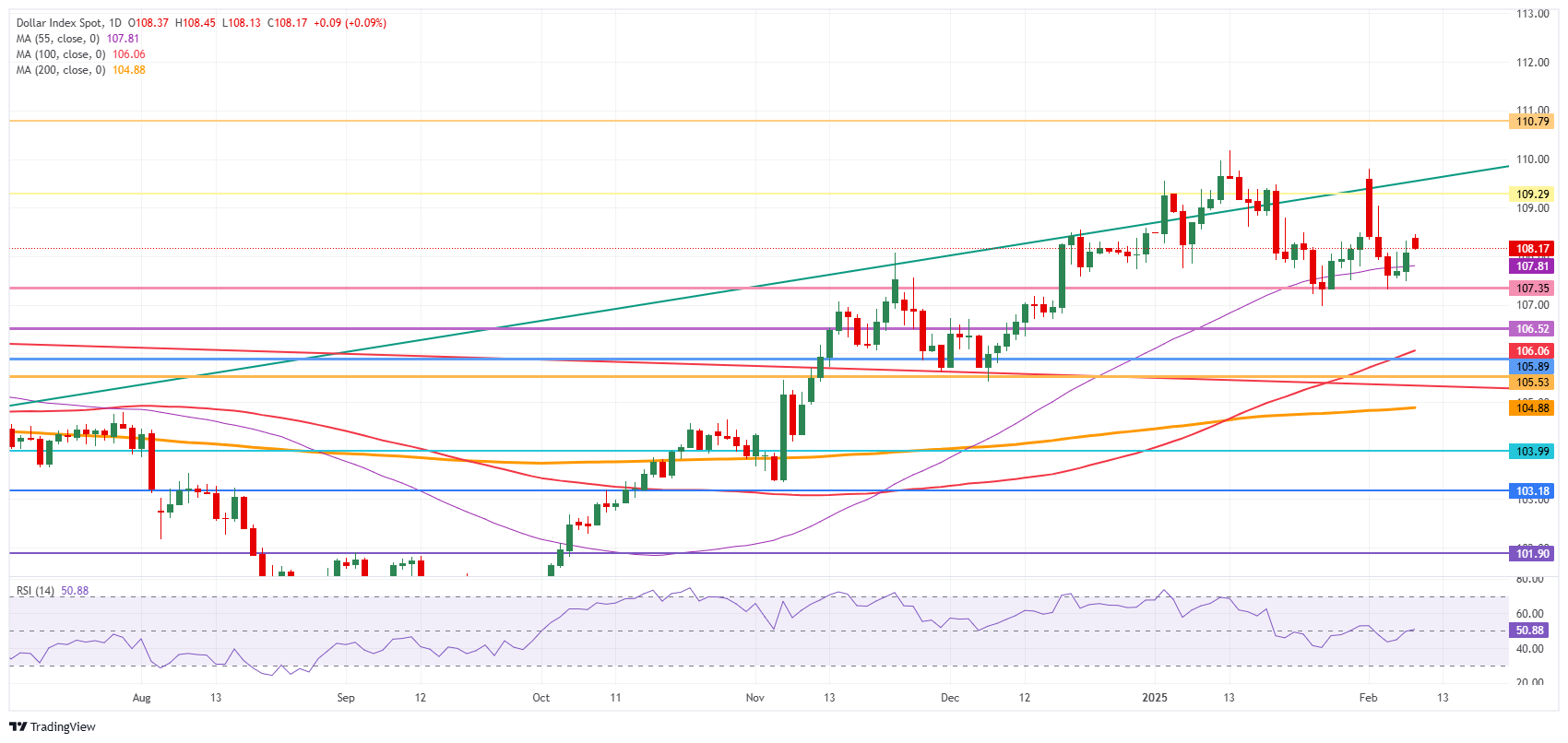
US Dollar Index: Daily Chart
Inflation FAQs
Inflation measures the rise in the price of a representative basket of goods and services. Headline inflation is usually expressed as a percentage change on a month-on-month (MoM) and year-on-year (YoY) basis. Core inflation excludes more volatile elements such as food and fuel which can fluctuate because of geopolitical and seasonal factors. Core inflation is the figure economists focus on and is the level targeted by central banks, which are mandated to keep inflation at a manageable level, usually around 2%.
The Consumer Price Index (CPI) measures the change in prices of a basket of goods and services over a period of time. It is usually expressed as a percentage change on a month-on-month (MoM) and year-on-year (YoY) basis. Core CPI is the figure targeted by central banks as it excludes volatile food and fuel inputs. When Core CPI rises above 2% it usually results in higher interest rates and vice versa when it falls below 2%. Since higher interest rates are positive for a currency, higher inflation usually results in a stronger currency. The opposite is true when inflation falls.
Although it may seem counter-intuitive, high inflation in a country pushes up the value of its currency and vice versa for lower inflation. This is because the central bank will normally raise interest rates to combat the higher inflation, which attract more global capital inflows from investors looking for a lucrative place to park their money.
Formerly, Gold was the asset investors turned to in times of high inflation because it preserved its value, and whilst investors will often still buy Gold for its safe-haven properties in times of extreme market turmoil, this is not the case most of the time. This is because when inflation is high, central banks will put up interest rates to combat it. Higher interest rates are negative for Gold because they increase the opportunity-cost of holding Gold vis-a-vis an interest-bearing asset or placing the money in a cash deposit account. On the flipside, lower inflation tends to be positive for Gold as it brings interest rates down, making the bright metal a more viable investment alternative.
Author

Filip Lagaart
FXStreet
Filip Lagaart is a former sales/trader with over 15 years of financial markets expertise under its belt.
















