US Dollar stalls amid Trump tariff threats and Fed pressure
- The US Dollar Index stalls as markets weigh Trump's tariff threats and Fed independence.
- The US Dollar hinges on bank earnings and US economic data releases on Tuesday.
- Price action for the DXY remains under pressure with psychological resistance firming at 98.00.

The US Dollar Index (DXY), which measures the strength of the US Dollar (USD) against a basket of major currencies, remains under pressure at the start of the week, trading below the 98.00 level on Monday.
Fresh geopolitical risks have emerged after US President Donald Trump's announcement of tariff threats against the European Union (EU) and Mexico over the weekend.
At the same time, reports that President Trump is pressuring Federal Reserve (Fed) Chair Jerome Powell to resign have reignited concerns about the central bank's independence, a factor that may influence investor confidence and US Dollar sentiment in the coming weeks.
On Tuesday, the June Consumer Price Index (CPI) will be released, providing an updated look at US inflation. Whether the data indicates that inflationary pressures persist or ease, it will likely have a significant impact on Federal Reserve policy expectations and, by extension, on the DXY's trajectory.
Meanwhile, several major US financial institutions will kick off the second-quarter earnings season, with JPMorgan Chase, Citigroup, Wells Fargo, and BlackRock all set to report. These results could offer important insights into the health of the US financial system, a key driver of risk sentiment.
US Dollar Index (DXY) daily chart
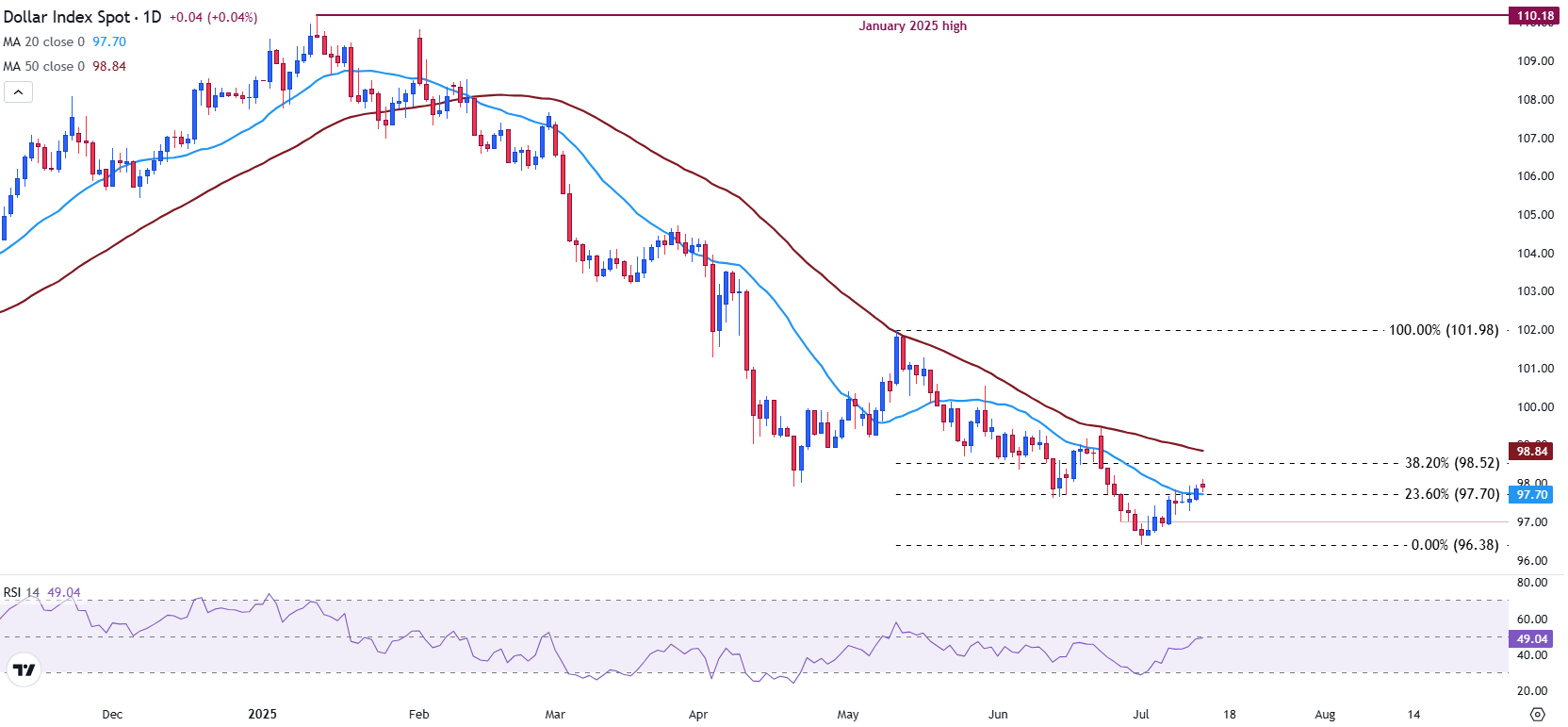
The DXY has staged a modest rebound from its July 1 low at 96.38, but it continues to trade below the 98.00 psychological resistance level. Price action is currently testing the 20-day Simple Moving Average (SMA) at 97.70, while the 50-day SMA at 98.84 remains intact as a key level of resistance.
Both moving averages are trending downward, underscoring the broader bearish outlook.
The Relative Strength Index (RSI) stands at 49, reflecting neutral momentum. While not yet in oversold territory, this RSI reading suggests that the Dollar currently lacks the strength to mount a decisive bullish reversal.
US Dollar FAQs
The US Dollar (USD) is the official currency of the United States of America, and the ‘de facto’ currency of a significant number of other countries where it is found in circulation alongside local notes. It is the most heavily traded currency in the world, accounting for over 88% of all global foreign exchange turnover, or an average of $6.6 trillion in transactions per day, according to data from 2022. Following the second world war, the USD took over from the British Pound as the world’s reserve currency. For most of its history, the US Dollar was backed by Gold, until the Bretton Woods Agreement in 1971 when the Gold Standard went away.
The most important single factor impacting on the value of the US Dollar is monetary policy, which is shaped by the Federal Reserve (Fed). The Fed has two mandates: to achieve price stability (control inflation) and foster full employment. Its primary tool to achieve these two goals is by adjusting interest rates. When prices are rising too quickly and inflation is above the Fed’s 2% target, the Fed will raise rates, which helps the USD value. When inflation falls below 2% or the Unemployment Rate is too high, the Fed may lower interest rates, which weighs on the Greenback.
In extreme situations, the Federal Reserve can also print more Dollars and enact quantitative easing (QE). QE is the process by which the Fed substantially increases the flow of credit in a stuck financial system. It is a non-standard policy measure used when credit has dried up because banks will not lend to each other (out of the fear of counterparty default). It is a last resort when simply lowering interest rates is unlikely to achieve the necessary result. It was the Fed’s weapon of choice to combat the credit crunch that occurred during the Great Financial Crisis in 2008. It involves the Fed printing more Dollars and using them to buy US government bonds predominantly from financial institutions. QE usually leads to a weaker US Dollar.
Quantitative tightening (QT) is the reverse process whereby the Federal Reserve stops buying bonds from financial institutions and does not reinvest the principal from the bonds it holds maturing in new purchases. It is usually positive for the US Dollar.
Author

Tammy Da Costa, CFTe®
FXStreet
Tammy is an economist and market analyst with a deep passion for financial markets, particularly commodities and geopolitics.