|

US Dollar Price Analysis: DXY fate lies in US CPI

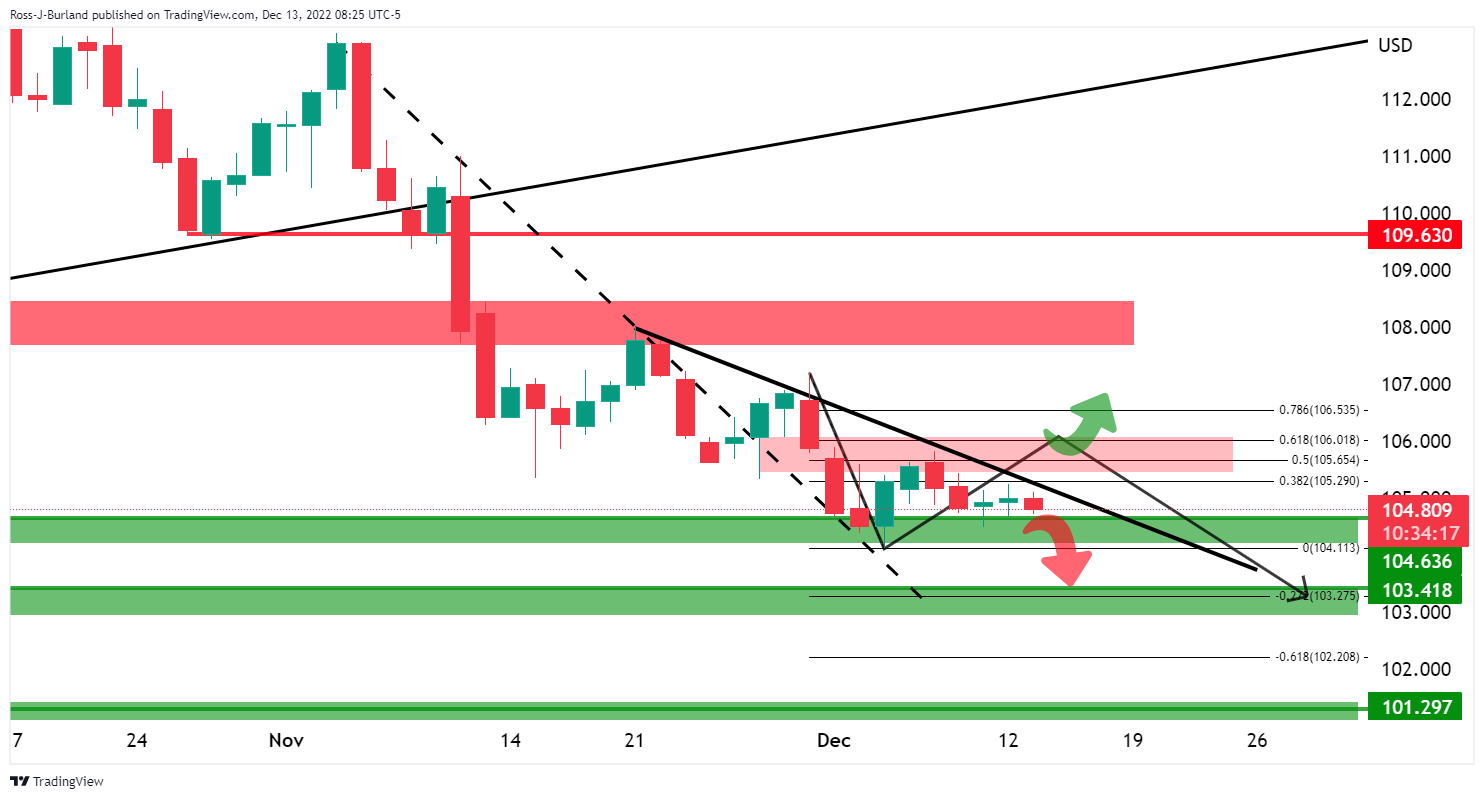
The US Dollar is sitting in a technical bundle of key structures that has something for both the bulls and bears ahead of the release of US inflation data and the final Federal Reserve meeting of the year.

Traders are looking for signs of a Fed pivot, i.e., for its policy outlook to change course from its currently contractionary (tight) monetary policy to expansionary (loose).

A Fed pivot typically happens when economic conditions have fundamentally changed in such a way that the Fed can no longer continue its prior policy stance and the US Consumer Price Inflation data is used as a primary gauge in that respect. In fact, the DXY's biggest daily drop and second-largest daily gain in 2022 have come on the back of prior CPI data.

The Fed is widely expected to hike the funds rate by 50 basis points (bp) on Wednesday, after four consecutive 75 bp hikes. If the data comes in hotter than expected, this will be problematic for the Fed eager to slow the pace of tightening and potentially weigh on risk assets and thus lead to a stronger US Dollar. 

The headline is expected at 7.3% YoY vs. 7.7% in October, while the core is expected at 6.1% YoY vs. 6.3% in October.  Last week, the Producer Price Index came in higher than expected, raising concerns that inflation is likely to prove to be much stickier than the markets are pricing.

DXY technical analysis
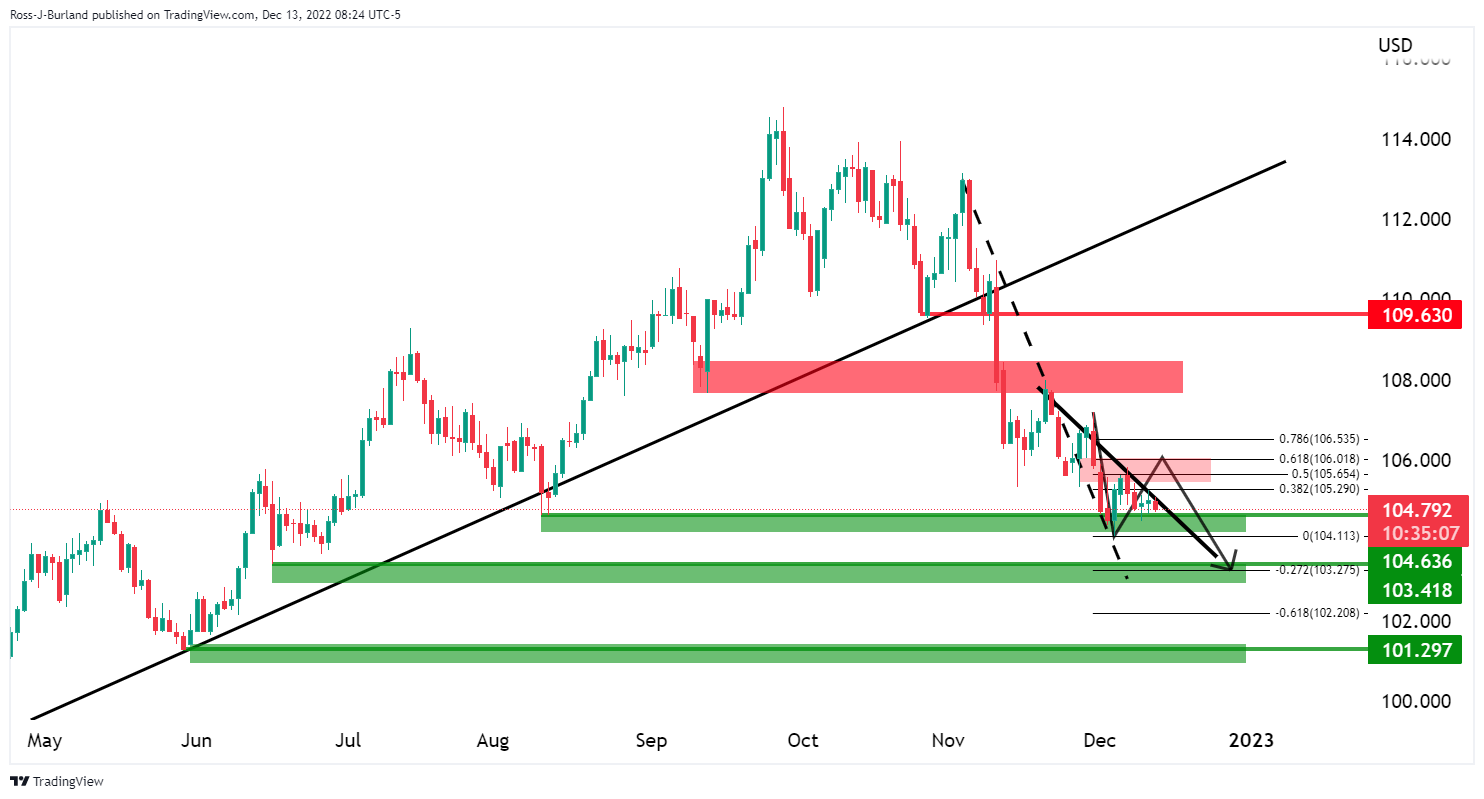
 

The trendline was broken and the bulls are on the back side of it. If the data comes in hot, a move beyond the 50% mean reversion resistance near 1.05.65 could spell an upside correction continuation scenario for the near future.  On the flip side, 103.00 will be a key target for the remaining weeks of the year should a Fed pivot be priced in even further.

Author

Ross J Burland

Ross J Burland, born in England, UK, is a sportsman at heart. He played Rugby and Judo for his county, Kent and the South East of England Rugby team.


More from Ross J Burland
Share:

Editor's Picks

AUD/USD struggles to recover as hawkish Fed bets escalate

The Australian Dollar is under pressure against the US Dollar as traders have raised bets supporting interest rate hikes by the Federal Reserve this year, with the AUD/USD pair posting a fresh almost eight-week low at around 0.7025. Hawkish Fed bets have accelerated following the release of the surprisingly strong United States Nonfarm Payroll (NFP) data for May.

USD/JPY holds higher ground toward 160.50 despite 'Yentervention' fears

USD/JPY holds higher ground toward 160.50 in Monday's Asian trading, despite intervention fears. Japan’s revised GDP print, which confirmed that the economy lost momentum in the first quarter, weighs on the Japanese Yen. Meanwhile, Friday's upbeat US NFP report and fresh Israel-Iran attacks favor the US Dollar bulls, underpinning the currency pair.

Gold sticks to the positive bias, still below  $4,350

Gold manages to reclaim the $4,300 mark per troy ounce and above on Monday. The yellow metal’s small uptick comes on the back of modest losses in the US Dollar, while traders continue to follow geopolitical events in the Middle East and the likelihood of a tighter-for-longer Fed.

Solana: ETF outflows and bearish sentiment reinforce downside risks

Solana (SOL) remains under pressure, trading below $66 on Monday after losing nearly 20% in the previous week. Institutional demand weakened with spot Exchange Traded Funds recording a net outflow of over $6.5 million last week, snapping a four-week streak of inflows.

$1.75 trillion: Is SpaceX the most popular IPO in history, or the most engineered?

On June 12, the largest initial public offering (IPO) in history is set to hit the tape, and almost nobody is asking whether the price is right, because almost everybody already wants in.

The US economy defies the rules: 100 days into the Oil shock and the recession signal is still missing

More than three months after the start of the Iran war and the resulting disruption to global energy markets, the US economy continues to display remarkable resilience. The conflict has triggered a sharp rise in Oil prices, reignited inflationary pressures and fueled widespread concerns about a potential economic slowdown.