US Dollar gains ground after CPI, Trump calls for lower interest rates
- The US Dollar regains ground after the June CPI release, with the DXY trading above the 98.00 psychological level.
- Market sentiment stays cautious amid persistent tariff threats from US President Donald Trump.

The US Dollar (USD) extends its intraday advance on Tuesday after the release of the June Consumer Price Index (CPI) report, as traders reassess their expectations of monetary policy easing by the Federal Reserve (Fed). Following the release of the June CPI report, market expectations for a near-term Federal Reserve rate cut have shifted notably. According to the CME FedWatch Tool, the probability of a rate cut at the July meeting has dropped sharply to just 2.6%, down from around 6% earlier this week. Meanwhile, the odds of a rate cut at the September meeting have also decreased, falling to around 54% from nearly 60%.
The Greenback is gaining ground as markets scale back hopes for imminent policy easing, with the Fed expected to remain in wait-and-see mode until inflation shows more decisive progress toward the 2% target. At the time of writing, the US Dollar Index (DXY) is holding firm around 98.70, marking its strongest level since June 23, with a daily gain of over 0.50% as bullish momentum continues to build.
The US CPI report revealed headline inflation rose by 0.3% on a monthly basis — the largest increase in five months — bringing the annual rate up to 2.7% from 2.4% in May. Both readings were in line with market expectations. However, Core CPI, which excludes volatile food and energy components, increased by 0.2% MoM, below the forecast of 0.3% and up slightly from the 0.1% gain in May. On an annual basis, core inflation ticked higher to 2.9% from 2.8%, signaling persistent underlying price pressures despite the softer monthly print.
The report showed firm price gains across energy, transportation, and tariff-affected sectors, suggesting trade-related inflation is beginning to flow through to consumers.
Fed Chair Jerome Powell has clearly stated that uncertainty over the impact of tariffs is one of the main reasons why the central bank has held off on cutting interest rates. Powell highlighted that the Fed “went on hold when we saw the size of the tariffs,” and now intends to assess how deeply tariffs will filter through to consumer prices and growth before easing monetary policy.
While some Fed officials believe the tariffs may cause only a temporary rise in prices, many are worried that the inflation effects could be more lasting, making it harder for the Fed to lower rates in the near term.
Market Movers: Trump doubles down on tariffs and criticism of Fed Powell
- Following the June CPI report, President Donald Trump took to Truth Social to call for immediate interest rate cuts, saying: “Consumer Prices LOW. Bring down the Fed Rate, NOW!!!” He argued that slashing rates could save the U.S. government over a trillion dollars annually in interest payments. The post adds fresh political pressure on the Federal Reserve, even as inflation remains above target and markets continue to price in only gradual easing.
- President Trump also reaffirmed his strong support for cryptocurrency legislation, calling this week “Crypto Week” as the House prepares to vote on the GENIUS Act. In a Truth Social post, Trump described the bill as a major step toward making the United States the global leader in digital assets. He urged Republicans to vote in favor, stating that the legislation would place the country “lightyears ahead” of global competitors like China and Europe. Trump framed digital assets as the future of finance and part of his broader vision to strengthen America’s leadership in technology and innovation
- On Monday, US President Donald Trump announced plans to impose “very severe tariffs” — potentially up to 100% — on Russian exports if a peace deal with Ukraine is not reached within 50 days. In a further escalation, Trump also warned of “secondary tariffs” on countries that continue to engage in trade with Russia, particularly targeting those still importing Russian Oil and Gas. The move is aimed at isolating Moscow economically and increasing pressure on its trading partners, including China, India, and Turkey. These aggressive trade threats have heightened global market uncertainty and raised fears of further disruptions to global supply chains, particularly in the energy and commodities sectors.
- The yield on the benchmark US 10‑year Treasury note held steady above 4.43% on Tuesday, marking a one-month high as investors await today’s June CPI report. The sustained rise in yields reflects ongoing expectations that inflation may remain elevated due to tariff-related pressures, signaling that the Federal Reserve could delay interest rate cuts until price growth shows clearer signs of cooling.
- US President Donald Trump has once again targeted the Fed Chair Jerome Powell. In comments made Monday, Trump called Powell a “knucklehead” and criticized him for keeping interest rates too high, arguing that rates should already be closer to 1%. He also claimed that Powell is hurting the economy by refusing to move faster on rate cuts. In addition to his policy criticism, Trump’s remarks come as his administration probes the Fed’s recent $2.5 billion headquarters renovation project, suggesting the costs were excessive and hinting at the possibility of firing Powell “for cause.”
- The Supreme Court has signaled that a president cannot remove a Fed Chair simply for policy disagreements, misconduct, or mismanagement could be grounds for removal. However, White House National Economic Council Director Kevin Hassett has stated that this issue is "being looked into" to determine if it provides sufficient cause.
- According to The Washington Post, Hassett is emerging as a leading contender to succeed Powell as the next Federal Reserve chair. Hassett supports President Donald Trump’s push for lower rates and risks being seen by the markets as lacking policy autonomy.
- Looking ahead, traders will be paying close attention to speeches from several Fed officials later today, following the stronger-than-expected US inflation data. Fed Governors Michael Barr and Michelle Bowman, along with Richmond Fed President Tom Barkin, are all scheduled to speak. With the next FOMC meeting approaching, any shift in tone could influence interest rate expectations and impact the US Dollar’s near-term direction.
Technical Analysis: DXY confirms bullish breakout as momentum builds above 98.00
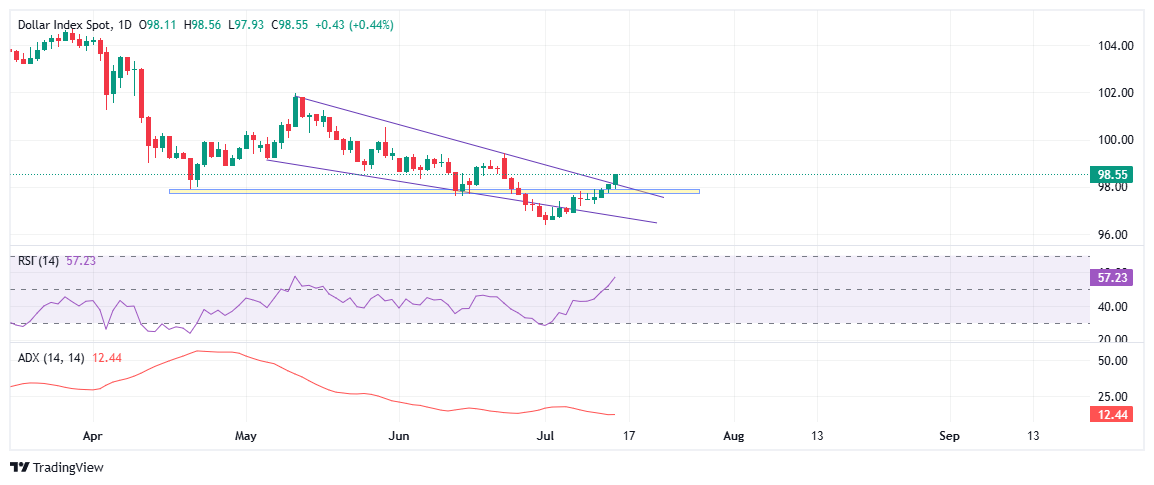
Over the past two weeks, the US Dollar Index (DXY) has been steadily recovering, supported by the 9-day moving average at 97.70. Following a period of consolidation, the index has now broken decisively above the upper boundary of the falling wedge pattern, clearing the key 98.00 resistance level and advancing toward 98.55 during the American session. This breakout confirms a short-term bullish continuation, opening the door for a potential rally toward the 98.80-99.00 zone in the coming sessions.
Momentum indicators are turning more constructive. The Relative Strength Index (RSI) has risen to 57.23, indicating growing buying interest as the breakout gains momentum. However, the Average Directional Index (ADX) remains relatively weak at 12.44, suggesting the trend is still in its early stages and may require further confirmation. With inflation data already released, market focus now shifts to follow-through buying and whether the DXY can maintain momentum above the wedge structure. Immediate support now lies at 98.00, followed by the 9-day EMA at 97.70.
Author

Vishal Chaturvedi
FXStreet
I am a macro-focused research analyst with over four years of experience covering forex and commodities market. I enjoy breaking down complex economic trends and turning them into clear, actionable insights that help traders stay ahead of the curve.

















