|

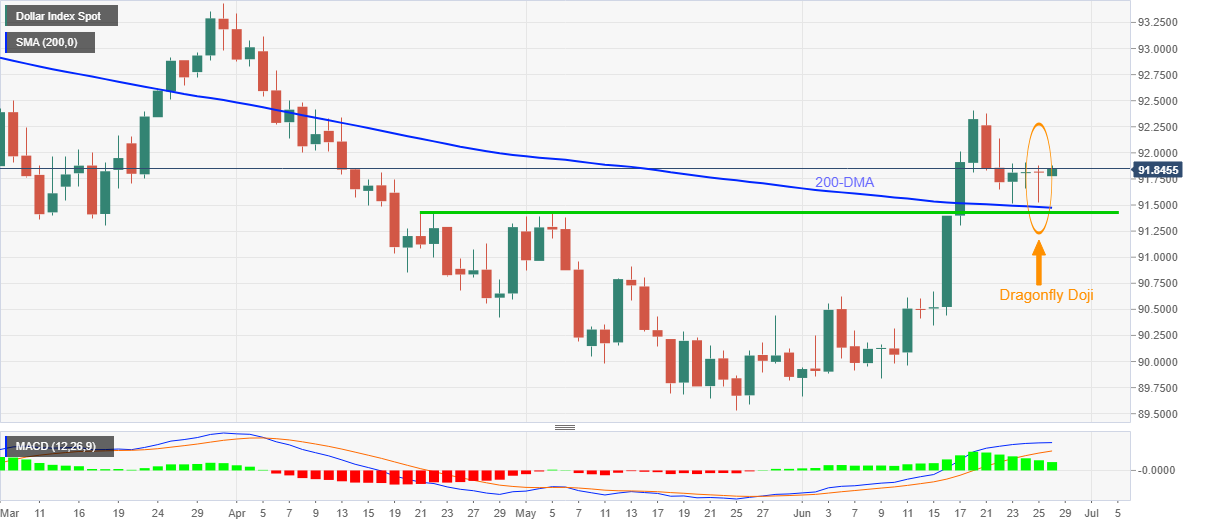
US Dollar Index Price Analysis: DXY justifies dragonfly Doji above 200-DMA to target 92.00

  • DXY consolidates the previous week’s losses, picks up bids to intraday high of late.
  • Bullish candlestick formation above the key SMA support favors buyers.
  • Late-April, early May top add to the downside filters.

US dollar index (DXY) reverses the early Asian losses, attacks intraday top near 91.85, ahead of Monday’s European session. In doing so, the greenback gauge justifies Friday’s dragonfly Doji bullish candlestick above 200-day SMA, (DMA). Also favoring the USD optimists could be the bullish MACD.

Hence, DXY buyers are well-directed towards the 92.00 threshold before challenging the monthly top near 92.40.

However, the late March tops near 92.80 may probe the US dollar index bulls before directing them to the yearly peak of 93.43.

Alternatively, a downside break of 200-DMA, around 91.45 is a green pass to the DXY sellers are a two-month-old horizontal area around 91.40, which will validate the quote’s further downside.

On a clear break of 91.40, the mid-May top near 90.90 should return to the charts.

DXY daily chart
Trend: Recovery expected

Additional important levels

Overview
Today last price91.87
Today Daily Change0.05
Today Daily Change %0.05%
Today daily open91.82
 
Trends
Daily SMA2090.84
Daily SMA5090.66
Daily SMA10091.12
Daily SMA20091.48
 
Levels
Previous Daily High91.88
Previous Daily Low91.53
Previous Weekly High92.38
Previous Weekly Low91.51
Previous Monthly High91.44
Previous Monthly Low89.54
Daily Fibonacci 38.2%91.66
Daily Fibonacci 61.8%91.74
Daily Pivot Point S191.6
Daily Pivot Point S291.39
Daily Pivot Point S391.25
Daily Pivot Point R191.96
Daily Pivot Point R292.09
Daily Pivot Point R392.31

Author

Anil Panchal

Anil Panchal

FXStreet

Anil Panchal has nearly 15 years of experience in tracking financial markets. With a keen interest in macroeconomics, Anil aptly tracks global news/updates and stays well-informed about the global financial moves and their implications.


More from Anil Panchal
Share:

Editor's Picks

GBP/USD extends the drop to 1.3360

GBP/USD builds on Monday’s decline and briefly clinches five-day lows near 1.3360 on Tuesday. Cable’s extra pullback follows the better tone in the Greenback as uncertainty in the Middle East prompts investors to adopt a cautious stance. Meanwhile, an apathetic UK labour market report also collaborates with the selling pressure on the British Pound.

EUR/USD stays offered just above 1.1400

EUR/USD keeps the downtrend well in place for yet another day, challenging the 1.1400 contention zone on Tuesday. The continuation of the selling impulse in spot comes amid decent gains in the US Dollar, which continues to find support in the persistent effervescence surrounding the US-Iran crisis.

Middle East crisis intensifies, Gold up

Gold now seems to have embarked on a consolidative phase below the key $4,100 mark per troy ounce in the latter part of Tuesday’s session. Meanwhile, uncertainty surrounding the Middle East conflict and rising expectations for a hawkish Fed policy outlook are expected to limit the precious metal’s bullish momentum in the near term.

XRP rebounds on rising on-chain activity
Ripple (XRP) ticks up and trades around $1.13 at the time of writing on Tuesday. This rebound aligns with a broader recovery in the cryptocurrency market, attributed to reports that mediators between the United States (US) and Iran are seeking a 10-day cessation of strikes to find a way back to the signed Memorandum of Understanding (MoU).
The Iranian war has again risen
The Iranian war has again risen to the top of the economics factor list. There is no end in sight. Intelligence experts say the current level of offense/retaliation will not change minds in Tehran, while in Washington, Trump fears all-out war, which would mean boots on the ground.
US Dollar mid-year outlook: Exceptional currency, exceptional risks?
The US Dollar enters the second half of 2026 in a markedly different position from a year ago. The King currency has recovered, reflecting persistent US inflation, changing expectations for Fed policy, geopolitical tensions and renewed demand for defensive assets.