US Dollar Index adds to recent losses and retests 95.40 ahead of data
- DXY extends the decline to the 95.40 region on Thursday.
- US yields correct further lower from recent tops.
- Initial Claims, the Philly Fed Index are next in the US docket.

The greenback is extending the bearish correction from recent tops and receding to the 95.40 region when gauges by the US Dollar Index (DXY).
US Dollar Index looks to yields, data
The index has lost ground for the second session in a row on Thursday following the continuation of the corrective downside in US yields across the curve. Despite the current knee-jerk reaction in yields, they are still managing to trade in the area of recent tops.
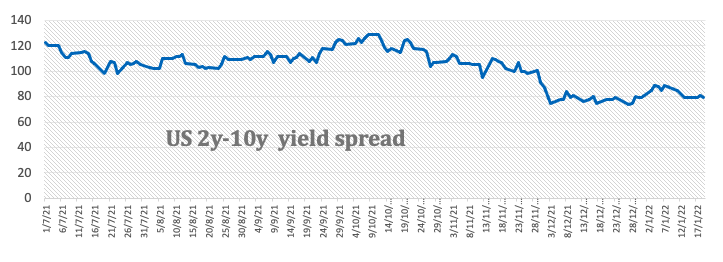
The Fed’s potential lift-off-in-March narrative continues to be the main catalyst for price action around the buck, always propped up by persevering, elevated, inflation and amidst the strong economic recovery in the US.
In the docket, the usual weekly Claims are due, seconded by the always important Philly Fed Manufacturing Index, and Existing Home Sales.
What to look for around USD
The index came under some downside pressure soon after peaking near 95.90. In fact, the recovery from as low as the 94.60 area (January 14) almost fully reclaimed the ground lost earlier in the new year, always on the back of the sharp move higher in US yields, firmer speculation of a sooner move on rates by the Federal Reserve and supportive Fedspeak.
Key events in the US this week: Initial Claims, Philly Fed Index, Existing Home Sales (Thursday).
Eminent issues on the back boiler: Start of the Fed’s tightening cycle. US-China trade conflict under the Biden administration. Debt ceiling issues. Potential geopolitical effervescence vs. Russia and China.
US Dollar Index relevant levels
Now, the index is losing 0.12% at 95.50 and a break above 95.83 (weekly high Jan.18) would open the door to 96.46 (2022 high Jan.4) and finally 96.93 (2021 high Nov.24). On the flip side, the next down barrier emerges at 94.78 (100-day SMA) followed by 94.62 (2022 low Jan.14) and then 93.27 (monthly low Oct.28 2021).
Author
Pablo Piovano
FXStreet
Born and bred in Argentina, Pablo has been carrying on with his passion for FX markets and trading since his first college years.