US Dollar sets forth winning streak on Monday fueled by concerned traders
- The US Dollar sprints higher for a fifth straight day against nearly every major G20 peer.
- Markets are getting spooked by the idea that the Fed's policy in 2025 might be more restrictive than anticipated.
- The US Dollar Index (DXY) surges to 110.00, looking for consolidation at these upper levels.

The US Dollar Index (DXY), which tracks the Greenback’s value against six major currencies, rallies for the fifth straight day and orbits at levels not seen since November 2022 while traders mull on their Fed policy rate outlook for 2025. The move comes after markets catch up with the recent Nonfarm Payrolls report for December, released on Friday, and adjusted to the new narrative that the Federal Reserve (Fed) would be more restrictive and keep rates steady for longer, with chances for several interest rate cuts in 2025 diminishing.
The US economic calendar is rather calm in the run-up to the Consumer Price Index (CPI) release on Wednesday and Retail Sales on Thursday. At least this Monday will be a very quiet start, with just a few smaller bond auctions on the agenda. Meanwhile, traders can assess their next moves ahead of President-elect Donald Trump's inauguration next week.
Daily digest market movers: Equities nosedive lower
- At 16:30 GMT, the US Treasury will allocate a 3-month and a 6-month bill.
- At 19:00 GMT, the December Budget Statement will be released. The deficit is expected to shrink to $62 billion from $367 billion.
- Equities are dipping lower, dragged lower by Nvidia shares selling off. The rout comes after several major companies such as Microsoft have cancelled their large orders for Nvidia's latest chip server racks.
- The CME FedWatch Tool projects a 97.3% chance that interest rates will be kept unchanged at current levels in the January meeting. Expectations are for the Federal Reserve (Fed) to remain data-dependent with uncertainties that could influence the inflation path once President-elect Donald Trump takes office on January 20.
- US yields are softening slightly. The 10-year benchmark is at 4.770%, off the fresh nine-month high of 4.798% seen in Asian trading on Monday.
US Dollar Index Technical Analysis: Safe haven inflow
The US Dollar Index (DXY) is in the last seven days before President-elect Donald Trump takes office. With the changing market narrative towards a longer and more restrictive Fed monetary policy going forward, chances that the Fed might not even cut at all in 2025 could be very plausible. In that case, the ramifications for the Greenback would be that the US Dollar Index would surge even further.
On the upside, the 110.00 psychological barrier needs to be held, and a consolidation must be seen above it for the rally to move higher. Further up, 110.79 remains the next big upside level to hit. Once beyond there, it is quite a stretch to 113.91, the double top from October 2022.
On the downside, the first downside barrier is 107.35, which has now turned into support. The next level that might halt any selling pressure is 106.52, with the 55-day Simple Moving Average (SMA) at 106.83 reinforcing above this region of support.
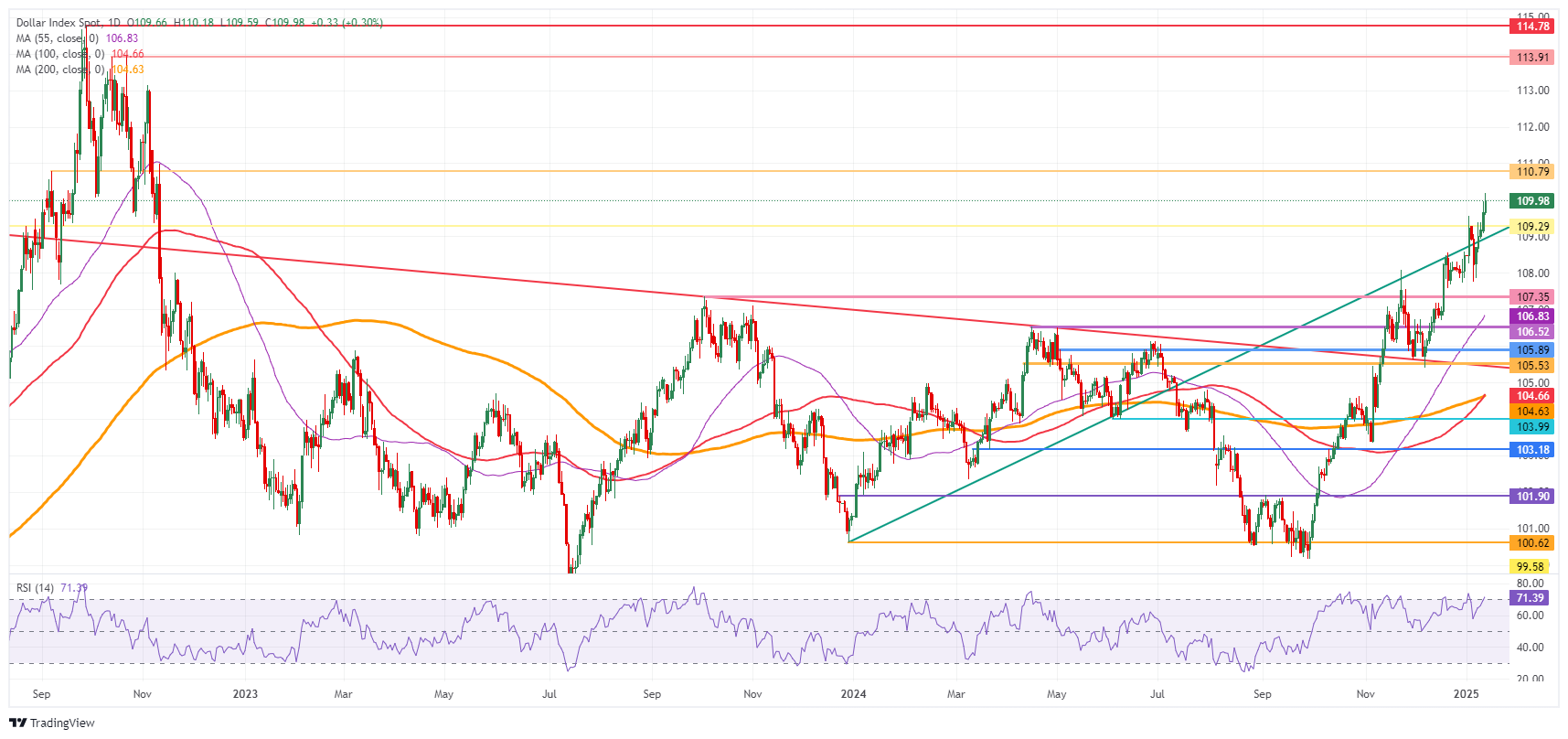
US Dollar Index: Daily Chart
Risk sentiment FAQs
In the world of financial jargon the two widely used terms “risk-on” and “risk off'' refer to the level of risk that investors are willing to stomach during the period referenced. In a “risk-on” market, investors are optimistic about the future and more willing to buy risky assets. In a “risk-off” market investors start to ‘play it safe’ because they are worried about the future, and therefore buy less risky assets that are more certain of bringing a return, even if it is relatively modest.
Typically, during periods of “risk-on”, stock markets will rise, most commodities – except Gold – will also gain in value, since they benefit from a positive growth outlook. The currencies of nations that are heavy commodity exporters strengthen because of increased demand, and Cryptocurrencies rise. In a “risk-off” market, Bonds go up – especially major government Bonds – Gold shines, and safe-haven currencies such as the Japanese Yen, Swiss Franc and US Dollar all benefit.
The Australian Dollar (AUD), the Canadian Dollar (CAD), the New Zealand Dollar (NZD) and minor FX like the Ruble (RUB) and the South African Rand (ZAR), all tend to rise in markets that are “risk-on”. This is because the economies of these currencies are heavily reliant on commodity exports for growth, and commodities tend to rise in price during risk-on periods. This is because investors foresee greater demand for raw materials in the future due to heightened economic activity.
The major currencies that tend to rise during periods of “risk-off” are the US Dollar (USD), the Japanese Yen (JPY) and the Swiss Franc (CHF). The US Dollar, because it is the world’s reserve currency, and because in times of crisis investors buy US government debt, which is seen as safe because the largest economy in the world is unlikely to default. The Yen, from increased demand for Japanese government bonds, because a high proportion are held by domestic investors who are unlikely to dump them – even in a crisis. The Swiss Franc, because strict Swiss banking laws offer investors enhanced capital protection.
Author

Filip Lagaart
FXStreet
Filip Lagaart is a former sales/trader with over 15 years of financial markets expertise under its belt.