|

US Dollar gathers pace, flirting with 95.00

  • The greenback extends its momentum near the 95.00 mark.
  • US 10-year yields find support near 2.90%.
  • NAHB index, speeches by Bostic, Dudley in the limelight.

The greenback, in terms of the US Dollar Index (DXY), has started the week on the right footing and trades in the area of daily highs around the 95.00 milestone.

US Dollar looks to US-China, Draghi

The index seems to have recovered the smile at the beginning of the week and is now reverting Friday’s pullback, hovering over the 95.00 neighbourhood against the backdrop of a weaker tone in the risk-associated space.

The greenback so far manages to leave behind another round in the US-China trade conflict, all amidst the recently imposed US tariffs on Chinese products and the subsequent retaliatory measures from the Asian economy.

It is worth mentioning that the greenback’s performance remains decoupled from yields in the US money markets, where the key US 10-year note is navigating the area of recent lows in the 2.90%-2.91% band.

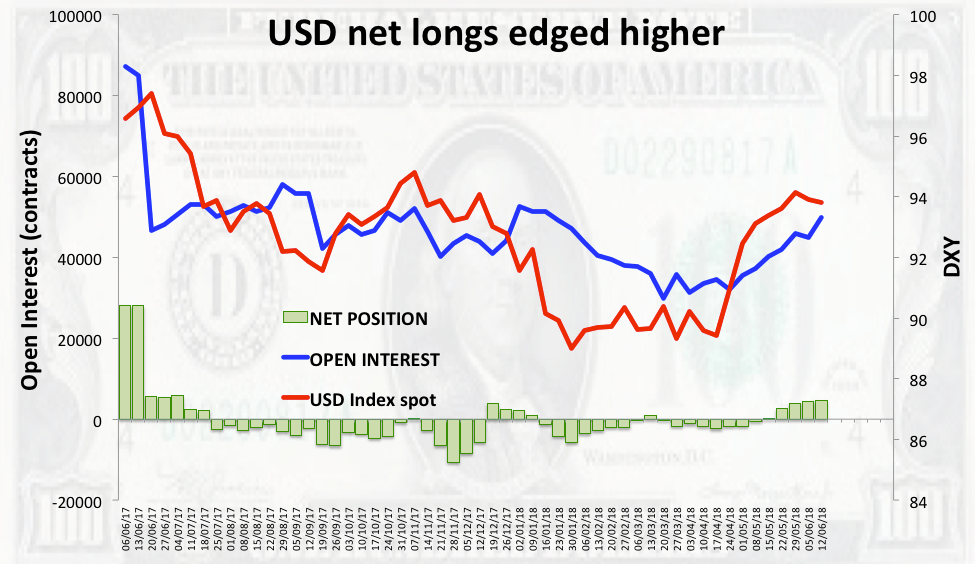
News from the speculative community notes USD net longs climbed to the highest level since early July 2017 during the week ended on June 12, as per the latest CFTC report.

In today’s US calendar, the NAHB index is only expected ahead of the speeches by Atlanta Fed R.Bostic (voter, centrist) and New York Fed W.Dudley (permanent voter, centrist).

US Dollar relevant levels

As of writing the index is up 0.20% at 94.98 facing the next hurdle at 95.14 (2018 high Jun.15) seconded by 95.15 (high Nov.6 2017) and finally 96.51 (high Jul.4 2017). On the other hand, a breach of 94.04 (21-day sma) would open the door to 94.02 (10-day sma) and then 93.21 (low Jun.6).
Author

Pablo Piovano

Born and bred in Argentina, Pablo has been carrying on with his passion for FX markets and trading since his first college years.


More from Pablo Piovano
Share:

Editor's Picks

AUD/USD defends 0.7000 ahead of RBA on Tuesday

AUD/USD is defending 0.7000 at the start of a new week, trading near its lowest level since August 4 amid a bullish US Dollar. US yields hold near multi-year highs amid inflation risks from higher oil prices and rising bets on an October Fed rate hike. This, along with the US-Iran standoff, continues to underpin the safe-haven buck and weigh on the pair ahead of Tuesday's RBA policy announcements.

USD/JPY climbs back toward 158.00 after BoJ minutes amid firm USD

USD/JPY finds dip-buyers and reverses part of Friday's slide driven by speculation that authorities will step in again to prop up the Japanese Yen. However, the BoJ's dovish Minutes cap the JPY. Meanwhile, the US Dollar regains traction as the US-Iran standoff supports crude oil prices, fueling inflation fears and reaffirming bets for an October Fed rate hike. This further supports the pair, driving it back toward 158.00.

Gold tumbles further; focus shifts to $4,100

Gold kicks in the week on the back foot, selling off to the vicinity of the $4,100 mark per troy ounce, levels last traded back in early August. The resurgence of geopolitical concerns in combination with the firmer US Dollar and rising US Treasury yields keep the yellow metal under heavy pressure on Monday.

Bitcoin dips as ETF inflows meet Fed headwinds

Bitcoin trades below $82,800 at the time of writing on Monday after gaining over 4% last week, with the rally losing momentum near recent highs. Strong institutional demand, supported by spot Bitcoin Exchange Traded Fund inflows, continues to drive demand.

The week ahead: A key moment for the global economy as threats rise

UK diesel hits a record, as economic concerns rise. The market expects an aggressive Fed rate hiking cycle, but is it necessary? Oil supply concerns ease, even as oil prices rise. What’s next for the AI trade.

Fed vs BoJ: Both hiked. The market only believes one of them – and the chart shows which

The Fed and the BoJ have just done something remarkably similar. Both central banks raised interest rates by 25 bps last week, both are confronting inflation risks, and both signal that future decisions will depend on incoming economic data.