US Dollar heads for weekly decline as traders eye Fed rate decision and tariff deadlines
- The US Dollar strengthens for a second day on Friday, supported by solid US economic data and improving sentiment on trade.
- Markets remain cautious ahead of next week’s Federal Reserve decision and the August 1 tariff deadline.
- The DXY US Dollar Index trades near 97.80 after finding strong support at the 97.00 psychological level.

The US Dollar (USD) trades with a positive tone for the second straight day on Friday, drawing strength from upbeat US economic data and fresh optimism on trade. On Thursday, better-than-expected weekly Initial Jobless Claims and steady Purchasing Managers Index (PMI) figures helped ease recession worries, supporting the view that the US economy remains resilient. At the same time, recent progress on bilateral tariff deals between the United States (US) and Japan, Indonesia, and the Philippines has improved risk sentiment, thereby limiting pressure on the Greenback.
The US Dollar Index (DXY), which measures the Greenback against a basket of six major currencies, is edging modestly higher during Friday’s American trading hours, recovering from a two-week low touched earlier in the week. At the time of writing, the index is hovering around 97.77. However, the DXY is on track to snap a two-week winning streak, struggling to gain traction above the 98.00 barrier. Still, caution prevails ahead of the August 1 tariff deadline and next week’s Federal Reserve (Fed) monetary policy decision, keeping traders on edge and limiting aggressive moves in the US Dollar.
US President Donald Trump made headlines on Thursday with a rare visit to the Fed’s Washington headquarters, the first by a sitting US president to the central bank in nearly two decades. Trump toured the Fed’s $2.5 billion renovation project alongside Fed Chair Jerome Powell and Senator Tim Scott. During the visit, Trump alleged that the project had gone over budget, stating that costs had ballooned to $3.1 billion. Powell pushed back immediately, clarifying that the additional amount referred to a building completed five years ago and did not reflect true overrun costs.
Trump also used the visit to renew pressure on the Fed to cut interest rates, saying the central bank is “moving too slowly” and should be doing more to support growth. However, he added that he has “no plans” to remove Powell from his post, for now. The visit, while framed as a tour, clearly had political undertones and reignited debate about the Fed’s independence.
On Friday, President Donald Trump told reporters he had a “good meeting” with Fed Chair Jerome Powell and said he got the impression that Powell “might be ready to cut rates,” according to Reuters. The comments added fresh fuel to rate cut speculation and underscored the growing political pressure on the central bank. With the next Fed policy meeting just days away, markets are closely watching to see how the central bank responds to growing political pressure.
The Fed's monetary policy decision is due on Wednesday, markets widely expect interest rates to remain steady, with most forecasts pointing to September at the earliest. According to a recent Reuters poll, 100% of economists anticipate the Fed will hold its benchmark rate steady in the 4.25%-4.50% range next week.
Market movers: Markets on edge ahead of Fed policy decision and trade deadline
- On Friday, President Donald Trump signaled that “most of the trade deals are finished,” noting that many are now formalized through letters specifying tariff rates ranging from 10% to 15%. Trump also said there is a “50-50 chance” of reaching a deal with the European Union, while EU diplomats hinted that a framework agreement could materialize as early as this weekend. European Commission President Ursula von der Leyen confirmed on Friday that she will meet US President Donald Trump in Scotland on Sunday to discuss transatlantic trade relations. She described the conversation as “a good call” and emphasized that the meeting will focus on maintaining strong trade ties between the US and the European Union, amid growing optimism that a framework deal could be reached soon.
- Trump maintained a firm tone on Canada, suggesting limited progress on trade talks with the northern neighbor. “I haven’t had a lot of luck with Canada,” he added, saying that he may impose a unilateral tariff rate without further negotiation. “There’s not a lot of negotiating, and I’m not focused on a deal with Canada."
- Durable goods orders in the U.S. declined 9.3% month-over-month to $311.84 billion in June 2025, reversing an upwardly revised 16.5% surge in May. The drop was less severe than the 10.8% decline expected, with the sharp pullback largely due to a slump in commercial aircraft bookings. Excluding transportation, orders rose 0.2%, pointing to some resilience in underlying manufacturing demand. However, core capital goods orders fell by 0.7%.
- The yield on the 10-year US Treasury note hovers around 4.39% on Friday, stabilizing after a volatile week as investors tread carefully ahead of next week’s Federal Reserve policy meeting. Markets are currently pricing in 43 basis points of rate cuts by the end of 2025, with reductions expected in September and December. The steady yield reflects uncertainty surrounding the inflation outlook, the impact of tariffs, and the broader direction of monetary policy.
- The United States has so far sealed five trade agreements with key partners, including Japan, the Philippines, Vietnam, Indonesia, and the United Kingdom, and reached a preliminary deal with China. Talks are still underway with the European Union, South Korea, and India, as major trading partners race to finalize negotiations ahead of the August 1 tariff deadline. The EU is pushing for a deal modeled after the US-Japan agreement, seeking a 15% baseline tariff and exemptions for key sectors, such as autos and pharmaceuticals, to avoid a steeper 30% levy. Speaking on Friday, Trump signalled that there’s a “50-50 chance” of a trade agreement with the EU.
- South Korea’s Industry Minister Kim Jung-kwan and Trade Envoy Yeo Han-koo are scheduled to meet US Commerce Secretary Howard Lutnick on Friday in Washington, as both sides enter the final stretch of talks. Seoul is offering a $100 billion investment package from major firms like Samsung and Hyundai to help secure a deal and avoid the threat of 25% tariffs on key exports.
- US President Trump arrived in Scotland on Friday for a multi-day visit combining business and diplomacy. Trump is expected to meet UK Prime Minister Keir Starmer on Monday, with trade and tariffs expected to be a key focus. US tariffs on major British exports, including steel, whisky, and pharmaceuticals, while crafting a refined version of the existing trade pact.
- On Wednesday, Trump reiterated his hardline trade stance, announcing that future tariffs on US trading partners would range from 15% to 50%, up from his earlier proposal of a 10% baseline. He made it clear that only countries willing to fully open their markets to American goods and services would be offered any tariff relief. For those unwilling to engage in reciprocal trade, the full punitive tariffs would apply.
- A split among Fed officials is fueling debate over the July interest rate decision. Dovish voices, including Governor Christopher Waller and Vice Chair for Supervision Michelle Bowman, support a 25 basis point rate cut this month, citing that recent tariffs are driving a temporary spike in inflation and that easing now could shield the economy from slowing growth. In contrast, Fed Chair Jerome Powell and most officials favor a more cautious approach. They warn that early easing could reignite price pressure if tariff-related inflation proves more persistent than expected.
Technical analysis: DXY finds footing near 97.00 as bullish correction unfolds
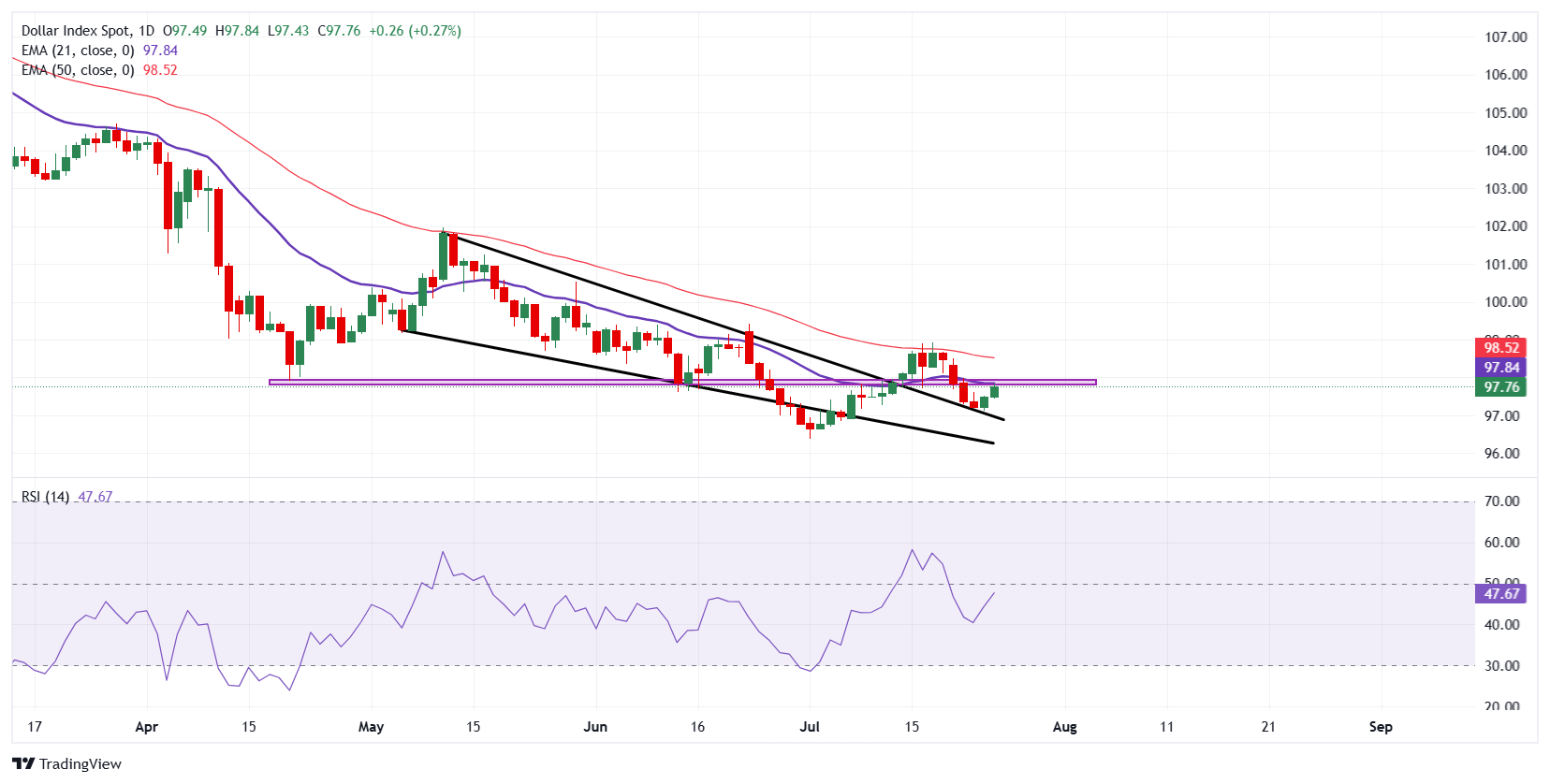
The US Dollar Index (DXY) is edging higher on Friday after successfully retesting the upper boundary of a falling wedge pattern, which it broke decisively last week. The US Dollar Index (DXY) found strong support near the key 97.00 psychological mark on Thursday, as buyers stepped in to defend the level and revive bullish momentum.
Price action is now trending higher, with the first major hurdle seen around the 97.80-98.00 zone — a former support turned resistance area that also coincides with the 21-day Exponential Moving Average (EMA). A sustained break above this region could open the door for a test of the previous week’s high at 98.93, with interim resistance of the 50-day EMA at 98.52.
On the downside, a daily close below 97.00 would negate the bullish correction structure and could signal a fresh wave of selling pressure, with the index likely heading back toward the lower wedge boundary or even retesting the multi-year low of 96.38 set on July 1.
The 14-day Relative Strength Index (RSI) is currently at 47 and pointing north, signaling a modest recovery from recent lows. However, it remains below the neutral 50 mark, indicating that bullish momentum is still tentative.
Author

Vishal Chaturvedi
FXStreet
I am a macro-focused research analyst with over four years of experience covering forex and commodities market. I enjoy breaking down complex economic trends and turning them into clear, actionable insights that help traders stay ahead of the curve.