US Dollar sees geopolitical and US economic data concerns pick up
- US Vice President JD Vance’s comments about Europe in leaked Signal chat could be setback from Trump administration.
- US President Trump issues “secondary tariffs” and puts Venezuela Oil exports as example.
- The US Dollar Index fails to break 104.50 after a brief test.

The US Dollar Index (DXY), which tracks the performance of the US Dollar (USD) against six major currencies, has broken below 104.00 after headlines from the United States (US) President Donald Trump and his Vice President JD Vance. The index trades slightly above 104.00 at the time of writing on Tuesday, while markets assess two main stories. The first market driver comes from United States (US) President Donald Trump, who issued “secondary tariffs” of 25% on all goods from countries that still buy Oil from Venezuela. Trump eased off on the size and broadness of reciprocal tariffs that are set to kick in on April 2 and commented about adding more targeted tariffs on cars, aluminum, pharmaceuticals, chips and lumber, Bloomberg reports.
Meanwhile, markets are looking for comments from the European bloc after a US news editor got invited by mistake to a Signal’s chat group with several Trump administration officials, including Vice President JD Vance, National Security Advisor Michael Waltz, Defense Secretary Pete Hegseth and Secretary of State Marco Rubio, among others. Comments from JD Vance towards Europe painted a clear picture of what and how he would like to see the EU being targeted with tariffs to pay for the US military actions against Houthi rebels, the Financial Times reports. The issue not only raises questions on the stance of the US towards Europe but also about security problems as a third-party chat application was used to discuss US military operations, weapon inventories and tactical plans.
Daily digest market movers: Sentiment weighs
- In early European trading, the German Institute for Economic Research (IFO) has released its Sentiment Index. The Current Assessment number came in at 85.7, beating the 85.5 expectation and the previous 85.0 reading.
- Around 12:40 GMT, Adriana D. Kugler of the Board of Governors of the Federal Reserve (Fed) spoke on the economic landscape and entrepreneurship at the US Hispanic Chamber of Commerce 2025 Legislative Summit. Fed's Kugler said the Fed can wait and keep rates steady for longer.
- The Housing Price Index for January came in at 0.2% as expected, softer compared to the previous 0.4% reading, which got revised to 0.5%.
- The Philadelphia Fed Non-Manufacturing Activity Index for March fell to a staggering -32.5, coming from already a contraction number of -13.1 in February.
- Fed Bank of New York President John Williams has delivered opening remarks at the 2025 New York Fed Regional and Community Banking Conference at the New York Fed, New York.
- Some US economic data has been released around 14:00 GMT:
- The US Business Confidence or March sinks to -15.1, missing the -11.5 survey and below the previous -12.3 reading.
- US Conference Board Consumer Confidence falls to 92.9, coming from 100.1 and missing the 94.0 estimate.
- New Home Sales for February drop to 0.676 million units, missing the 0.68 million estimate.
- The Richmond Fed Manufacturing Index for March contracts to -4, missing the +1 estimate and below the previous +6.
- Equities are mixed this Tuesday, with Chinese indices slumping. The Hang Seng closed over 2% lower. European equities are ticking up over 1.00%, while US futures are positive by less than 0.5%.
- According to the CME Fedwatch Tool, the probability of interest rates remaining at the current range of 4.25%-4.50% in May’s meeting is 89.2%. For June, the odds for borrowing costs being lower stand at 62.5%.
- The US 10-year yield trades around 4.31% after bonds sold off on Monday with the surge in equities.
US Dollar Index Technical Analysis: Business Sentiment sinks
The US Dollar Index (DXY) faces some selling pressure on Tuesday after a very early test to break above 104.50. The turnaround comes after US President Donald Trump issued more concerns and constraints on tariffs ahead of the deadline on April 2. The leaked messages from US Vice President JD Vance on Europe and other trade partners are an issue of concern for markets.
With the weekly close above 104.00 last week, a large sprint higher towards the 105.00 round level could still occur, with the 200-day Simple Moving Average (SMA) converging at that point and reinforcing this area as a strong resistance at 104.97. Once broken through that zone, a string of pivotal levels, such as 105.53 and 105.89, could limit the upward momentum.
On the downside, the 104.00 round level could be considered the first nearby support. If that does not hold, the DXY risks falling back into that March range between 104.00 and 103.00. Once the lower end at 103.00 gives way, watch out for 101.90 on the downside.
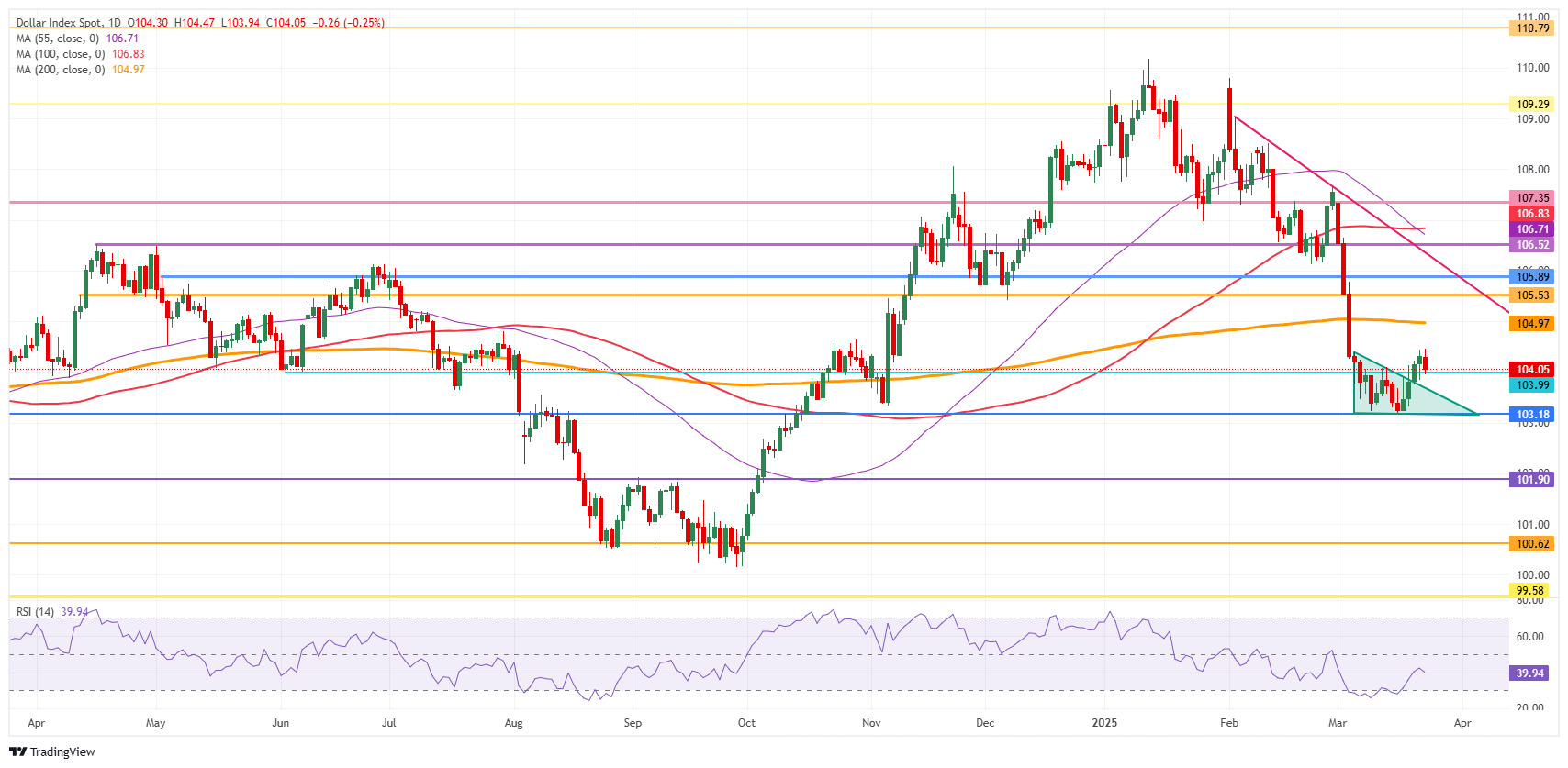
US Dollar Index: Daily Chart
Central banks FAQs
Central Banks have a key mandate which is making sure that there is price stability in a country or region. Economies are constantly facing inflation or deflation when prices for certain goods and services are fluctuating. Constant rising prices for the same goods means inflation, constant lowered prices for the same goods means deflation. It is the task of the central bank to keep the demand in line by tweaking its policy rate. For the biggest central banks like the US Federal Reserve (Fed), the European Central Bank (ECB) or the Bank of England (BoE), the mandate is to keep inflation close to 2%.
A central bank has one important tool at its disposal to get inflation higher or lower, and that is by tweaking its benchmark policy rate, commonly known as interest rate. On pre-communicated moments, the central bank will issue a statement with its policy rate and provide additional reasoning on why it is either remaining or changing (cutting or hiking) it. Local banks will adjust their savings and lending rates accordingly, which in turn will make it either harder or easier for people to earn on their savings or for companies to take out loans and make investments in their businesses. When the central bank hikes interest rates substantially, this is called monetary tightening. When it is cutting its benchmark rate, it is called monetary easing.
A central bank is often politically independent. Members of the central bank policy board are passing through a series of panels and hearings before being appointed to a policy board seat. Each member in that board often has a certain conviction on how the central bank should control inflation and the subsequent monetary policy. Members that want a very loose monetary policy, with low rates and cheap lending, to boost the economy substantially while being content to see inflation slightly above 2%, are called ‘doves’. Members that rather want to see higher rates to reward savings and want to keep a lit on inflation at all time are called ‘hawks’ and will not rest until inflation is at or just below 2%.
Normally, there is a chairman or president who leads each meeting, needs to create a consensus between the hawks or doves and has his or her final say when it would come down to a vote split to avoid a 50-50 tie on whether the current policy should be adjusted. The chairman will deliver speeches which often can be followed live, where the current monetary stance and outlook is being communicated. A central bank will try to push forward its monetary policy without triggering violent swings in rates, equities, or its currency. All members of the central bank will channel their stance toward the markets in advance of a policy meeting event. A few days before a policy meeting takes place until the new policy has been communicated, members are forbidden to talk publicly. This is called the blackout period.
Author

Filip Lagaart
FXStreet
Filip Lagaart is a former sales/trader with over 15 years of financial markets expertise under its belt.

















