US Dollar sees Asian currency turmoil losses starting to pare back
- The US Dollar down for a second consecutive day, after softer-than-expected US inflation data.
- The Korean Won strengthens over the Greenback after the announcement that both countries have discussed Forex markets.
- The US Dollar Index hits support ahead of 100-level and bounces for now.

The US Dollar Index (DXY), which tracks the performance of the US Dollar (USD) against six major currencies, has dipped in the direction of the 100-marker, near 100.60 on Wednesday. The downside move comes after softer-than-expected inflation in the US and the confirmation that the United States (US) and South Korea have been in talks about currencies, according to Bloomberg. The Greenback is on the backfoot against most major Asian currencies.
The news opened up not-so-old wounds from earlier this month, when the Taiwan Dollar (TWD) appreciated sharply against the US Dollar. In addition, the soft Consumer Price Index (CPI) reading for April released on Tuesday has revamped rate cut bets for the Federal Reserve (Fed) this year, seeing the probability for a rate cut grow bigger compared to last week. This narrows the rate differential between the US and other countries and devalues the Greenback a touch.
Daily digest market movers: Where there is smoke...
- US President Donald Trump said that he has good hopes for a breakthrough between Russia and Ukraine on Thursday's meeting.
- Only two Fed speakers for this Wednesday:
- Vice Chair Philip Jefferson commented that the Fed's policy is well positioned to respond in a timely way on a surprise drop or surge in inflation. Though, the Fed's Vice Chair went on to say that there is a high uncertainty that inflationary pressures would be temporary.
- Near 21:40 GMT, Federal Reserve Bank of San Francisco President Mary Daly participates in a fireside chat at the California Bankers Association's 2025 Annual Conference & Directors Forum.
- Equities are trying to brush off the negative tone while US equities see a lift on the back of the several deals US President Trump brings back from his trip to the Middle East.
- The CME FedWatch tool shows the chance of an interest rate cut by the Federal Reserve in June’s meeting at just 8.2%. Further ahead, the July 30 decision sees odds for rates being lower than current levels at 38.6%.
- The US 10-year yields trade around 4.48%, steady as traders mull Tuesday’s inflation numbers and rate cut bets for 2025.
US Dollar Index Technical Analysis: First Taiwan, now Korea...
A headline on possible currency adjustments appears to be enough to set off some devaluation for the Greenback. The fact that South Korea and the US have been in talks is enough to scaremonger markets in anticipation of the actual event happening. Should more headlines be revealed on the matter, or the actual intervention from the Bank of Korea (BoK) take place, expect to see possibly a revisit of the DXY to the multi-year low at 94.56.
On the upside, 101.90 is the first big resistance again as it already acted as a pivotal level throughout December 2023 and as a base for the inverted head-and-shoulders (H&S) formation during the summer of 2024. In case Dollar bulls push the DXY even higher, the 55-day Simple Moving Average (SMA) at 102.29 comes into play.
On the other hand, the previous resistance at 100.22 is acting as firm support, followed by 97.73, near the low of 2025. Further below, a relatively thin technical support comes in at 96.94 before looking at the lower levels of this new price range. These would be at 95.25 and 94.56, meaning fresh lows not seen since 2022.
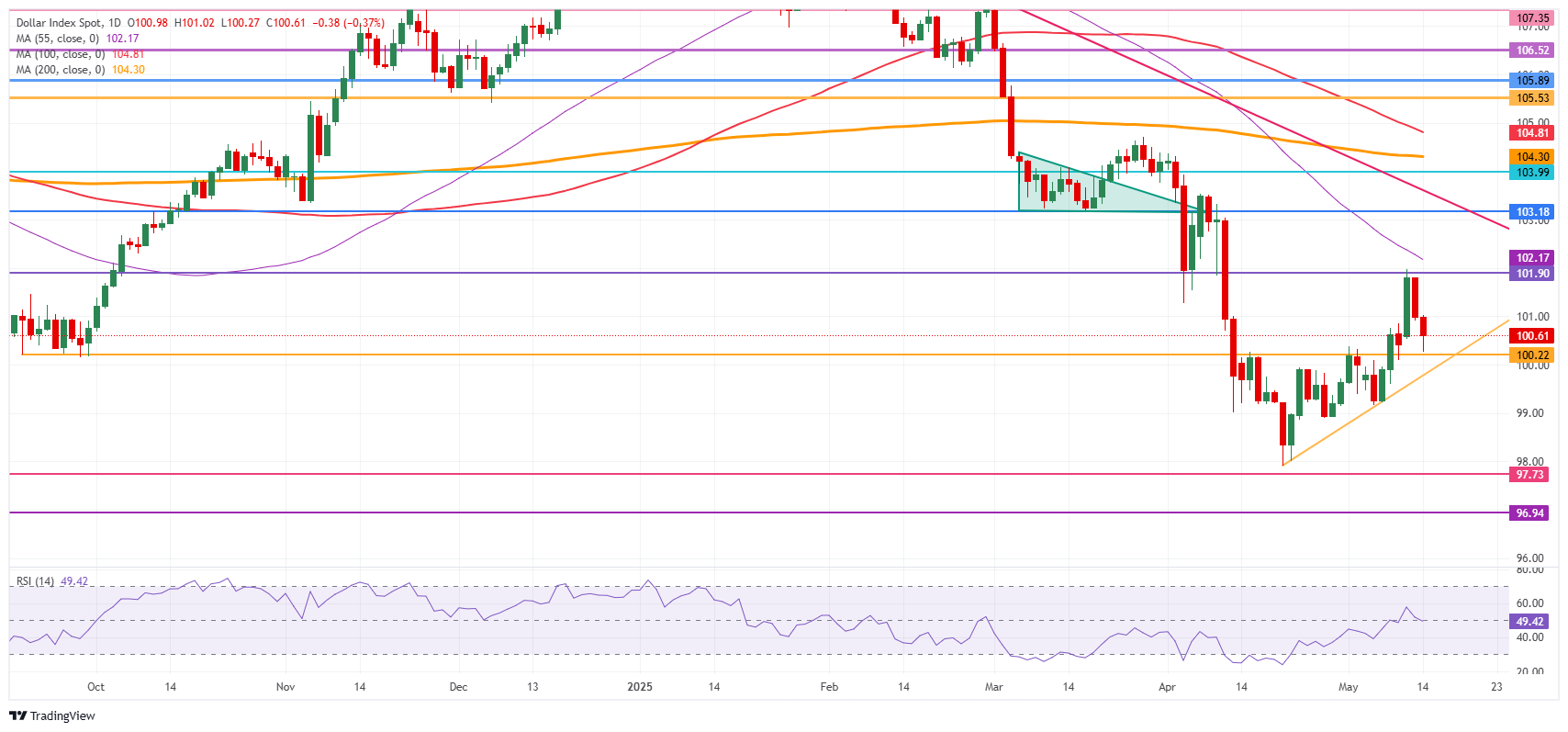
US Dollar Index: Daily Chart
Banking crisis FAQs
The Banking Crisis of March 2023 occurred when three US-based banks with heavy exposure to the tech-sector and crypto suffered a spike in withdrawals that revealed severe weaknesses in their balance sheets, resulting in their insolvency. The most high profile of the banks was California-based Silicon Valley Bank (SVB) which experienced a surge in withdrawal requests due to a combination of customers fearing fallout from the FTX debacle, and substantially higher returns being offered elsewhere.
In order to fulfill the redemptions, Silicon Valley Bank had to sell its holdings of predominantly US Treasury bonds. Due to the rise in interest rates caused by the Federal Reserve’s rapid tightening measures, however, Treasury bonds had substantially fallen in value. The news that SVB had taken a $1.8B loss from the sale of its bonds triggered a panic and precipitated a full scale run on the bank that ended with the Federal Deposit Insurance Corporation (FDIC) having to take it over.The crisis spread to San-Francisco-based First Republic which ended up being rescued by a coordinated effort from a group of large US banks. On March 19, Credit Suisse in Switzerland fell foul after several years of poor performance and had to be taken over by UBS.
The Banking Crisis was negative for the US Dollar (USD) because it changed expectations about the future course of interest rates. Prior to the crisis investors had expected the Federal Reserve (Fed) to continue raising interest rates to combat persistently high inflation, however, once it became clear how much stress this was placing on the banking sector by devaluing bank holdings of US Treasury bonds, the expectation was the Fed would pause or even reverse its policy trajectory. Since higher interest rates are positive for the US Dollar, it fell as it discounted the possibility of a policy pivot.
The Banking Crisis was a bullish event for Gold. Firstly it benefited from demand due to its status as a safe-haven asset. Secondly, it led to investors expecting the Federal Reserve (Fed) to pause its aggressive rate-hiking policy, out of fear of the impact on the financial stability of the banking system – lower interest rate expectations reduced the opportunity cost of holding Gold. Thirdly, Gold, which is priced in US Dollars (XAU/USD), rose in value because the US Dollar weakened.
Author

Filip Lagaart
FXStreet
Filip Lagaart is a former sales/trader with over 15 years of financial markets expertise under its belt.