US Dollar back to flat ahead of Fed's Minutes release later this Wednesday
- The US Dollar is holding on to some minor gains on Wednesday.
- US President Donald Trump extends the scope of tariffs to pharmaceuticals and semiconductors by April.
- The US Dollar Index (DXY) recovers above 107.00 and is still looking for direction this week.

The US Dollar Index (DXY), which tracks the performance of the US Dollar (USD) against six major currencies, is seeing traders brace for the Federal Reserve (Fed) Minutes release from its latest monetary policy meeting in January, with traders seeing the DXY well positioned amidst all tariff and geopolitical headlines. Overnight, United States (US) President Donald Trump said that car tariffs will be around 25%, and that pharmaceutical and semiconductor imports will be added to the same scheme by April. President Trump tried to deflect the rather unsuccessful first day of negotiations between Russia and the US officials on a peace deal on Ukraine, lashing out at the latter and retaining that it is Ukraine’s fault a deal has not been made and probably will be difficult to make.
Regarding the economic calendar, all eyes shift to the Federal Open Market Committee (FOMC) Minutes from the Federal Reserve’s (Fed) January policy meeting. The Minutes could provide some support for the US Dollar, which has been softening due to weaker US Yields. A rather hawkish Minutes could jack up US rates again, phase out chances or odds on interest rate cuts for 2025, and see a stronger Greenback as the end result.
Daily digest market movers: All eyes on Fed's summary
- Weekly Mortgate Applications already fell substantially for this week, dropping 6.6% against last week's performance.
- Before facing the Fed’s latest FOMC Minutes,some data on the US housing market came out.
- January Building Permits climbed to 1.483 million units, beating the 1.460 million estimate and from 1.482 million in December.
- Housing Starts in January fell to 1.366 million, missing the 1.4 million estimate, coming from 1.499 million.
- At 19:00 GMT, the Federal Reserve will release its January notes from its monetary policy. Any hawkish tilts or undertones could be enough to push back current rate cut expectations for 2025 and could mean a stronger US Dollar in the outcome.
- Equities are not having a very good day and are all in the red across Europe and the US. The Shanghai Shenzhen Index is an outlier, closing 0.7% higher despite President Trump’s broadening of tariffs to include drugs and chips.
- The CME FedWatch tool shows a 53.5% chance that interest rates will remain unchanged at current levels in June.
- The US 10-year yield is trading around 4.56%, near the highest level for this week.
US Dollar Index Technical Analysis: All or nothing
The US Dollar Index (DXY) is barely moving on the recent broadening of US President Donald Trump’s tariffs. The Greenback nearly did not move on the back of it and only started to tick up a little bit on Tuesday when the conclusion came that the first day of talks between Russia and the US officials did not really have any result. With the Fed releasing its January Minutes on Wednesday, maybe that can get the DXY moving in any direction.
On the upside, the previous support at 107.35 has now turned into a firm resistance. Further up, the 55-day SMA at 107.93 must be regained before reclaiming 108.00.
On the downside, look for 106.52 (April 16, 2024, high), 106.51 (100-day SMA), or even 105.89 (resistance in June 2024) as support levels. As the Relative Strength Index (RSI) momentum indicator in the daily chart shows room for more downside, the 200-day SMA at 104.96 could be a possible outcome.
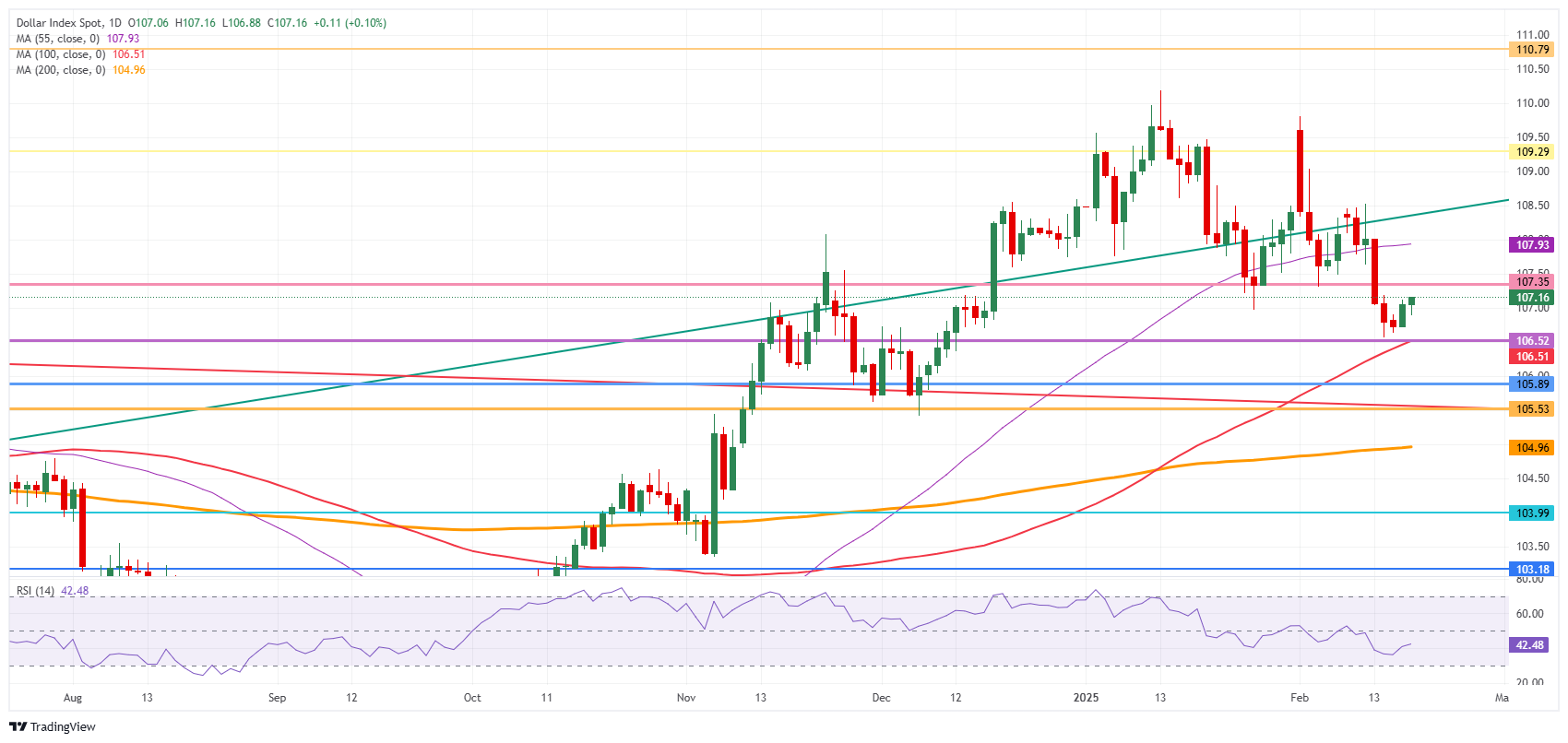
US Dollar Index: Daily Chart
Fed FAQs
Monetary policy in the US is shaped by the Federal Reserve (Fed). The Fed has two mandates: to achieve price stability and foster full employment. Its primary tool to achieve these goals is by adjusting interest rates. When prices are rising too quickly and inflation is above the Fed’s 2% target, it raises interest rates, increasing borrowing costs throughout the economy. This results in a stronger US Dollar (USD) as it makes the US a more attractive place for international investors to park their money. When inflation falls below 2% or the Unemployment Rate is too high, the Fed may lower interest rates to encourage borrowing, which weighs on the Greenback.
The Federal Reserve (Fed) holds eight policy meetings a year, where the Federal Open Market Committee (FOMC) assesses economic conditions and makes monetary policy decisions. The FOMC is attended by twelve Fed officials – the seven members of the Board of Governors, the president of the Federal Reserve Bank of New York, and four of the remaining eleven regional Reserve Bank presidents, who serve one-year terms on a rotating basis.
In extreme situations, the Federal Reserve may resort to a policy named Quantitative Easing (QE). QE is the process by which the Fed substantially increases the flow of credit in a stuck financial system. It is a non-standard policy measure used during crises or when inflation is extremely low. It was the Fed’s weapon of choice during the Great Financial Crisis in 2008. It involves the Fed printing more Dollars and using them to buy high grade bonds from financial institutions. QE usually weakens the US Dollar.
Quantitative tightening (QT) is the reverse process of QE, whereby the Federal Reserve stops buying bonds from financial institutions and does not reinvest the principal from the bonds it holds maturing, to purchase new bonds. It is usually positive for the value of the US Dollar.
Author

Filip Lagaart
FXStreet
Filip Lagaart is a former sales/trader with over 15 years of financial markets expertise under its belt.