US Dollar flips to green after German lawmakers agree spending bill
- The US Dollar is turning green and avoids a fresh five-month low in the US Dollar Index.
- Traders see Germany boost its spending by 0.5 trillion Euro.
- The US Dollar Index recovers from earlier declines as Putin and Trump are talking.
The US Dollar Index (DXY), which tracks the performance of the US Dollar (USD) against six major currencies, trades flat at 103.60 at the time of writing on Tuesday, while United States (US) President Donald Trump and Russian President Vladimir Putin are speaking to one another. The initial move came after several news headlines, increasing geopolitical uncertainty and key events taking place during the day. Any headline could be a catalyst to push the DXY to an even six-month low and below the 103.00 level.
At the time of writing, a high-stakes meeting between the United States (US) President Donald Trump and Russian President Vladimir Putin is taking place, with the two parties discussing territory and divide up certain assets in Ukraine. This has raised concerns that Ukraine will be torn up and the European Union (EU) and North Atlantic Treaty Organisation (NATO) will be bolstered to boost even more their defense spending.
Meanwhile, Israel has broken this morning the ceasefire truce with Gaza that started in January by attacking Hamas’ tactical installations and buildings The military move comes after Israel and the US claimed Hamas did not hold its end of the bargain by releasing hostages. This will, in turn, possibly bring more attacks in the Red Sea by Houthi rebels and retaliation from Hamas.
Daily digest market movers: Headlines coming in
- Several data points have already been released:
- Monthly Building Permits came in at 1.456 million, beating the estimate of 1.45 million in February, below the 1.473 million in January.
- Housing Starts for February came in at 1.501 million units, a beat on the expected 1.38 million and up compared to 1.366 million in January.
- The monthly Export Price Index rose by 0.1%, beating the expected contraction by 0.2% in February, coming from a positive 1.3% in January. The Import Price Index jumped by 0.4%, beating the expected contraction by 0.1% and compared to the January positive 0.3%.
- At 13:15 GMT, Industrial Production for February came out. The actual number came in at 0.7%, beating the 0.2% consensus and above the 0.5% in January.
- Equities are mixed again on Tuesday, with European indices up nearly 1% on chances the German spending budget passes, while US equities are diving near 1% lower in clearly divided trading day.
- The CME Fedwatch Tool sees a 99.0% chance for no interest rate changes in the upcoming Fed meeting on Wednesday. The probability of a rate cut at the May meeting currently stands at 21.5%.
- The US 10-year yield trades around 4.30%, off its near five-month low of 4.10% printed on March 4.
US Dollar Index Technical Analysis: Not a straight line
The US Dollar Index (DXY) flirts with a breakdown of its recent range between 103.18 and 103.99 on Tuesday as downside pressure builds. With recent US economic data deteriorating and geopolitical events that would benefit the Eurozone, such as the possible approval in Germany to increase spending and the call between Trump and Putin for a ceasefire in Ukraine, another leg lower for the DXY could be a possible outcome.
Should markets consider current developments as ‘sell the rumour, buy the fact’, some surprise upside would initially materialize and see a return to 104.00. If bulls can avoid a technical rejection there, look for a large sprint higher towards the 105.00 round level, with the 200-day Simple Moving Average (SMA) converging at that point and reinforcing this area as a strong resistance. Once broken through that zone, a string of pivotal levels, such as 105.53 and 105.89, will present as caps.
On the downside, the 103.00 round level could be considered a bearish target in case US yields roll off again, with even 101.90 not unthinkable if markets further capitulate on their long-term US Dollar holdings.
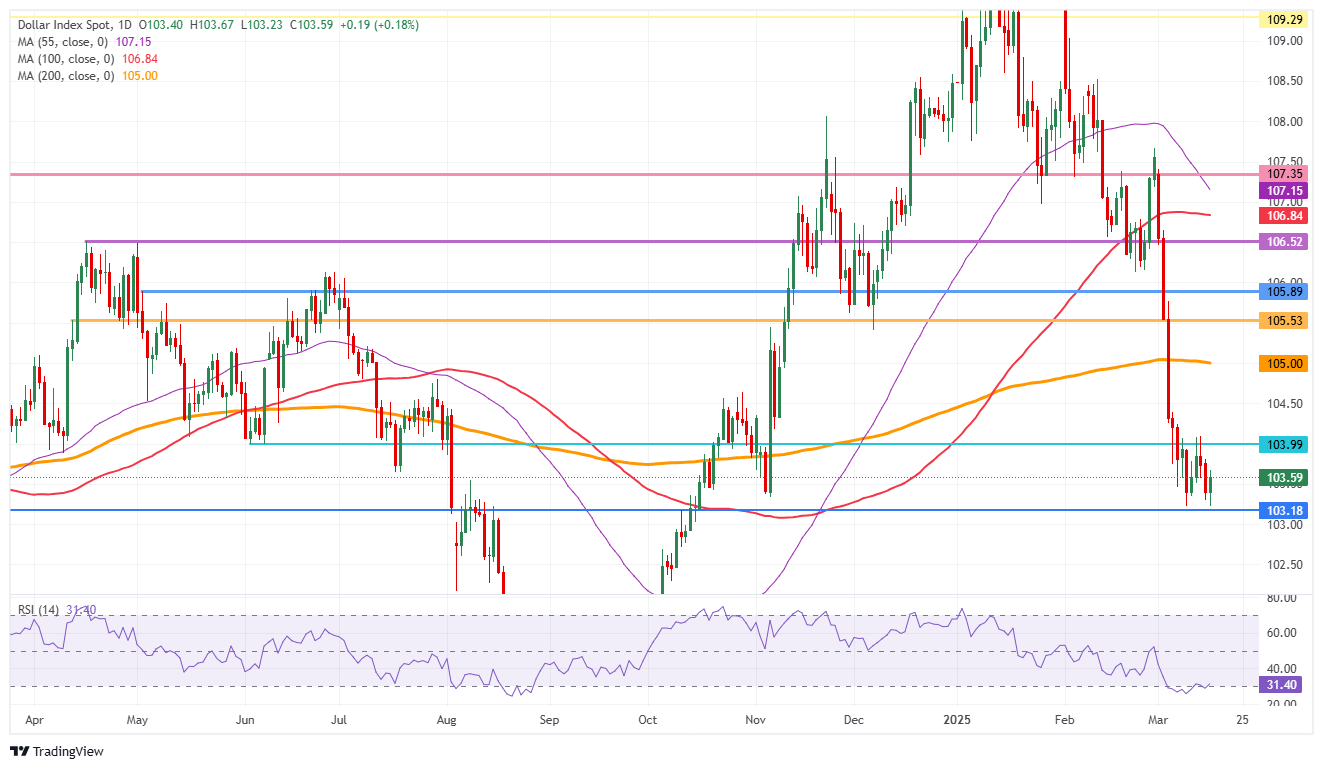
US Dollar Index: Daily Chart
Banking crisis FAQs
The Banking Crisis of March 2023 occurred when three US-based banks with heavy exposure to the tech-sector and crypto suffered a spike in withdrawals that revealed severe weaknesses in their balance sheets, resulting in their insolvency. The most high profile of the banks was California-based Silicon Valley Bank (SVB) which experienced a surge in withdrawal requests due to a combination of customers fearing fallout from the FTX debacle, and substantially higher returns being offered elsewhere.
In order to fulfill the redemptions, Silicon Valley Bank had to sell its holdings of predominantly US Treasury bonds. Due to the rise in interest rates caused by the Federal Reserve’s rapid tightening measures, however, Treasury bonds had substantially fallen in value. The news that SVB had taken a $1.8B loss from the sale of its bonds triggered a panic and precipitated a full scale run on the bank that ended with the Federal Deposit Insurance Corporation (FDIC) having to take it over.The crisis spread to San-Francisco-based First Republic which ended up being rescued by a coordinated effort from a group of large US banks. On March 19, Credit Suisse in Switzerland fell foul after several years of poor performance and had to be taken over by UBS.
The Banking Crisis was negative for the US Dollar (USD) because it changed expectations about the future course of interest rates. Prior to the crisis investors had expected the Federal Reserve (Fed) to continue raising interest rates to combat persistently high inflation, however, once it became clear how much stress this was placing on the banking sector by devaluing bank holdings of US Treasury bonds, the expectation was the Fed would pause or even reverse its policy trajectory. Since higher interest rates are positive for the US Dollar, it fell as it discounted the possibility of a policy pivot.
The Banking Crisis was a bullish event for Gold. Firstly it benefited from demand due to its status as a safe-haven asset. Secondly, it led to investors expecting the Federal Reserve (Fed) to pause its aggressive rate-hiking policy, out of fear of the impact on the financial stability of the banking system – lower interest rate expectations reduced the opportunity cost of holding Gold. Thirdly, Gold, which is priced in US Dollars (XAU/USD), rose in value because the US Dollar weakened.
Author

Filip Lagaart
FXStreet
Filip Lagaart is a former sales/trader with over 15 years of financial markets expertise under its belt.