US Dollar test fresh highs ahead of the US JOLTS jobs data on tap
- US Dollar resumes its bullish trend and tests three-month highs at 104.55.
- US JOLTS Job Openings and Consumer Confidence data will be the main attractions.
- The Dollar remains buoyed by higher US yields and market expectations of gradual Fed easing.

The US Dollar Index (DXY) has resumed its broader bullish trend ahead of the US market session opening on Tuesday. The Greenback remains supported by solid US data but upside attempts are likely to remain limited, as investors wait for first-tier US releases, due in the second half of the week, to place US Dollar's (USD) directional bets.
The main attraction on Tuesday will be on the US Consumer Confidence Index and the JOLTS Job Openings figures, which are expected to bolster the case of a solid US economy ahead of Wednesday’s Q3 GDP release.
The USD index, which measures the value of the US Dollar against the six main traded currencies, is on track to its best monthly performance in more than two years. Strong US data has forced markets to dial down expectations of a steep easing cycle by the Federal Reserve (Fed), pushing US yields higher and pushing the USD up with them.
Daily digest market movers: The US Dollar holds its ground with JOLTS jobs on focus
- US JOLTS Job Openings surprised in August with an increase to 8.05 million vacancies and is expected to have remained close to the 8 million openings in September.
- The Conference Board’s Consumer Confidence Index is seen improving to 99.5 from September’s 98.7 reading.
- These figures are likely to improve the expectations of the preliminary Q3 Gross Domestic Product (GDP) data, to be released on Wednesday. The US economy is expected to have grown at a 3% annualized pace, a strong expansion that could provide additional support to the US Dollar.
- On Friday, the Nonfarm Payrolls (NFP) report is expected to show a lower increase in employment than in the previous month. Such an outcome might cap the US Dollar’s rally.
- According to the CME Fed Watch Tool, futures markets are practically fully pricing a 25 bps cut in November and a 72% chance of another 25 bps cut in December.
DXY technical outlook: Upside bias remains intact
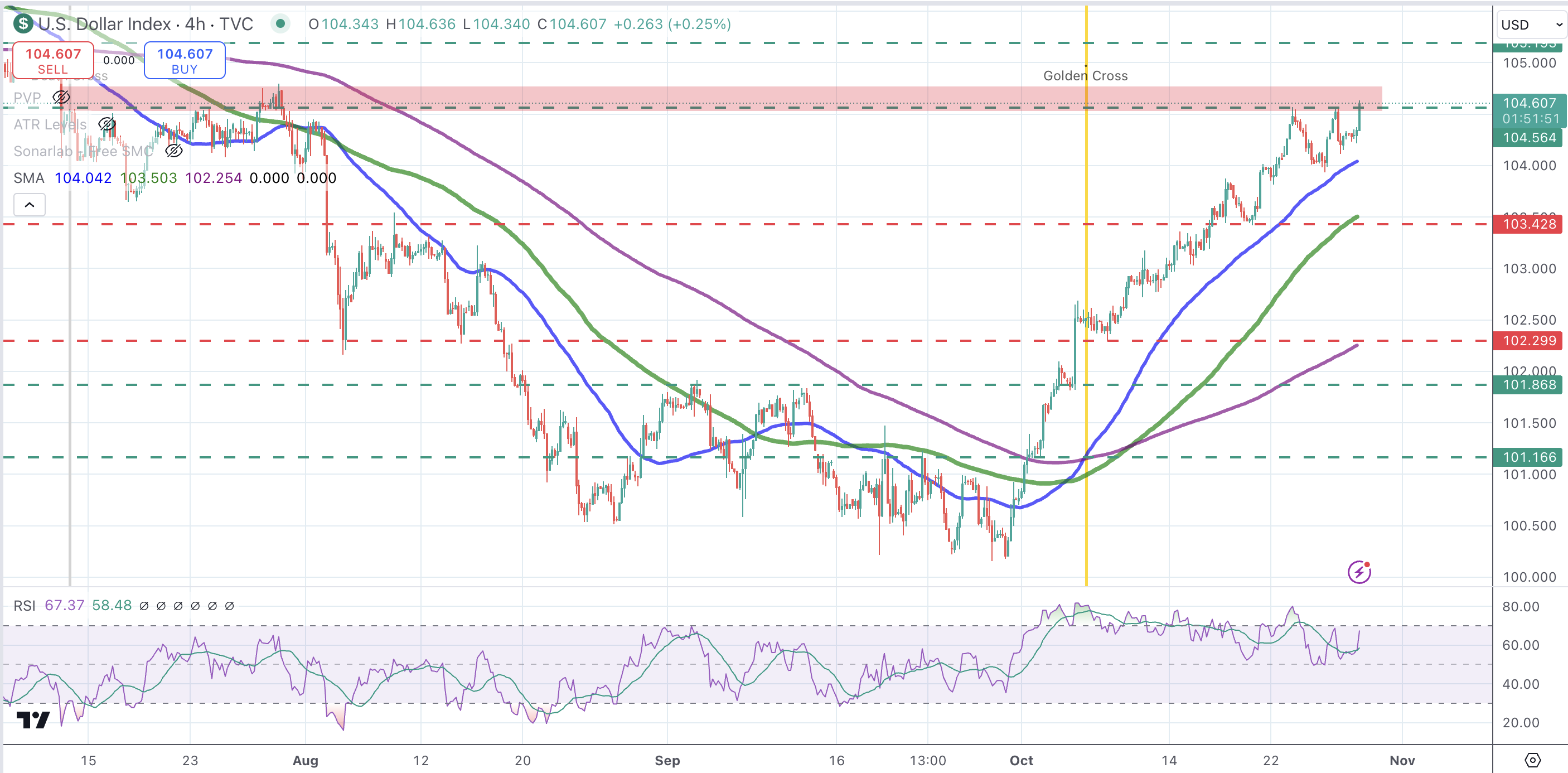
The DXY index keeps moving within a bullish channel, printing higher highs and higher lows. The Index has a significant resistance area between 10455 and 104.75, where bulls were capped several times on previous occasions. Above here, the target is 105.20.
On the downside, the 4-hour 50 Simple Moving Average (SMA) and last week´s low, at 103.95 are holding the bears’ attempts for now, with the next target below that level at 103.40. To the upside, above 104.50, the next resistance level is at 105.20.
USD Index 4-hour chart
US Dollar FAQs
The US Dollar (USD) is the official currency of the United States of America, and the ‘de facto’ currency of a significant number of other countries where it is found in circulation alongside local notes. It is the most heavily traded currency in the world, accounting for over 88% of all global foreign exchange turnover, or an average of $6.6 trillion in transactions per day, according to data from 2022. Following the second world war, the USD took over from the British Pound as the world’s reserve currency. For most of its history, the US Dollar was backed by Gold, until the Bretton Woods Agreement in 1971 when the Gold Standard went away.
The most important single factor impacting on the value of the US Dollar is monetary policy, which is shaped by the Federal Reserve (Fed). The Fed has two mandates: to achieve price stability (control inflation) and foster full employment. Its primary tool to achieve these two goals is by adjusting interest rates. When prices are rising too quickly and inflation is above the Fed’s 2% target, the Fed will raise rates, which helps the USD value. When inflation falls below 2% or the Unemployment Rate is too high, the Fed may lower interest rates, which weighs on the Greenback.
In extreme situations, the Federal Reserve can also print more Dollars and enact quantitative easing (QE). QE is the process by which the Fed substantially increases the flow of credit in a stuck financial system. It is a non-standard policy measure used when credit has dried up because banks will not lend to each other (out of the fear of counterparty default). It is a last resort when simply lowering interest rates is unlikely to achieve the necessary result. It was the Fed’s weapon of choice to combat the credit crunch that occurred during the Great Financial Crisis in 2008. It involves the Fed printing more Dollars and using them to buy US government bonds predominantly from financial institutions. QE usually leads to a weaker US Dollar.
Quantitative tightening (QT) is the reverse process whereby the Federal Reserve stops buying bonds from financial institutions and does not reinvest the principal from the bonds it holds maturing in new purchases. It is usually positive for the US Dollar.
Author

Guillermo Alcala
FXStreet
Graduated in Communication Sciences at the Universidad del Pais Vasco and Universiteit van Amsterdam, Guillermo has been working as financial news editor and copywriter in diverse Forex-related firms, like FXStreet and Kantox.