Gold rallies as Oil rout eases inflation fears
- XAU/USD post gains underpinned by the drop in Oil prices.
- Oil slump cools inflation fears despite lingering Middle East risks.
- Weak US jobless data pressures the US Dollar before Friday’s Nonfarm Payrolls.
- Fed officials remain cautious as inflation stays above target.
Gold (XAU/USD) rises over 1% on Thursday as Oil prices slide, easing inflationary pressures, while market sentiment is upbeat amid speculation of a resolution to the US-Iran conflict.

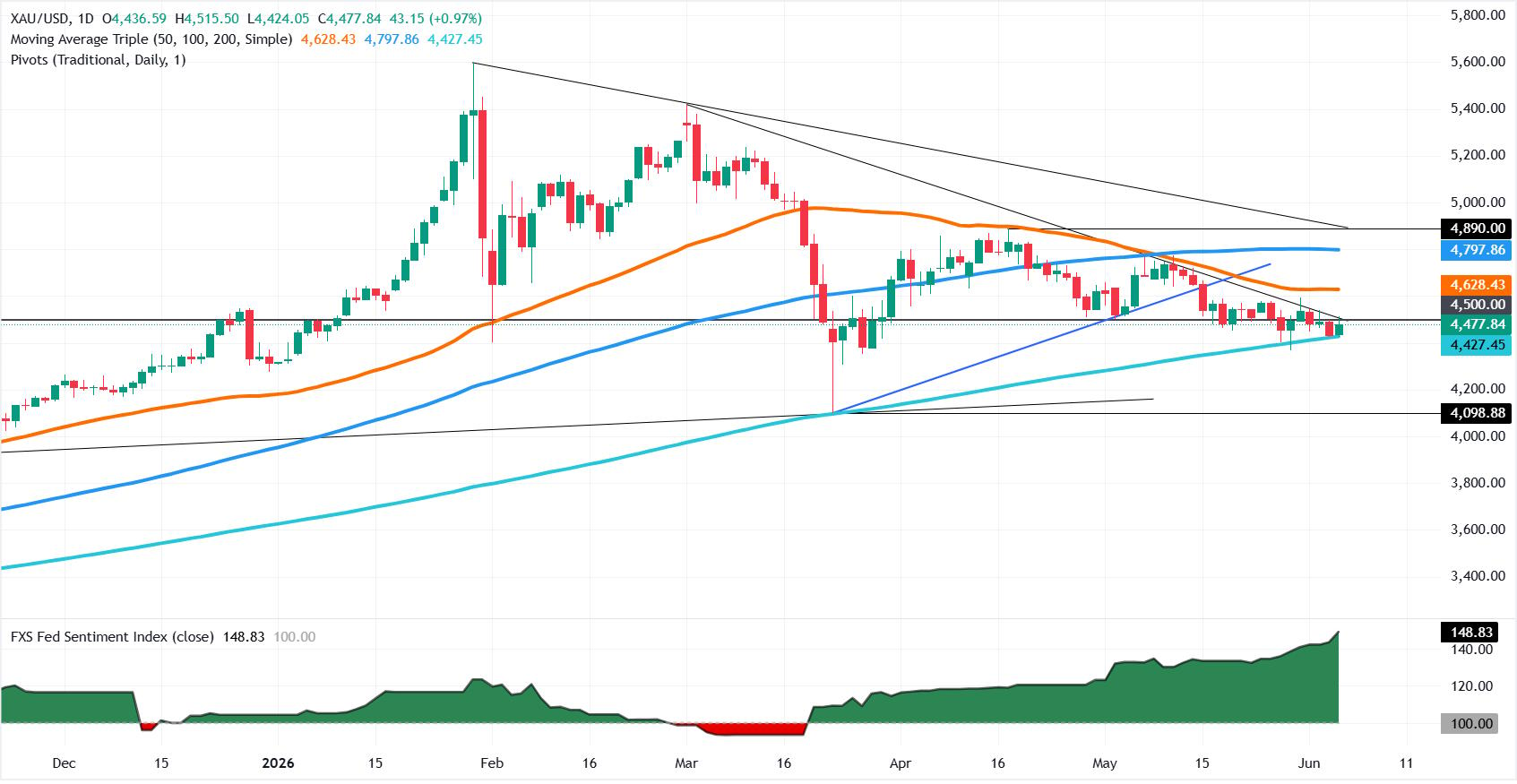
The XAU/USD pair trades at $4,483 after bouncing off daily lows of $4,424.
XAU/USD climbs as weaker Dollar and yields support bullion
Market sentiment is mixed as investors rotate from technology-driven stocks into other sectors, while the Dow Jones Industrial Average is poised to reach record highs. In the precious metals segment, the yellow metal advances amid uncertainty over the Middle East conflict, as hostilities continued even though Israel and Lebanon reached a ceasefire agreement. Nevertheless, Hezbollah—an Iran-backed militia—rejected the deal, troubling the path for a resolution of the US-Iran conflict.
Despite this, Oil prices are plummeting more than 4% in the day, tempering worries that high energy prices could trigger a spike in inflation.
The US Dollar Index (DXY), which measures the buck’s value against a basket of six currencies, is down 0.21% to 99.34.
US Treasury yields are falling as well, with the 10-year benchmark note yielding 4.463%, down three basis points, even though there’s less optimism about a resolution to the Middle East conflict.
In the meantime, Federal Reserve (Fed) officials are crossing the wires, with the Kansas City Fed Jeffrey Schmid saying that “inflation is too high”, adding that it’s the biggest risk that the US economy is facing, and that the question is “whether the Fed should stay patient on rates,” or act.
His colleague, San Francisco Fed Mary Daly, said that AI is not driving inflation up or down, adding that policy is in good shape.
US jobs data were weaker than expected. Initial Jobless Claims for the week ending May 30 were 225K, higher than the predicted 213K, and up from a revised 212K the week before. The 4-week average is 214.75K, about 5K above the previous 208.25K. May's Challenger Job Cuts increased from 83.387K to 97.006K, with nearly 39% in the tech sector, a 16% rise from April.
Although the data is not supportive of the US Dollar, the labor market remains stable as traders await Friday’s May Nonfarm Payrolls report, which is expected to show an increase of 85K jobs and an Unemployment Rate steady at 4.3%.
XAU/USD technical outlook: Gold bounces near the 200-day SMA, still bearish
From a technical standpoint, Gold is holding above the 200-day Simple Moving Average (SMA) at $4,427, which, if broken, could open the door to further downside.
The Relative Strength Index (RSI) suggests that XAU/USD could continue its bearish run past the 200-day SMA, but the index is aiming higher, an indication that buyers are gaining some momentum.
If XAU/USD ends the day above $4,500, it could open the door to challenging strong resistance at the 20-day SMA at $4,562. Once cleared, the next stop is $4,600 ahead of the 50-day SMA at $4,628 and the 100-day SMA at $4,797.
On the flip side, if Gold stays below $4,500, the path of least resistance would be downwards. The first support would be the 200-day SMA at $4,427 ahead of the $4,400 psychological figure. Below this level, the next area of interest would be the March 23 swing low of $4,098.
Gold FAQs
Gold has played a key role in human’s history as it has been widely used as a store of value and medium of exchange. Currently, apart from its shine and usage for jewelry, the precious metal is widely seen as a safe-haven asset, meaning that it is considered a good investment during turbulent times. Gold is also widely seen as a hedge against inflation and against depreciating currencies as it doesn’t rely on any specific issuer or government.
Central banks are the biggest Gold holders. In their aim to support their currencies in turbulent times, central banks tend to diversify their reserves and buy Gold to improve the perceived strength of the economy and the currency. High Gold reserves can be a source of trust for a country’s solvency. Central banks added 1,136 tonnes of Gold worth around $70 billion to their reserves in 2022, according to data from the World Gold Council. This is the highest yearly purchase since records began. Central banks from emerging economies such as China, India and Turkey are quickly increasing their Gold reserves.
Gold has an inverse correlation with the US Dollar and US Treasuries, which are both major reserve and safe-haven assets. When the Dollar depreciates, Gold tends to rise, enabling investors and central banks to diversify their assets in turbulent times. Gold is also inversely correlated with risk assets. A rally in the stock market tends to weaken Gold price, while sell-offs in riskier markets tend to favor the precious metal.
The price can move due to a wide range of factors. Geopolitical instability or fears of a deep recession can quickly make Gold price escalate due to its safe-haven status. As a yield-less asset, Gold tends to rise with lower interest rates, while higher cost of money usually weighs down on the yellow metal. Still, most moves depend on how the US Dollar (USD) behaves as the asset is priced in dollars (XAU/USD). A strong Dollar tends to keep the price of Gold controlled, whereas a weaker Dollar is likely to push Gold prices up.
Author

Christian Borjon Valencia
FXStreet
Markets analyst, news editor, and trading instructor with over 14 years of experience across FX, commodities, US equity indices, and global macro markets.