UnitedHealth Group plunges 17% as Justice Department opens Medicare fraud probe
- UNH stock sinks 17% after a Wall Street Journal article.
- The Journal alleges that Justice Department fraud investigators are close to charging the company.
- US Retail Sales for April rise just 0.1% MoM.
- UNH stock sinks to $253, a five-year low.

UPDATED: When it rains, it pours, folks! UnitedHealth Group (UNH) stock is facing its fourth single-session sell-off exceeding 5% in a month on Thursday after the US Justice Department opened a criminal fraud investigation against the nation's largest private health insurer.
UNH stock is trading about 17.5% lower on Thursday morning, while its primary index, the Dow Jones Industrial Average (DJIA), sheds some recent gains in light of slowing consumer spending.
US Retail Sales for April were released early Thursday, and they show a sharp reduction in spending power. The topline figure showed 0.1% growth on a monthly basis, which was technically better than the 0.0% expectation, but was down from the revised 1.4% monthly gain seen in March. The US Retail Sales Control Group arrived at -0.2% compared with March's 0.5%.
Additionally, in the company's quarterly earnings call, Walmart (WMT) CEO Doug McMillon told analysts that the magnitude of cost increases from suppliers owing to the Trump administration's tariff policy would lead to higher prices for consumers.
UnitedHealth Group stock news
The Wall Street Journal published a story late Wednesday concerning the Department of Justice (DOJ) opening a probe of UnitedHealth's Medicare Advantage business. Medicare Advantage is the privately-managed healthcare program for US seniors that is funded by the US government's Medicare platform. UnitedHealth has the largest Medicare Advantage program in the country, with more than 8.2 million enrollees and manages roughly ~30% of all Medicaid Advantage plans.
The details of the probe were sparse, and the DOJ has remained mum about its investigation thus far, but the news follows earlier reporting from the Journal in February that claimed UnitedHealth was adding "questionable diagnoses" to members' medical records in order to claim higher Medicare payouts.
UnitedHealth denied the allegation at the time, and on Thursday a UnitedHealth spokesperson said that the company had not been notified by the government about any criminal investigation.
It's awful timing for the company, coming in the same week as it replaced its CEO with board chair and former CEO Stephen Hemsley. UnitedHealth Group is also being sued by shareholders for allegedly failing to disclose adverse business effects following the fallout from the murder of former UnitedHealthcare CEO Brian Thompson in December 2024.
Additionally, the healthcare company suspended its 2025 guidance earlier this week as healthcare costs have continued to trend higher, particularly in its Medicare Advantage plans. In the first quarter, the medical care ratio rose to 84.8% compared to 84.3% one year earlier.
UnitedHealth Group stock forecast
UNH stock has now fallen ~59% off its all-time high from November 11, 2024 near $630. After losing the 161.8% Fibonacci Extension at $313.19, the next point of support comes at $197.78 (the 261.8% Fibo), still fairly distant from the $258 but not impossible.
Analysts' price targets caved dramatically earlier this week after the guidance suspension, but most analysts kept them between $350 and $400.
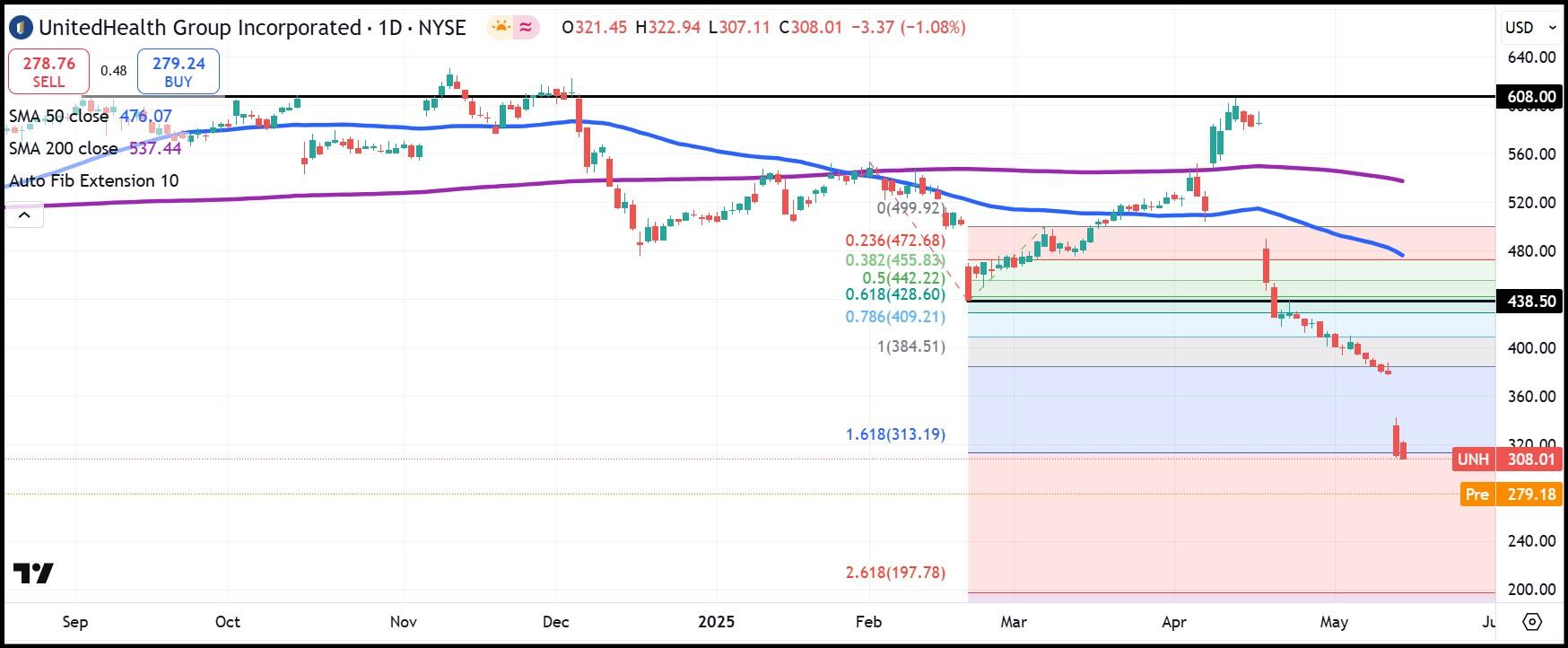
UNH daily stock chart
This is untrammeled territory for most UnitedHealth investors, who have counted on UNH as one of their most trusted dividend growth plays. The stock company has raised its dividend for 15 consecutive years, more than 14% on average over the past five years, but finds itself trading at a five-year low. It last traded at $253 in April 2020 during the covid scare.
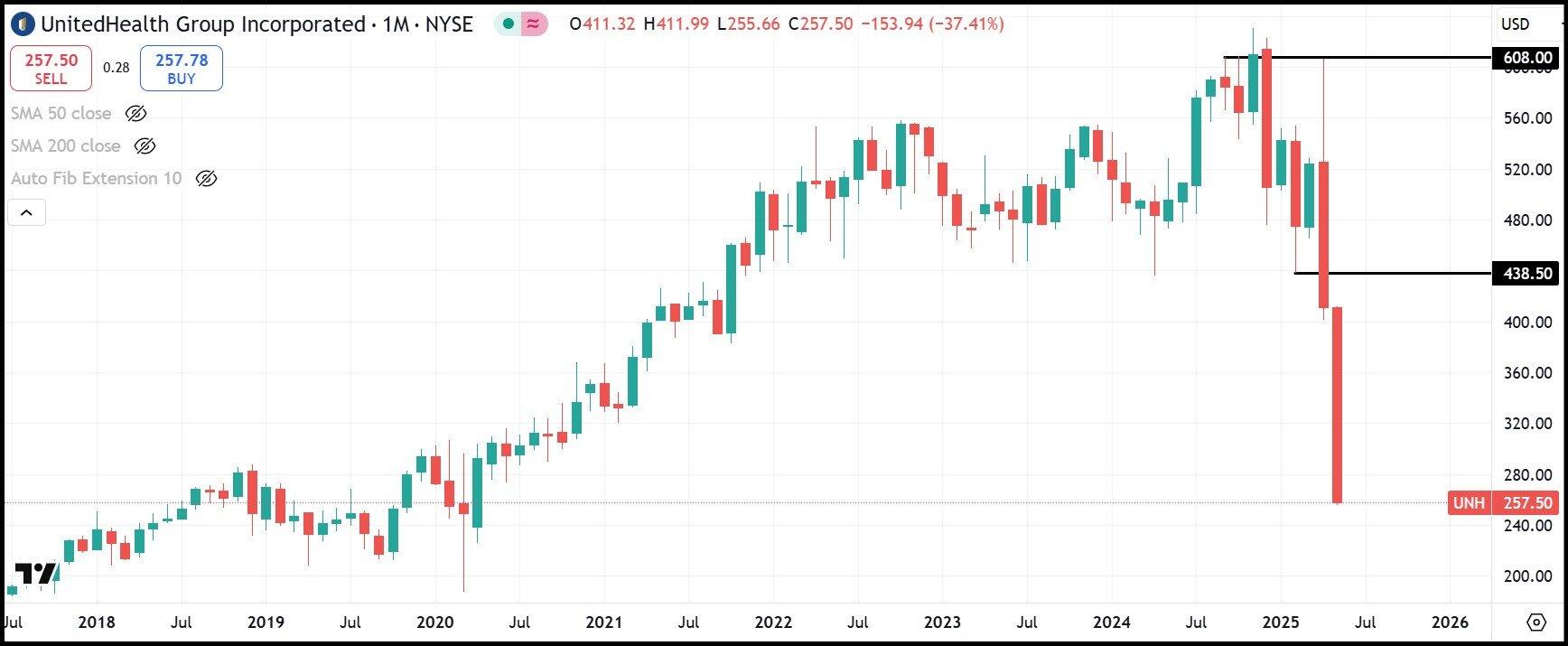
UNH monthly stock chart
Author

Clay Webster
FXStreet
Clay Webster grew up in the US outside Buffalo, New York and Lancaster, Pennsylvania. He began investing after college following the 2008 financial crisis.

















