United Kingdom Forex today: British Pound ahead of Retail Sales

The British Pound (GBP) falls slightly against the US Dollar (USD) at the time of writing on Thursday, to around 1.3430 (-0.1%), after several sessions of high volatility in the United Kingdom’s (UK) Bond market.
Traders are now awaiting Friday’s official UK Retail Sales figures from the Office for National Statistics (ONS) for August, a key indicator for gauging the health of British consumption, which is set to be released at 06:00 GMT.
This data will be decisive for the direction of the currency, especially as it comes after eleven consecutive months of falling sales volumes reported by the Confederation of British Industry (CBI), pointing to a sector in serious difficulty.
Against this backdrop, the GBP in the Forex today is poised between a resilience fuelled by the rate differential between the Bank of England (BoE) and other central banks, and persistent concerns over domestic demand.
GBP/USD technical analysis
According to the 1-hour chart, the GBP/USD pair has been in a downtrend since peaking at 1.3590 on August 14, and trades within a descending channel below its 200-hour Simple Moving Average (SMA), confirming its short-term bearish bias.
Note that the recent rebound from the 1.3340 area is finding resistance at 1.3460, just below the 200-hour moving average currently at 1.3472. A breach of this resistance zone could then encourage a more significant upward movement to the upper boundary of the descending channel pattern near 1.3540.
Conversely, a return below support at 1.3420 could encourage a sharper short-term decline.
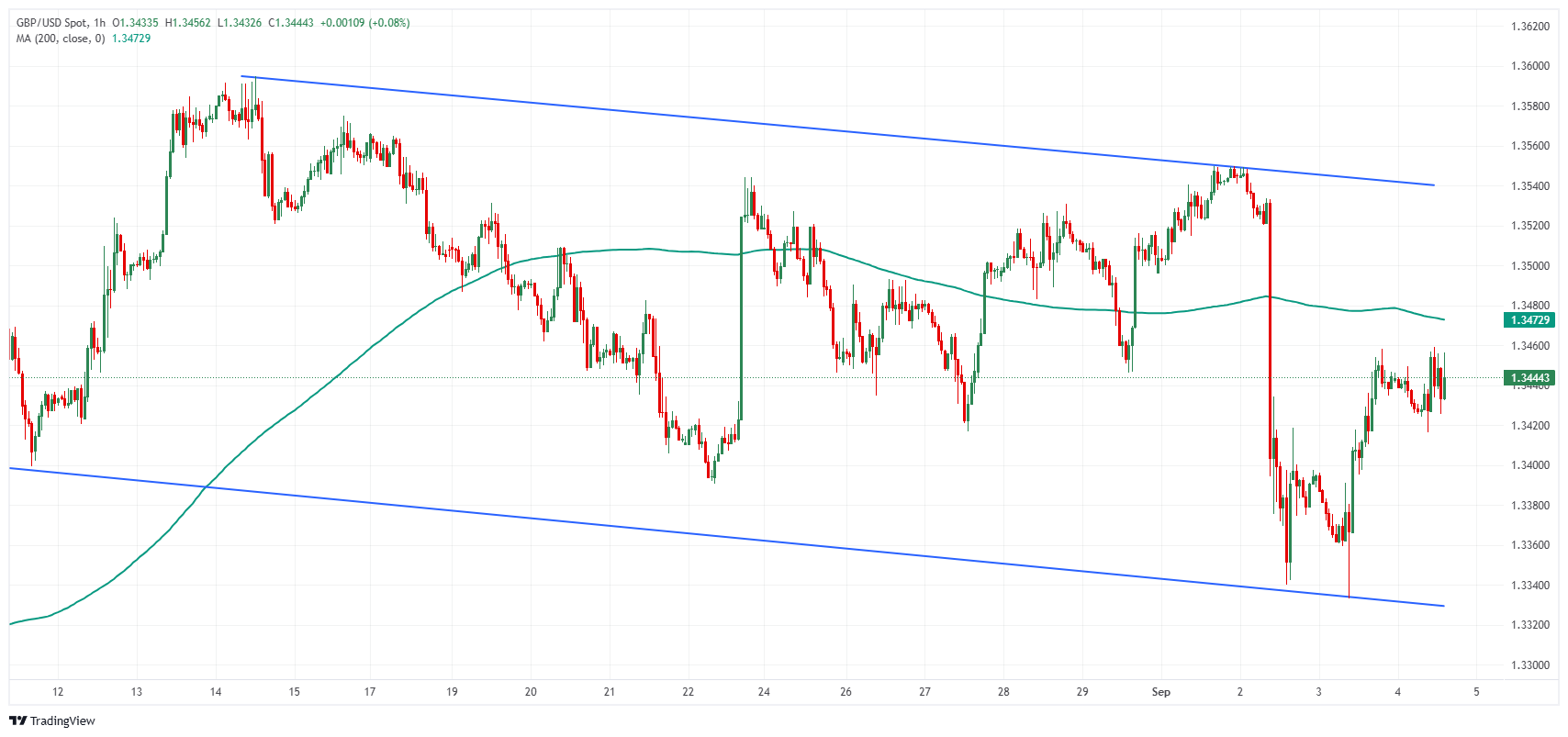
GBP/USD 1-hour chart. Source: FXStreet
Friday's retail sales data could then offer a catalyst for GBP/USD, on both the upside and the downside.
Pound Sterling Price Today
The table below shows the percentage change of British Pound (GBP) against listed major currencies today. British Pound was the strongest against the Australian Dollar.
| USD | EUR | GBP | JPY | CAD | AUD | NZD | CHF | |
|---|---|---|---|---|---|---|---|---|
| USD | 0.17% | 0.07% | 0.28% | 0.19% | 0.36% | 0.36% | 0.26% | |
| EUR | -0.17% | -0.08% | 0.14% | 0.03% | 0.27% | 0.20% | 0.05% | |
| GBP | -0.07% | 0.08% | 0.32% | 0.11% | 0.34% | 0.30% | 0.14% | |
| JPY | -0.28% | -0.14% | -0.32% | -0.15% | -0.05% | 0.06% | -0.07% | |
| CAD | -0.19% | -0.03% | -0.11% | 0.15% | 0.14% | 0.18% | 0.03% | |
| AUD | -0.36% | -0.27% | -0.34% | 0.05% | -0.14% | -0.06% | -0.20% | |
| NZD | -0.36% | -0.20% | -0.30% | -0.06% | -0.18% | 0.06% | -0.11% | |
| CHF | -0.26% | -0.05% | -0.14% | 0.07% | -0.03% | 0.20% | 0.11% |
The heat map shows percentage changes of major currencies against each other. The base currency is picked from the left column, while the quote currency is picked from the top row. For example, if you pick the British Pound from the left column and move along the horizontal line to the US Dollar, the percentage change displayed in the box will represent GBP (base)/USD (quote).
UK Consumption under pressure
UK Retail Sales are an essential barometer of the economy, accounting for a large share of business activity. After a solid rebound in June (+0.9% MoM), economists are expecting a marked slowdown in July, with growth limited to 0.2% MoM and 1.3% YoY.
Excluding fuels, growth is expected to reach 0.4% MoM and 1.2% YoY, according to forecasts compiled by analysts.
For TD Securities, this moderation reflects contrasting dynamics: "Warm weather has supported food and fuel sales, but the slowdown in summer footfall in clothing and household goods stores should bring growth back to a more modest pace", explain the bank's economists.
At the same time, advanced data from the CBI point to an even more fragile situation. In August, the employers' organization reported a -32% drop in sales volumes, the eleventh consecutive month of decline.
Martin Sartorius, CBI Principal Economist, said: "Retailers endured another tough month in August, with annual sales volumes falling for the eleventh consecutive month."
"Weak demand and higher labour costs continue to put pressure on margins, dampening sentiment across the retail and wider distribution sector. This downbeat outlook is reflected in firms' plans to scale back investment and hiring," Sartorius added.
Macro environment and monetary policy
While domestic consumption is a cause for concern, the Sterling's momentum also remains dictated by the Bank of England’s monetary policy.
BoE Governor Andrew Bailey recently stressed that "the risk of persistent inflation has increased", reports Reuters, justifying a more cautious tone on possible rate cuts. This stance has helped limit expectations of rapid policy easing, providing partial support for the currency.
However, fiscal uncertainties continue to weigh heavily. Yields on 30-year Gilts reached their highest level since 1998 (5.75%) on Tuesday, fuelling doubts about the sustainability of public finances.
"These fiscal concerns are once again becoming a determining factor in the Pound's performance," points out Lee Hardman, FX analyst at MUFG.
For their part, Scotiabank's strategists note that the market is "regaining some calm after the bond storm", but warn that "the road ahead remains fraught with pitfalls as the autumn budget approaches".
In the short term, the outcome will largely depend on the ONS Retail Sales figures. A better-than-expected figure would support the view that consumption remains resilient, and could give the Pound a boost. Conversely, a disappointing figure would reinforce the perception of a flagging economy, risking renewed selling pressure.
In the meantime, the GBP is on a slippery slope. As ING's Francesco Pesole sums up: "The Pound will remain hard to attract in the months ahead, with a downward bias as long as the budget debate and consumer uncertainties dominate."
Author

Ghiles Guezout
FXStreet
Ghiles Guezout is a Market Analyst with a strong background in stock market investments, trading, and cryptocurrencies. He combines fundamental and technical analysis skills to identify market opportunities.














