|

TTCF Stock Price: Tattooed Chef Inc readies for a breakout as new vegan options hit mainstream

  • NASDAQ:TTCF gains 6.27% as it breaks out of a recent lull.
  • The popularity of prepared meals continues to grow as the COVID-19 quarantine rolls on.
  • On its recent investor call, TTCF believes it can reach $1 billion in revenue by 2026. 

NASDAQ:TTCF has continued to see positive action to start 2021 as the stock recovers from a Kerrisdale short report that came out in November of 2020. That report caused shares to drop below $15 heading into December but on Tuesday, Tattooed Chef closed the trading session up 6.27% at $25.44. The recent surge has brought the stock well above its 50-day and 200-day moving averages and technical analysis fans are noting the recovery is forming a nice classic cup and handle pattern which could translate to increased momentum in the near future. 

Tattooed Chef has been capitalizing on the recent COVID-19 quarantine as the popularity of prepared meals and meal kit services has exploded. With many people continuing to work from their homes and the restaurant industry either closed or not widely available, companies like Tattooed Chef and Blue Apron (NYSE:APRN) have taken advantage. Tattooed Chef has recently unveiled new vegan-friendly meals and desserts to accommodate the growing number of people on plant-based diets. Perhaps surprisingly, Tattooed Chef is looking to manufacture its own line of plant-based meat alternatives and not use popular brands like Impossible Foods or Beyond Meat (NASDAQ:BYND). 

Tattooed Chef stock forecast
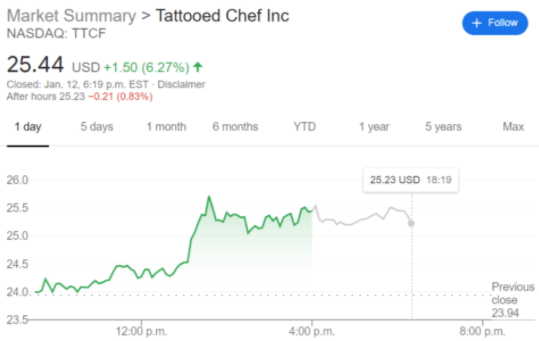
TTCF stock price chart

Prepared meals and food services is a tricky business to be in and it could be a while until Tattooed Chef sees profitability. On its recent investor call, the figure of $1 billion in revenue by the year 2026 was floated around, but the company will need to continue to add variety to its meal offerings and products if it wants to stay competitive. 

Author

More from Stocks Reporter
Share:

Editor's Picks

GBP/USD remains offered; bears target 1.3600

GBP/USD now leaves behind part of its recent recovery and revisits the low 1.3600s at the beginning of the week. Indeed, Cable trades with a mild downward bias amid decent gains in the Greenback as investors remain wary of upcoming US data releases and the Jackson Hole event.

EUR/USD remains sidelined above 1.1650

EUR/USD trades on the defensive following the closing bell on Wall Street on Monday, hovering around the 1.1660 region and adding to Friday’s small decline. The pair’s pullback comes in response to an acceptable rebound in the US Dollar in a context of generalised caution ahead of key US data releases and Chair Warsh’s speech in Jackson Hole.

Gold advances to over three-month high as bulls look to reclaim $4,700

Gold climbs to a fresh high since mid-May, with bulls now eyeing $4,700 and extending the rally witnessed since the beginning of this month. The US Treasury's bond market intervention failure fuels concerns about fiscal sustainability and boosts demand for bullion as an alternative store of value. Moreover, the US Dollar struggles to attract any meaningful buyers, which, along with receding bets for an immediate Fed rate hike, continues to benefit the non-yielding yellow metal.

XRP surged 72%, but is the rally really about XRP?
Ripple (XRP) surged more than 72% in less than a week, its strongest rally since July 2025, as cryptocurrency prices broadly broke out. But the move has a problem: it may have little to do with XRP itself. The token's near-term rally appears to have been driven largely by a broader liquidity shift after the US Treasury expanded long-end bond buybacks, pulling yields lower and lifting risk assets.
Convulsion in credit markets
The United States government just posted a $432.3 billion deficit for July, the largest monthly shortfall since March of 2021. That single burst of red ink pushed the yeartodate deficit to $1.8 trillion, with two months still remaining in fiscal 2026. At this pace, Washington will soon wax nostalgic for the “good old days” when annual deficits were only $2 trillion.
$20 billion offered, $2 billion taken: Why Treasury doubled its buyback cap

The US Treasury moved off its own calendar on Wednesday, and that is the part worth sitting with. At 12:32 GMT, the department said it would at least double the size of liquidity support buyback operations in the 10-year to 20-year and 20-year to 30-year sectors, lifting the maximum from $2 billion per operation to at least $4 billion, effective September 9 and running to November 4.