TSLA Stock Price and Forecast: Will Tesla get the Santa Jay rally or fall to $900?
- Tesla stock rallied on Wednesday as the Fed plays Santa Claus.
- Fed commits to tapering and rate rises but is bullish on the US economy.
- TSLA has been struggling as Elon Musk remains a seller.

Update: Tesla shares opened higher on Thursday as investors piled back into stocks after the Fed gave a bullish commentary on the prospects for the US economy. Tesla (TSLA) was up 0.5% from the open at $980. The short term pivot remains $1,000.
Tesla (TSLA) did rally on Wednesday as the Fed doled out the Christmas presents early to equity investors. A bullish stance taken on the prospects for the US economy, despite tapering and three rate hikes, helped calm investors. Equities duly rallied. The Fed is now foreseen as being at least in touch with the curve rather than behind it, but it was the commentary on the outlook for the US economy that really spurred equity investors to return to risk assets.
While inflation is a problem, at least the Fed has now owned up to that fact and both the Fed and equity investors appear confident that the strength of the US economy going forward will be enough to sustain the stock market for at least another year. That is a view we share. For more detail on our 2022 outlook, see our S&P 500 forecast here.
Tesla did underperform on Wednesday though. The stock rose 1.8% against a gain of 2.4% for the Nasdaq. We at FXStreet have been bearish on Tesla (TSLA) since late November, early December (basically, since Elon followed through on his promise to sell a large portion of his shares). In that time the stock has remained volatile and our call has been difficult to trade around, while the overall direction has worked out. This latest surge of bullishness is definitely testing our short-term target of $900, but we will stick with it for now and explain ourselves below in the forecast.
-637752522926496856.png)
TSLA 1-day chart, % terms
Tesla (TSLA) stock news
Above we can see the effect of Elon Musk's selling on Tesla. The stock is down over 15% and was lower. However, within that period there has been some large snapbacks as volatility remains high. Of course, the selling pressure is not solely down to Elon Musk selling stock. In that time period, we have had Omicron and profit-taking to contend with. Cathie Wood of ARK Invest has been steadily selling and remained a seller on Wednesday. ARK has sold over $3 billion shares in Tesla this quarter, according to Benzinga. They are still long the stock, it should be noted.
Tesla (TSLA) stock forecast
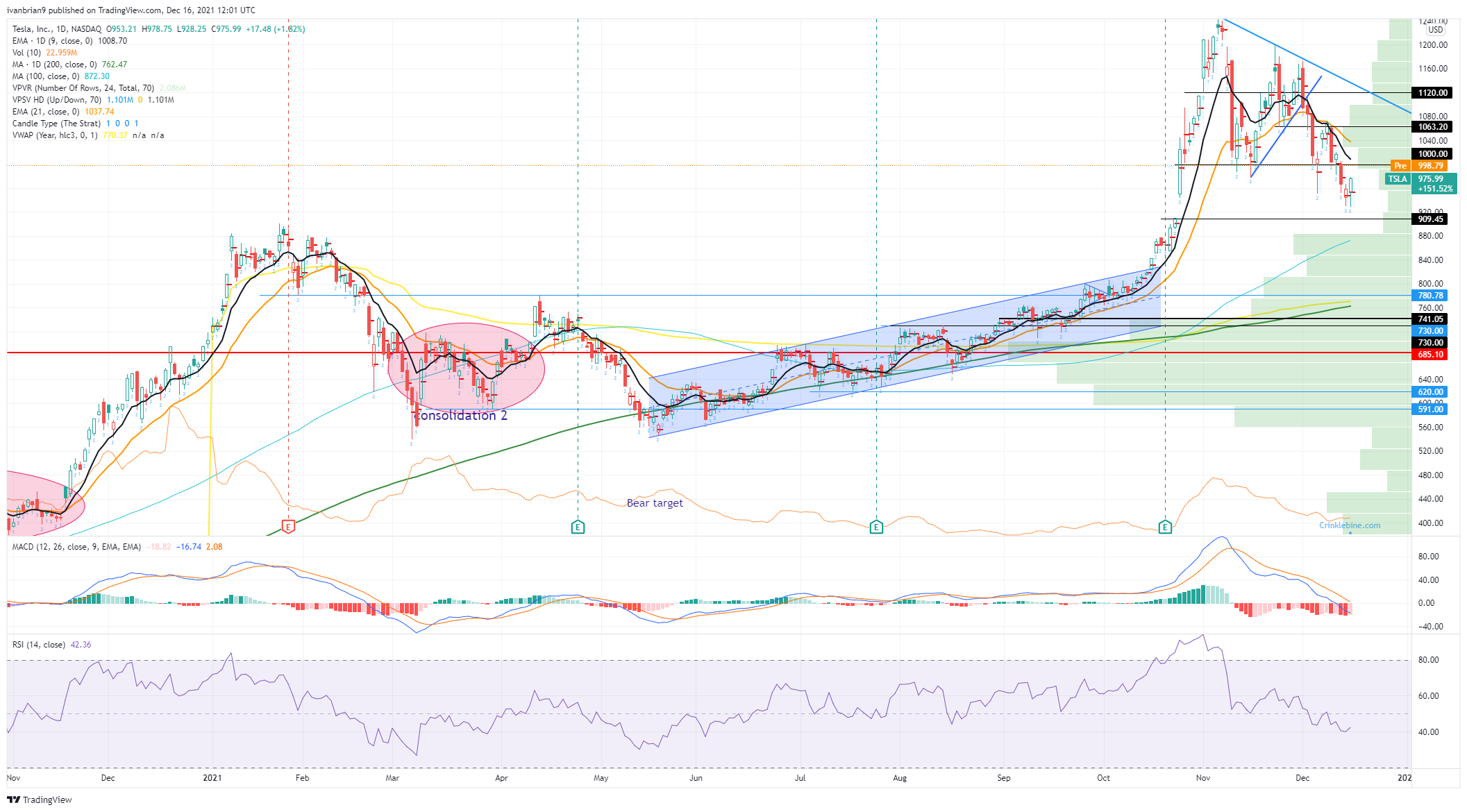
Forecasting further losses against a tide of rising investor optimism into year end is a tricky situation to be in, especially in such a strong momentum name like Tesla. However, that momentum has definitely slowed. Both the Moving Average Convergence Divergence (MACD) and the Relative Strength Index (RSI) have indicated this, in addition to the stock price itself.
Volumes have also been declining, a clearer sign of momentum. Call option volumes have fallen sharply, and this was a major factor in Tesla's Q4 surge. We are sticking to our $900 target for year end despite the Santa Jay rally in place for equities. TSLA has had a stellar year and especially the second half of the year, up 38% year to date and 56% for the second half. Profit-taking is inevitable as evidenced by the CEO himself and ARK Invest among others. $1,000 is now key resistance and pivot for the remainder of this week. Above and we may have to reconsider, but for now the RSI is below 50 and Tesla is below the 9-day moving average at $1,010, so we stick to our target.
TSLA chart, daily
Like this article? Help us with some feedback by answering this survey:
Author

Ivan Brian
FXStreet
Ivan Brian started his career with AIB Bank in corporate finance and then worked for seven years at Baxter. He started as a macro analyst before becoming Head of Research and then CFO.