The Taiwan Dollar is moving erratically again: What's behind its appreciation?


The volatility surrounding the New Taiwan Dollar (TWD) remains extremely high as investors assess trade-related news against the exposure of Taiwan’s life insurance companies’ to US Dollar(USD)-denominated assets. After falling nearly 5% on Thursday, the USD/TWD pair rebounded and was last seen trading near 29.50, losing about 1.5% on the day.
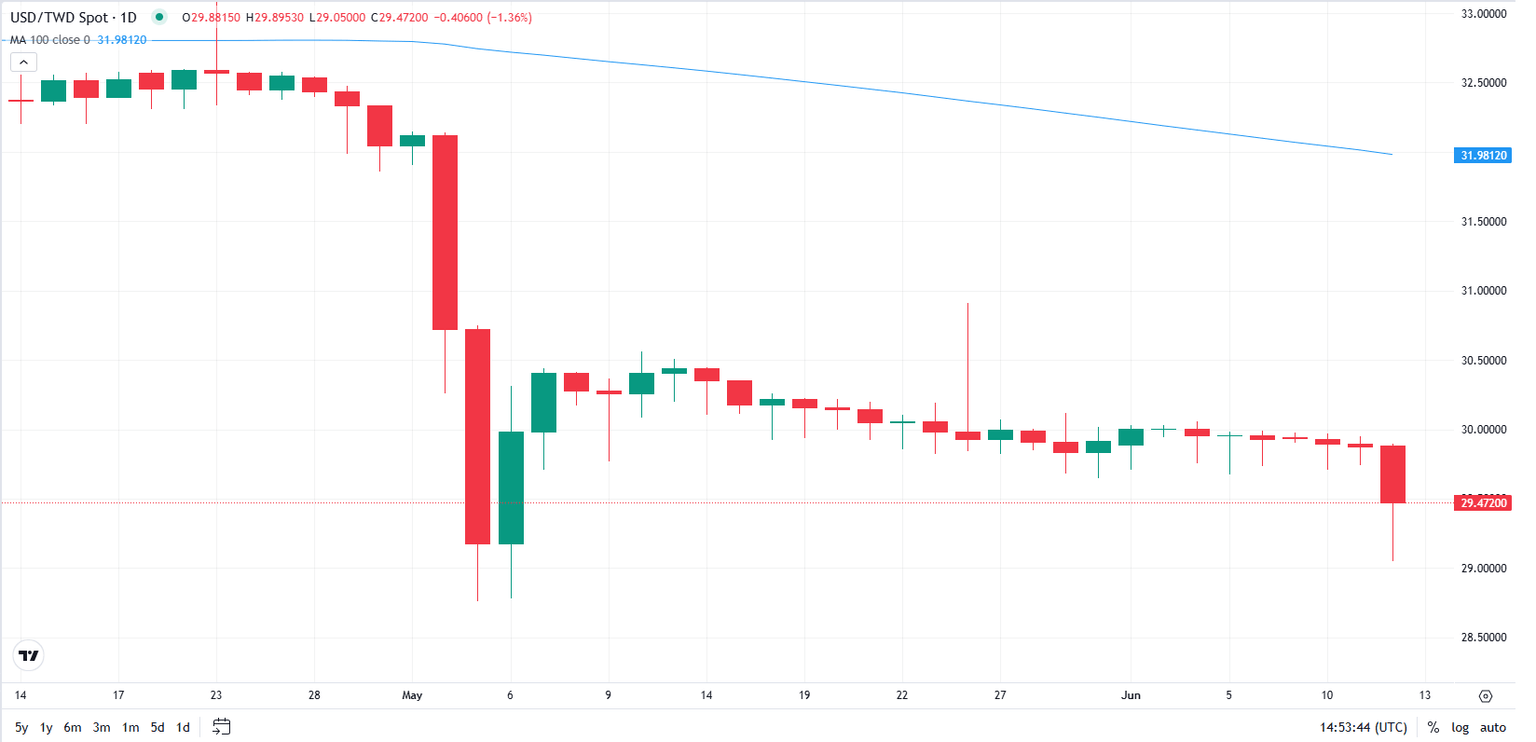
The USD/TWN resumed its downtrend on Thursday. Source: FXStreet.
Such sudden moves are rare for a currency that usually barely attracts headlines: What could the recent surge of the Taiwan Dollar be telling us?
Optimism about trade talks benefits Taiwan
One could think that the move responds to a better outlook regarding tariff talks between the US and China. At the end, the Taiwan Dollar surely benefits from easing trade tensions and the relatively upbeat performance of technology stocks in the US.
This is because Giants such as Apple, Nvidia and Qualcomm rely heavily on semiconductors supplied by the TSMC (Taiwan Semiconductor Manufacturing Company).
Recent inflation data from the US may have also contributed to the strength of the Taiwanese Dollar. Lower-than-expected US inflation data on Wednesday hurt the US Dollar and US Treasury bond yields, leading to capital outflows from the USD and toward, among others, the TWD.
Although the current environment seems advantageous for the Taiwanese economy – and its key chip sector – to continue to expand at a healthy pace, the appreciation of the Taiwan Dollar could have some adverse effects.
The role of Taiwanese life insurers
According to Bloomberg, there is another key factor that could be influencing the market beyond the trade talks: Taiwan’s life insurance companies have more than 90% of their overseas assets denominated in the US Dollar, unlike many other insurers in other countries that diversify their portfolios. This exposure of Taiwan’s insurers puts them under significant threat of financial losses when the Taiwan Dollar appreciates against the USD.
“Taiwan is at the epicenter of this massive dollar long held by institutional investors. With TWD having another large move today, we should be under no doubt that global pension funds and life insurers are watching closely as to how the unwind of this dollar imbalance plays out and what lessons they should be drawing for their own portfolios,” analysts at Deutsche Bank said.
There are few signs that insurers are readying a major overhaul of their investment model given the limited size of the Taiwanese financial market and their dependence on regulatory support when times are tough, Bloomberg wrote.
“That means the sector’s $4 billion currency loss between January and April and some of its biggest players’ worsening earnings woes may only mark the start of more shocks, raising questions of systemic risks to the island’s finances and retirement savings,” it added.
Earlier in May, USD/TWD lost nearly 10% in a two-day span and touched its weakest level in nine months below 28. The pair rose about 6% in the following days as the Governor of the Central Bank of Taiwan noted that they had stepped in to curb what it deemed as “excessive” inflows.
Back then, many speculated that the central bank had negotiated with the US a weakening of the currency as part of negotiations to secure a beneficial trade deal with the Trump administration. Taiwan denied such rumours.
It is currently unclear whether the central bank is intervening in the foreign exchange markets. But investors could be refraining from betting on a further appreciation of the Taiwan Dollar given the risk of getting caught on the wrong foot in case of an intervention.
Author
Eren Sengezer
FXStreet
As an economist at heart, Eren Sengezer specializes in the assessment of the short-term and long-term impacts of macroeconomic data, central bank policies and political developments on financial assets.