|

The Semiconductor index rally continues as planned

In our previous update from June 13th, we found that for the Semiconductor Index (SOX) based on the Elliott Wave (EW) Principle, a local top was due at ideally ~$5420, followed by a minor 4th wave correction (gray Wave iv?) to $5050+/-50 and a fifth wave (gray W-v) to $5745+/-100. See Figure 1A.

The index hit a high of $5311 on June 17, dropped to $5140 on June 23, and then rose to $5588 on June 27. Therefore, since our target zones were only off by up to 2%, the index followed the predicted “up->down->up” pattern, once again showing the strength of the EW. See Figure 1B.

Figure 1. Our preferred short-term EW count with several technical indicators and moving averages
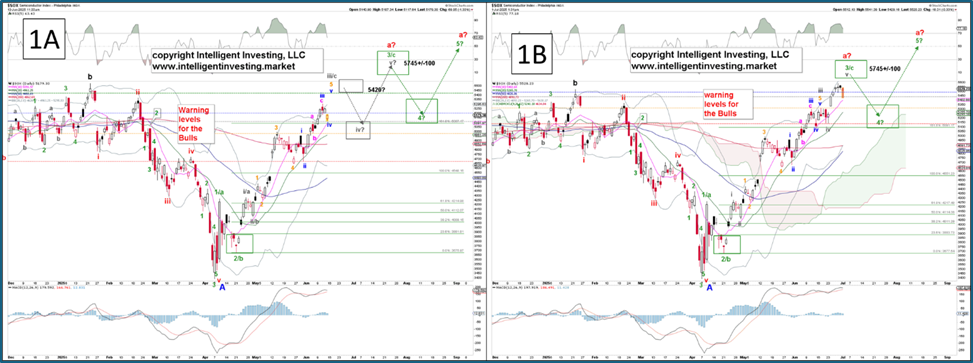
We continually review previous work to ensure that we accurately track the index and prevent it from drifting, which would necessitate adjustments. Forecasting financial markets is like predicting the weather; both are stochastic and probabilistic systems. Therefore, both need adjustments when the data changes. To that extent, we have our colored warning levels. If the index’s price stays above the orange level, there’s no real reason to suspect a, in this case, top. The blue and gray levels tell us to start paying more attention, whereas a drop below the red level guarantees us that a (local) top is in place. These warning levels are raised as the index moves higher, keeping us on the right side of the trade for as long as possible. E.g., compare the colored warning levels in Figure 1A vs. Figure 1B.

In the short term, our preferred EW count suggests that the green W-3/c is likely to complete in the ideal $5,745+/100 target zone over the next few days. The market can then determine whether it will provide us with the green W-4, -5 sequence, or if the larger bounce we have expected since early April has already been finished. Thanks to EW, we will know soon enough, as breakdowns below key price levels, which we have access to, will tell us the green W-5 will not happen.

Author

Dr. Arnout Ter Schure

Dr. Arnout Ter Schure

Intelligent Investing, LLC

After having worked for over ten years within the field of energy and the environment, Dr.

More from Dr. Arnout Ter Schure
Share:

Editor's Picks

GBP/USD corrects lower after testing 1.3400

Following Monday's advance, GBP/USD touched its highest level since mid-June slightly above 1.3400 early Tuesday but lost its bullish momentum. The pair trades marginally lower on the day at around 1.3380 as investors adopt a cautious stance following news of Iran targeting commercial ships attempting to pass through the Strait of Hormuz.

EUR/USD holds above 1.1400 as markets focus on Middle East news

EUR/USD struggles to gain traction and trades in a narrow channel above 1.1400 on Tuesday after failing to reclaim 1.1450. The pair's upside remains capped amid a modest recovery in the safe-haven US Dollar, as renewed tensions in the Strait of Hormuz and Asian tech sell-off fuel risk aversion.

Gold recovers above $4,150 following earlier decline

Gold stages a rebound after dropping toward $4,100 earlier Tuesday and trades above $4,150 in the American session. Crude oil prices edge higher amid renewed tensions in the Strait of Hormuz, reviving inflationary concerns. This, in turn, triggers a fresh leg up in US Treasury bond yields, offering some support to the US Dollar, and making it difficult for the yellow metal to gain traction.

Bonk extends correction after $20 million hack from BonkDAO treasury

Bonk remains under pressure, trading below $0.0000044 after losing over 10% in the previous day. Monday’s correction occurred as Bonk Decentralized Autonomous Organization announced a governance exploit that resulted in the theft of $20 million worth of BONK tokens from its treasury.

Bye, forward guidance: How to trade when central banks choose silence
Central banks have spent years telling markets what might come next. Now, traders face the possibility that they say a lot less. From the Federal Reserve to the European Central Bank and the Bank of England, policymakers are pushing back against forward guidance, arguing that the current world demands more flexibility.
Bye, forward guidance: How to trade when central banks choose silence

Central banks have spent years telling markets what might come next. Now, traders face the possibility that they say a lot less. From the Federal Reserve to the European Central Bank and the Bank of England, policymakers are pushing back against forward guidance.