The Nike rebound is over – Buying opportunity ahead

Key points
-
Nike had a decent quarter, but margin pressure is still present, and the guidance is weak.
-
Analysts support the bull case, but no upgrades or price target increases have emerged.
-
Nike stock could fall 10% or more if support does not step in to buy the post-release dip.
-
5 stocks we like better than NIKE.
Nike (NYSE: NKE) proved again that it can Just Do It when operating in an ever-changing business environment. The Q3 results and guidance prove the company’s resiliency but also give evidence of market shifts that could weigh on the action in the 2nd half of 2023. The most noticeable change is the shift from Wholesale to DTC channels.
That shift was underway before the COVID-19 lockdowns went into effect and were amplified because of them, the stimulus money, and the company’s lean into DTC because of its effectiveness. The offsetting factor is that Wholesale channels continue to weaken, and both DTC and Wholesale deal with markdowns and margin pressure.
Nike had a decent quarter: Shares fall anyway
Nike had a decent quarter, but shares are falling because the margins weakened compared to last year, and the guidance is also soft. The news suggests a top in the business and the stock, which trades at a high 35X its earnings outlook. Nike is worth the premium; it is a leader in the shoe, apparel, and sporting goods markets and pays safe dividends amplified by share repurchases. Still, finding equally safe payouts at lesser valuations in other stocks is possible.
This quarter, the cash flow was also negative, with CAPEX, debt repayments, dividends, and repurchases outpacing cash from ops. That resulted in a 17% decline in the cash balance that may lead to slowing repurchases, debt reductions, and CAPEX in future quarters.
The dividend is worth only 1.2%, with shares near $112, and the distribution is growing, which can be expected to continue. However, the yield is below the market average, which plays into an environment that does not typically produce a market rally.
Nike reported $12.83 billion in revenue, which is good for 4.9% growth compared to last and beat the consensus by $0.250 billion. That’s 200 basis points better than expected, but the strength did not carry through to the bottom line. Strength was driven by DTC channels led by company-owned stores, which grew by 24%.
Digital sales increased by 14% and were offset by a 2% decline in Wholesale. Converse sales also fell by 1.0%. APAC and North America led regionally with growth of 5% each; China contributed 16% in the APAC comparison. Footwear sales, the core business, grew by 7%, led by an 11% gain in Equipment and flat Apparel sales.
The margin news is the bad news in the report. The gross margin contracted by 140 basis points due to supply chain costs and markdowns, while SG&A increased due to various factors, including higher costs and increased overhead. The net result is that net income fell by 28% and GAAP EPS by 27%, 300 basis points more than expected.
The decline in EPS is exceptionally sharp considering the top-line strength, and the guidance for the next quarter is also weak. The company expects growth but is below consensus with tepid margin improvement.
The analysts support the bull case, but
Several analysts have come out supporting the bull case for Nike, but no one has increased a price target or raised a rating. The takeaway is that the sentiment in Nike is pegged at Moderate Buy, but it’s been slipping and is on the verge of Hold. The price target implies 16% of upside, but it was trending lower ahead of the release. That alone is enough to put a cap on the market, and if it trends, lower downward pressure will build.
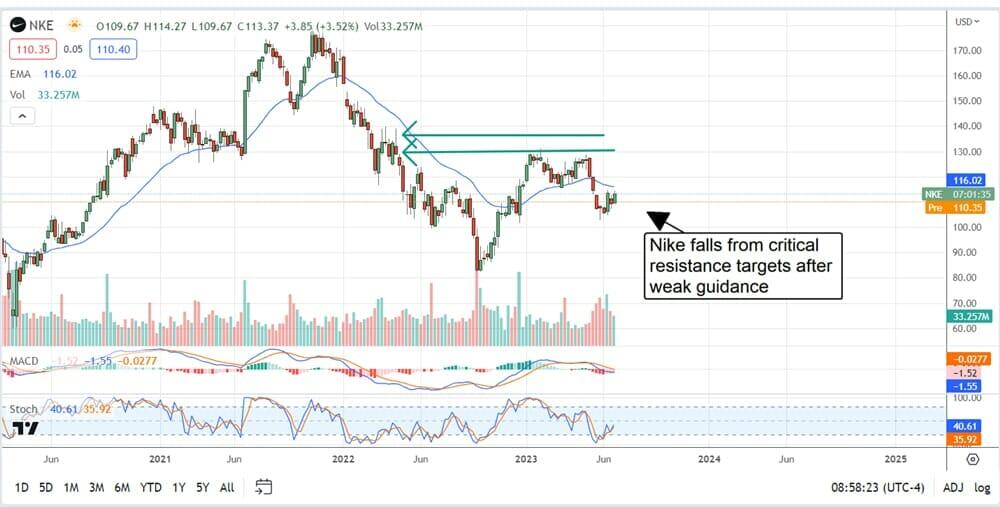
Shares of Nike fell about 3.0% in premarket trading and may move lower. The move confirms resistance at the short-term 30-day moving average and the 150-day EMA, which suggests a downtrend is in play. In this scenario, the stock could fall to $100 or lower, where it would provide a better yield, if not a better value.
Author

Jacob Wolinsky
ValueWalk
Jacob Wolinsky is the founder of ValueWalk, a popular investment site. Prior to founding ValueWalk, Jacob worked as an equity analyst for value research firm and as a freelance writer. He lives in Passaic New Jersey with his wife and four children.
















