The health of the stock market


Let’s continue our theme this week on the health of stock market and who metaphorically “has the ball” – the offense or the defense.
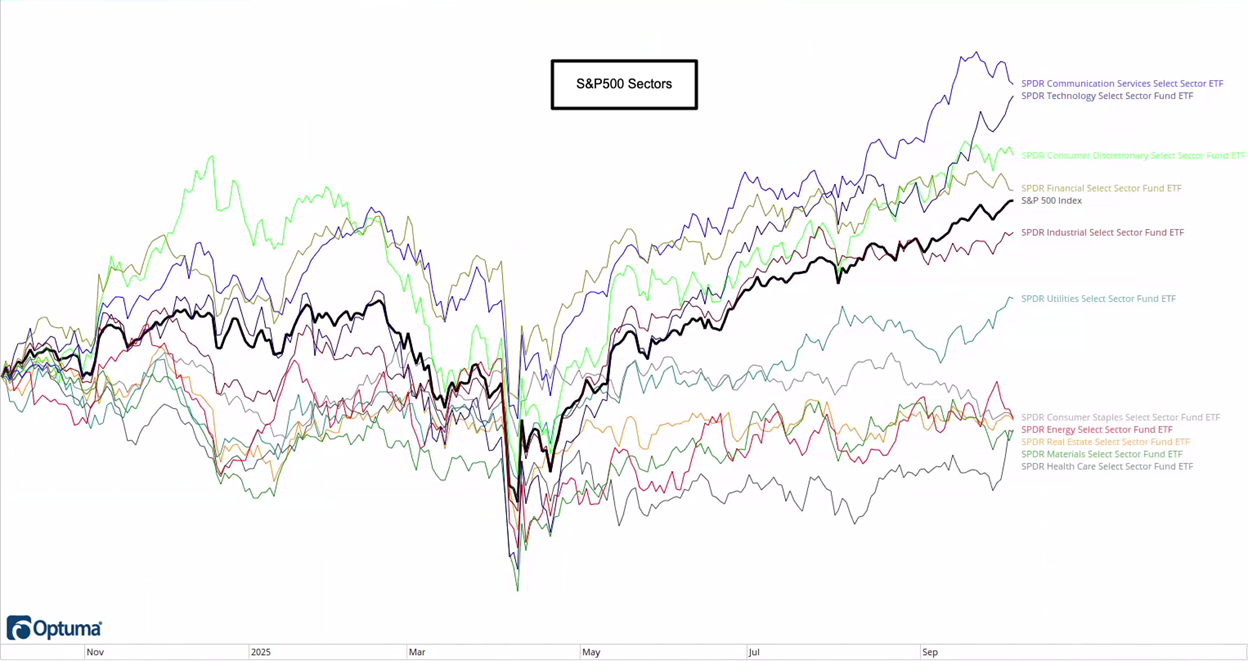
Below is a relative comparison chart where I’ve plotted all of the S&P500 SPDR sectors over the last 12 months.
Notice the sectors that have consistently ranked at the top… offensive sectors:
-
Communications
-
Technology
-
Consumer Discretionary
-
Financials
Next-in-line is the index itself, followed by industrials and then the defensive sectors in utilities, real estate, and consumer staples.
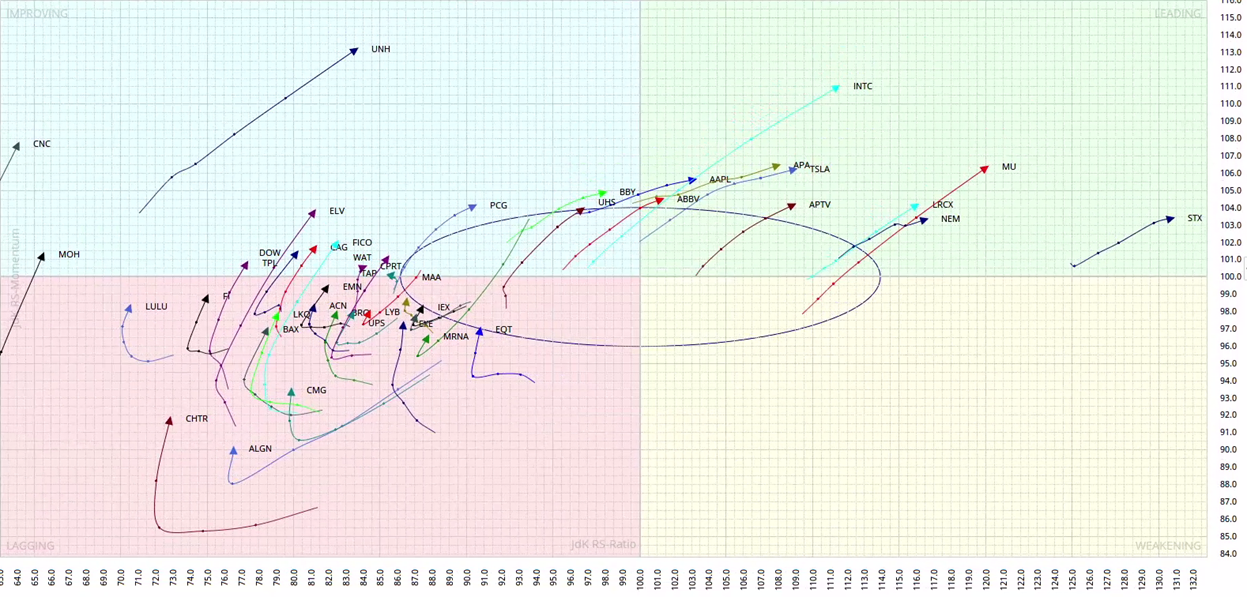
Next, I created a Relative Rotation Graph (RRG), and before we get into the specifics, let’s make sure you understand what you’re looking at here.
RRGs were invented by my good friend Julius de Kempenaer, and while his tool has been available on the Bloomberg terminal since 2011, you can also create your own for free at StockCharts.com, or check out what I personally use – Optuma (the 800 lb gorilla in the technical analysis software world).
Now, let’s learn how it works…
The middle point on the x/y axis is the benchmark – in this case, the S&P500 – and the arrows and stock symbols around it are different stocks within the S&P500.
Then, as far as the four quadrants go, any stocks in the:
-
The lower-left quadrant are lagging vs. the market
-
The upper-left quadrant are improving vs. the market
-
The upper-right quadrant are leading the market
-
The lower-right quadrant are weakening vs. the market
So, there are a nice handful of stocks that are currently leading the market – companies like Apple, AbbVie, Intel, APA, Tesla, Aptiv, Micron, Lam Research, Newmont, and Seagate.
However, while many of these companies could continue to experience growth and high relative strength (RS) that persists over time, it’s actually better to find stocks that are pointing “northeast” and coming out of the lagging quadrant.
If we focus on a few of those stocks, you’d see names like Centene, Molina Healthcare, Texas Pacific Land Corp, Dow, Elevance Health, Conagra, Fair Isaac, Waters, Copart, and Eastman Chemical.
Nerd’s note: The big oval in the middle is a filter that I put on all my RRG charts, and in this case, it’s a 2.0 standard deviation from the middle. Since we’re trying to find investments that out-perform the market, we want to avoid those that are “close to the center,” since the center = the S&P500 and thus, the probability of out-performance is smaller, the closer you get to center.
Lastly, and staying on-brand with RRG charts to finish today’s installment of Investopedia’s Chart Advisor, below is a chart style most have never seen before.
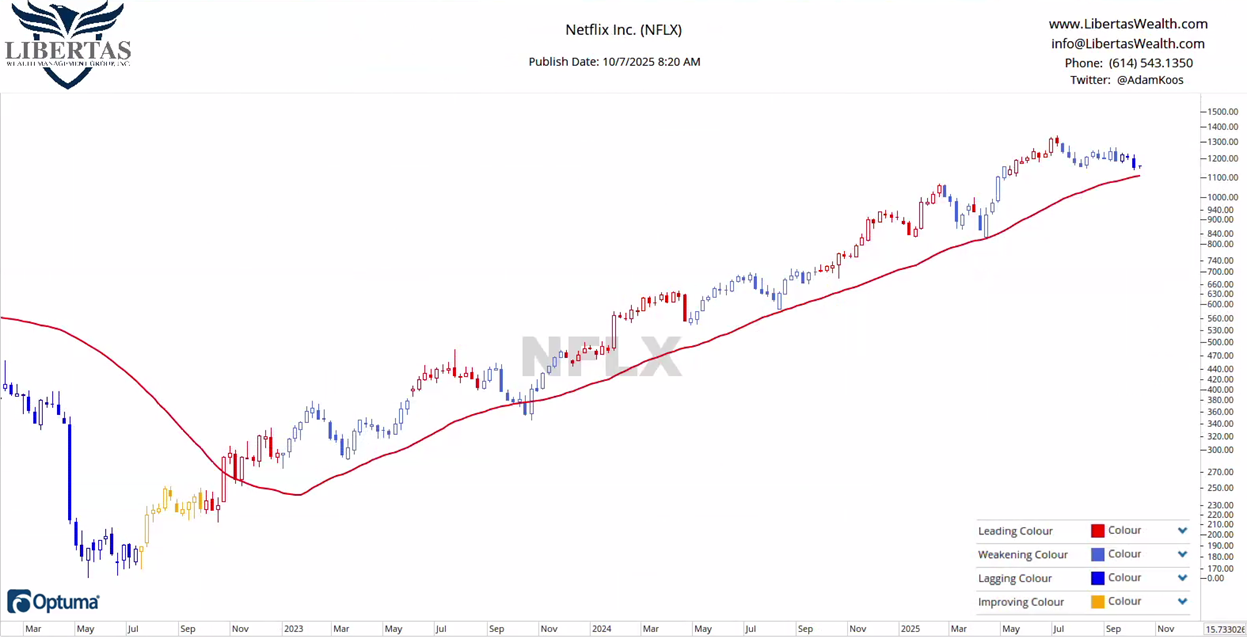
Below is an RRG Quadrant Candlestick Chart, and what I love about this chart style is the fact that you can not only see all the information a traditional candlestick chart tells us, but the colors of the candlesticks represent which RRG quadrant the stock resides in.
I’m colorblind, so one of the many beauties of Optuma is that it’s completely customizable, so while I couldn’t tell you what colors I’ve chosen with any certainty (or a second pair of eyes in my office, perhaps), I’m currently writing this article from my home office, the kids are already on the bus, and my bride is sound asleep, so the best I can do is guess. J
I’ve included a legend in the bottom-right so that you can see which colors I picked for each quadrant, but notice how Netflix was clearly lagging the market during the middle-part of 2022 before basing out in the lagging quadrant, then “warming up” into the improving quadrant, and then finding itself both 1) in the leading quadrant before 2) crossing above its 40-week moving average (40wMA) or in other words, it’s 40-week trendline.
Nerd’s Note: The 40-week moving average on a weekly chart is mathematically the same as a 200-day moving average on a daily chart.
Finally, watch as Netflix continues to trend northward, crossing below its 40wMA only once (in October ’23), but also crossing back and forth between the weakening and leading quadrants over and over again, maintaining its uptrend along the way.
I don’t know about you, but I find this stuff fascinating, and here’s the key… you don’t have to use 20 different chart styles in your own analysis.
Or another pet peeve of mine, which is taking a chart and adding 10 moving averages, 4 momentum indicators, 3 oscillators, Bollinger Bands, and Volume by Price.
Before you know it, the only thing your chart is doing for you is (maybe?) making you look cool in the eyes of people who don’t know any better.
So, if you want to create charts, let alone an investment management or trading system that is easy-to-use, repeatable, and above all – a system that works?
Three words: Keep – it – simple.
Unlock exclusive gold and silver trading signals and updates that most investors don’t see. Join our free newsletter now!
Unlock exclusive gold and silver trading signals and updates that most investors don’t see. Join our free newsletter now!
Author
CMT Association Research Team
CMT Association
The CMT Association is a global credentialing body that has served the financial industry for nearly 50 years.