Tesla, Alphabet stocks slide 1% on Q2 earnings releases
- Tesla stock falls despite hitting EPS consensus in Q2.
- Alphabet stock pulls back after beating on top and bottom lines.
- Tesla free cash flow in Q2 drops by three-fourths.
- Alphabet raises full-year capex by $10 billion.
Both Elon Musk's Tesla (TSLA) and Alphabet (GOOGL) released second-quarter earnings after the close on Wednesday, and traders are treating them much the same. Alphabet stock has lost 1.6% at the time of writing, while TSLA has given up 1.0%.
Neither company had terrible topline results, but the market seemed unenthused to say the least after all three major US indices closed at or near all-time highs. The Dow Jones Industrial Average (DJIA) led gains, advancing 1.14%. The NASDAQ Composite (IXIC) gained 0.61%, and the S&P 500 (SPX) gained 0.78%.
Alphabet earnings news
Alphabet, formerly called Google, earned $2.31 in GAAP earnings per share (EPS), 12 cents above the Wall Street consensus. Revenue of $96.43 billion grew 14% from a year earlier and bested consensus by nearly $2.5 billion.
But the market seemed somewhat worried due to extremely high capex. Alphabet management raised its full-year capex from $75 billion to $85 billion as the artificial intelligence (AI) revolution grows more costly than ever. Google's cloud business is spending heavily on AI chips for its data center buildout.
Cloud revenues grew 32% YoY as earlier capex is leading to surging sales.
"Search delivered double-digit revenue growth, and our new features, like AI Overviews and AIMode, are performing well," said Alphabet CEO Sundar Pichai. "We continue to see strong performance in YouTube as well as subscriptions offerings. And Cloud had strong growth in revenues, backlog and profitability. Its annual revenue run-rate is now more than $50 billion."

GOOGL daily stock chart
Tesla earnings news
Tesla earned $0.40 per share in adjusted EPS, in-line with Wall Street consensus and down from $0.52 in the year ago quarter. Revenue of $22.49 billion fell by 12% YoY but beat consensus by $360 million.
The electric vehicle leader saw capex rise to $2.39 billion in Q2 versus $1.49 billion in the first quarter. Likewise, free cash flow fell to $146 million versus $664 million Q1.
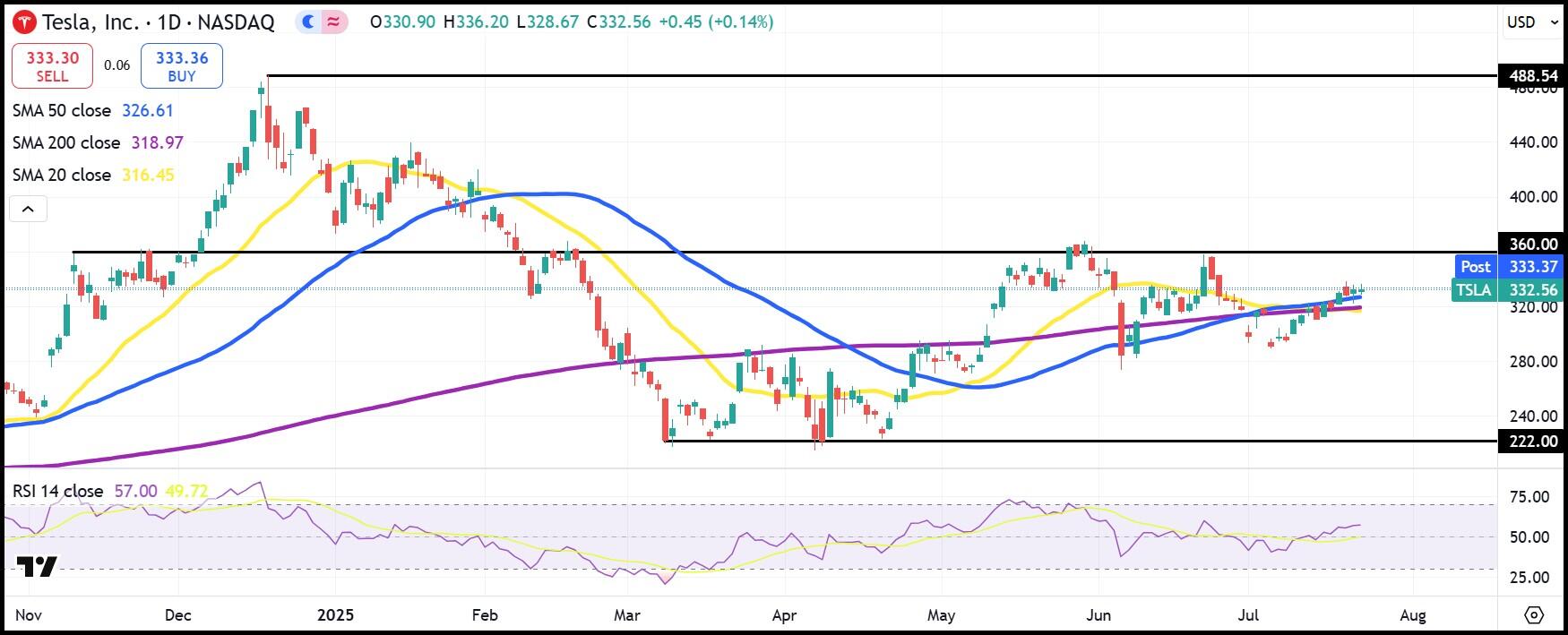
TSLA daily stock chart
Author

Clay Webster
FXStreet
Clay Webster grew up in the US outside Buffalo, New York and Lancaster, Pennsylvania. He began investing after college following the 2008 financial crisis.