|

Taiwan Semiconductor Manufacturing (TSM) riding the impulse wave

Taiwan Semiconductor Manufacturing Co. (NYSE: TSM) operates as the world’s leading semiconductor foundry, powering the global AI and computing evolution. As demand for advanced chips surges, the stock has broken into new high territory, confirming a powerful bullish cycle is now in force.

Today, we decode the Elliott Wave pattern driving this strategic breakout. Furthermore, our analysis provides a clear technical roadmap with specific targets for its continued ascent. The convergence of strong sector momentum and a clear wave structure creates a compelling technical opportunity.

Elliott Wave analysis

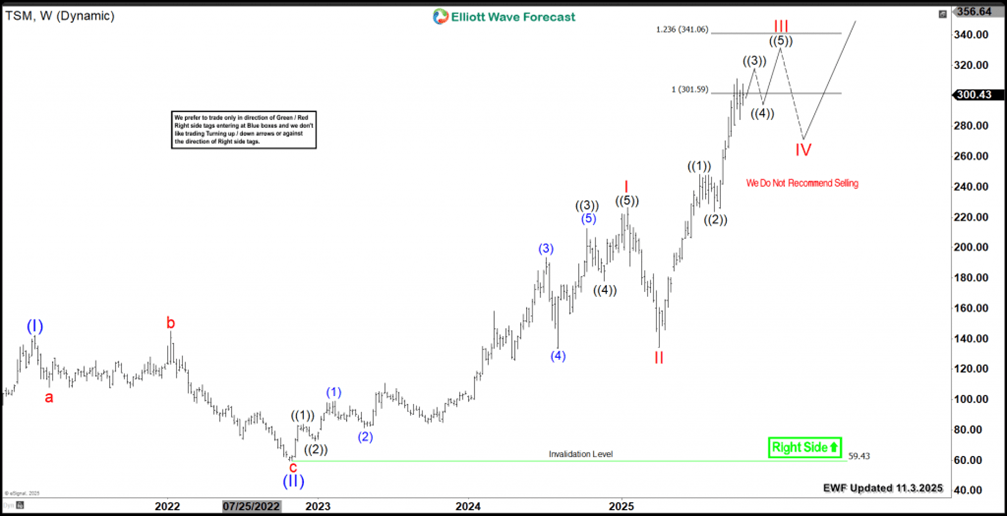
TSM began its rally from the 2022 low, unfolding in a clear three-wave structure. First, wave I peaked at $226.40. Then, wave II pulled back sharply to $134.25. Afterward, the stock surged to new all-time highs, entering wave III. Notably, wave III also displays a three-wave advance, now entering the equal legs zone between $301.59 and $341.06.

At this stage, TSM should see further upside to complete the five-wave sequence of wave III by the end of 2025 or in early Q1 of 2026. After that, a corrective wave IV pullback may follow presenting another buying opportunity. Eventually, the bullish cycle could resume, targeting the 1.618 Fibonacci extension near $404.

TSM weekly chart 10.20.2025
Chart

Conclusion

TSM shows a strong bullish sequence on the weekly chart. Therefore, investors should treat pullbacks as strategic buying opportunities. Use our Elliott Wave strategy to time entries with precision. Enter after the stock completes a 3-, 7-, or 11-swing correction. Moreover, our proprietary Blue Box system highlights high-probability zones with exceptional accuracy. As a result, this disciplined approach offers clarity and confidence to capture the next bullish leg.

Author

Elliott Wave Forecast Team

Elliott Wave Forecast Team

ElliottWave-Forecast.com

More from Elliott Wave Forecast Team
Share:

Markets move fast. We move first.

Orange Juice Newsletter brings you expert driven insights - not headlines. Every day on your inbox.

By subscribing you agree to our Terms and conditions.

Editor's Picks

EUR/USD rebounds after falling toward 1.1700

EUR/USD gains traction and trades above 1.1730 in the American session, looking to end the week virtually unchanged. The bullish opening in Wall Street makes it difficult for the US Dollar to preserve its recovery momentum and helps the pair rebound heading into the weekend.

GBP/USD steadies below 1.3400 as traders assess BoE policy outlook

Following Thursday's volatile session, GBP/USD moves sideways below 1.3400 on Friday. Investors reassess the Bank of England's policy oıtlook after the MPC decided to cut the interest rate by 25 bps by a slim margin. Meanwhile, the improving risk mood helps the pair hold its ground.

Gold stays below $4,350, looks to post small weekly gains

Gold struggles to gather recovery momentum and stays below $4,350 in the second half of the day on Friday, as the benchmark 10-year US Treasury bond yield edges higher. Nevertheless, the precious metal remains on track to end the week with modest gains as markets gear up for the holiday season.

Crypto Today: Bitcoin, Ethereum, XRP rebound amid bearish market conditions

Bitcoin (BTC) is edging higher, trading above $88,000 at the time of writing on Monday. Altcoins, including Ethereum (ETH) and Ripple (XRP), are following in BTC’s footsteps, experiencing relief rebounds following a volatile week.

How much can one month of soft inflation change the Fed’s mind?

One month of softer inflation data is rarely enough to shift Federal Reserve policy on its own, but in a market highly sensitive to every data point, even a single reading can reshape expectations. November’s inflation report offered a welcome sign of cooling price pressures. 

XRP rebounds amid ETF inflows and declining retail demand demand

XRP rebounds as bulls target a short-term breakout above $2.00 on Friday. XRP ETFs record the highest inflow since December 8, signaling growing institutional appetite.














