Swiss Franc trades steady ahead of SNB meeting on Thursday
- The Swiss Franc trades little changed ahead of the Swiss National Bank meeting on Thursday.
- Markets are pricing in a 29% probability of the SNB cutting interest rates.
- The technical picture shows a box range forming on the 4-hour chart.

The Swiss Franc (CHF) little changed at the start of the week, off a few hundredths of a percent in its most heavily traded pairs at the time of publication.
Swiss Franc traders are awaiting the big event of the week, the Swiss National Bank (SNB) March policy meeting on Thursday.
The probability of the SNB trimming its 1.75% policy at the meeting lies at 29%, according to Reuters. If it were to cut rates the Swiss Franc would weaken, as lower interest rates attract less foreign capital inflows.
Swiss Franc vulnerable due to lower inflation
The latest inflation data from Switzerland showed a fall in the Consumer Price Index (CPI) in February to 1.2% YoY from 1.3% in the previous month, according to the Federal Statistical Office.
Overall this is lower than the SNB expected back at its December meeting, when it said inflation, which was then at 1.4%, was likely to “increase somewhat in the coming months due to higher electricity prices and rents, as well as the rise in VAT.”
The SNB estimates inflation to average 1.9% in 2024. However, the rate of inflation is currently considerably below that figure at 1.2% – though on a monthly basis the CPI did rise 0.6% in February from 0.2% previously.
Inflation is also well below the SNB’s first-quarter forecast of 1.8%.
"Consumer price inflation is running 0.6 ppts below the bank's 1.8% first-quarter forecast, while core inflation of 1.1% is the lowest since January 2022," Reuters reports.
The Zurich-based institution will also publish a new set of medium-term inflation forecasts on Thursday, which could impact the outlook for monetary policy and CHF. If it revises down its inflation forecasts substantially, it would be negative for the Swissie, since it would suggest a higher probability of the SNB cutting interest rates on the horizon.
Often the SNB mimics the European Central Bank (ECB). However, inflation is falling faster in Switzerland than in the Eurozone, indicating a possibility it could move to cut rates before its European cousin.
Swiss Franc too expensive, says Jordan
The Swiss Franc is now too expensive for Swiss businesses after appreciating in real terms, said the Chairman of the Swiss National Bank, Thomas Jordan, in an interview with Bloomberg in February.
The SNB is known to directly intervene in foreign exchange markets to manage the value of the Swiss Franc. According to data on Switzerland's Foreign Exchange Reserves (CHFER), there has been a recovery in Swiss Forex reserves (of other currencies) in 2024, indicating that the SNB could be selling Swiss Francs to bring the exchange rate down.
Technical Analysis: Swiss Franc against USD forming a box range
The USD/CHF, which measures the buying power of a single US Dollar in Swiss Francs, has been oscillating within a relatively tight range between roughly 0.8900 and 0.8740 since the middle of February.
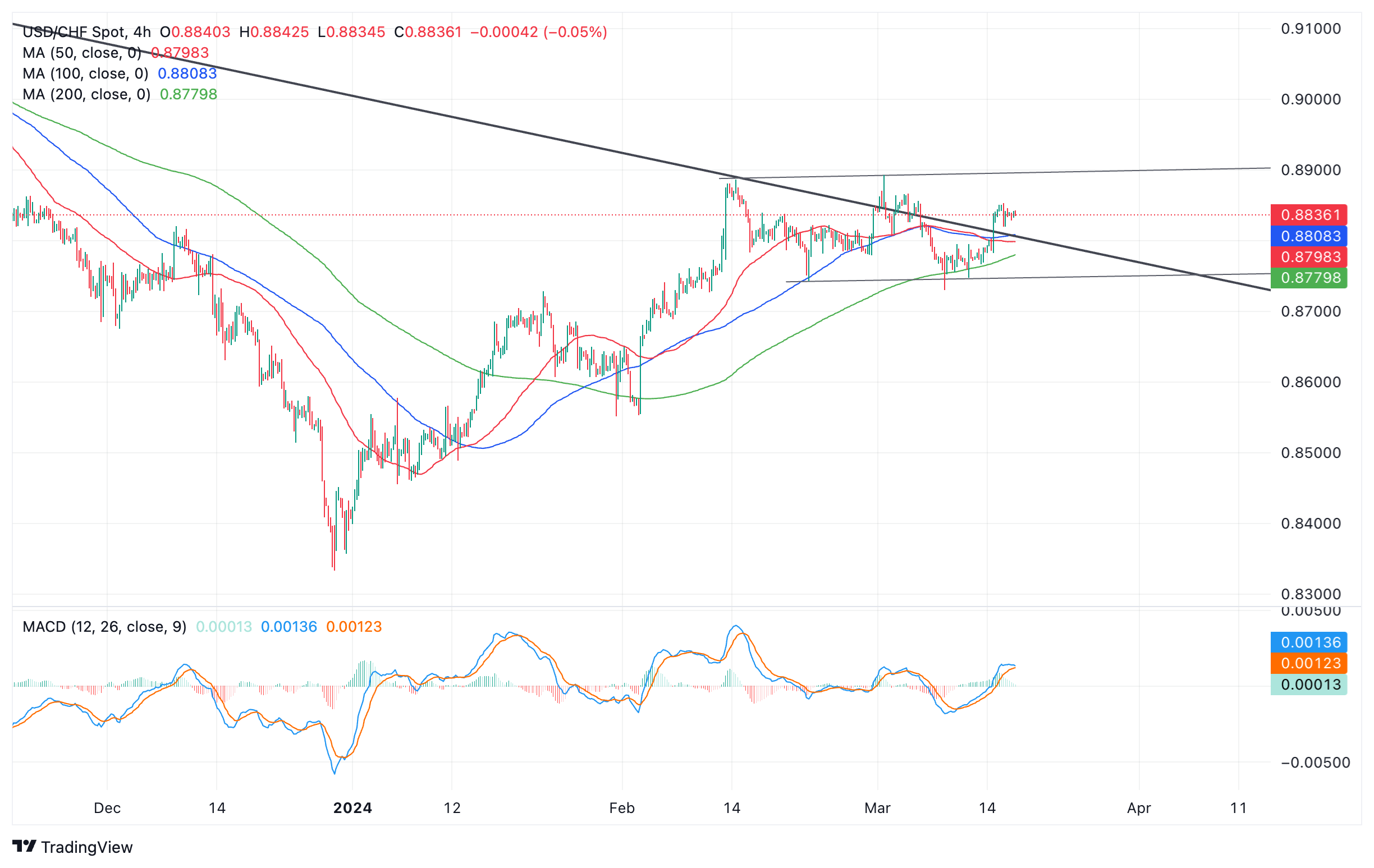
US Dollar versus Swiss Franc: 4-hour chart
The pair is overall in short-term uptrend with the expectation that it will eventually break out and start moving higher. However, resistance from a long-term trendline and the 50-week Simple Moving Average (SMA) present considerable obstacles.
For more upside to be confirmed, a decisive break above the range highs at 0.8900 would be required. Such a move would probably then extend to an initial target at 0.8992, the 0.618 Fibonacci (Fib) ratio of the height of the range extrapolated higher, followed by 0.9052, the full height extrapolated higher.
A decisive break below the range low at 0.8729, however, could indicate a short-term trend reversal and the start of a deeper slide lower. The first target for the move lower would be the 0.618 Fib extrapolation of the height of the range at 0.8632, followed by the full extrapolation at 0.8577, which is also close to the 0.8551 January 31 lows, another key support level to the downside.
SNB FAQs
The Swiss National Bank (SNB) is the country’s central bank. As an independent central bank, its mandate is to ensure price stability in the medium and long term. To ensure price stability, the SNB aims to maintain appropriate monetary conditions, which are determined by the interest rate level and exchange rates. For the SNB, price stability means a rise in the Swiss Consumer Price Index (CPI) of less than 2% per year.
The Swiss National Bank (SNB) Governing Board decides the appropriate level of its policy rate according to its price stability objective. When inflation is above target or forecasted to be above target in the foreseeable future, the bank will attempt to tame excessive price growth by raising its policy rate. Higher interest rates are generally positive for the Swiss Franc (CHF) as they lead to higher yields, making the country a more attractive place for investors. On the contrary, lower interest rates tend to weaken CHF.
Yes. The Swiss National Bank (SNB) has regularly intervened in the foreign exchange market in order to avoid the Swiss Franc (CHF) appreciating too much against other currencies. A strong CHF hurts the competitiveness of the country’s powerful export sector. Between 2011 and 2015, the SNB implemented a peg to the Euro to limit the CHF advance against it. The bank intervenes in the market using its hefty foreign exchange reserves, usually by buying foreign currencies such as the US Dollar or the Euro. During episodes of high inflation, particularly due to energy, the SNB refrains from intervening markets as a strong CHF makes energy imports cheaper, cushioning the price shock for Swiss households and businesses.
The SNB meets once a quarter – in March, June, September and December – to conduct its monetary policy assessment. Each of these assessments results in a monetary policy decision and the publication of a medium-term inflation forecast.
Author

Joaquin Monfort
FXStreet
Joaquin Monfort is a financial writer and analyst with over 10 years experience writing about financial markets and alt data. He holds a degree in Anthropology from London University and a Diploma in Technical analysis.