Swiss Franc remains under pressure against US Dollar, Fed’s policy in focus
- The Swiss Franc trades lower against the US Dollar ahead of the Fed’s policy decision on Wednesday.
- The Fed is widely anticipated to hike interest rates.
- Financial markets expect the SNB to hold interest rates at 0% later this month.

The Swiss Franc (CHF) is down against the US Dollar (USD) on Tuesday, with the USD/CHF pair trading slightly higher at around 0.8178 in the Asian session. The Swiss Franc pair remains higher as the US Dollar outperforms amid firm expectations that the Federal Reserve (Fed) will hike interest rates in the policy meeting on Wednesday.
At press time, the US Dollar Index (DXY), which gauges the Greenback’s value against six major currencies, trades 0.1% higher to near 99.58.
FOMC set for first hike since 2023 as market eyes Warsh’s guidance
Strategists at Brown Brothers Harriman (BBH) expect the FOMC to break its streak of five consecutive holds, noting that “the FOMC is poised to deliver a 25bps hike to a target range of 3.75%-4.00% on Wednesday, marking its first hike since July 2023.” BBH argues that “persistently above target US inflation and a stable labor market justify a rate increase,” and points out that positioning is already heavily skewed toward such an outcome, with “Fed funds futures price in roughly 90% odds of a hike this week.”
As the Fed is widely anticipated to tighten monetary conditions, market experts view monetary policy statement and Fed Chairman Kevin Warsh’s press conference as key trigger for the US Dollar’s next move.
Against that backdrop, BBH also said that “the vote split, updated Summary of Economic Projections (SEP), and Fed Chair Kevin Warsh’s press conference will guide the market reaction,” as investors parse the decision for signals on the policy path ahead.
On the Swiss Franc front, financial markets expect the Swiss National Bank (SNB) to continue on its monetary easing path and leave interest rates at 0% in the policy meeting later this month.
Nomura sees SNB on hold at zero
Analysts at Nomura argue that the Swiss policy stance is likely to remain unchanged, noting that “in Switzerland, we expect no change in rates for the foreseeable future, as inflation is low, but the policy rate is 0.00% and the SNB has expressed caution about unwanted side effects of a negative policy rate.” Against this backdrop, they see little impetus for the SNB to adjust its current setting, with subdued price pressures and concerns over the costs of re-entering negative territory reinforcing a steady policy bias.
USD/CHF Technical Analysis
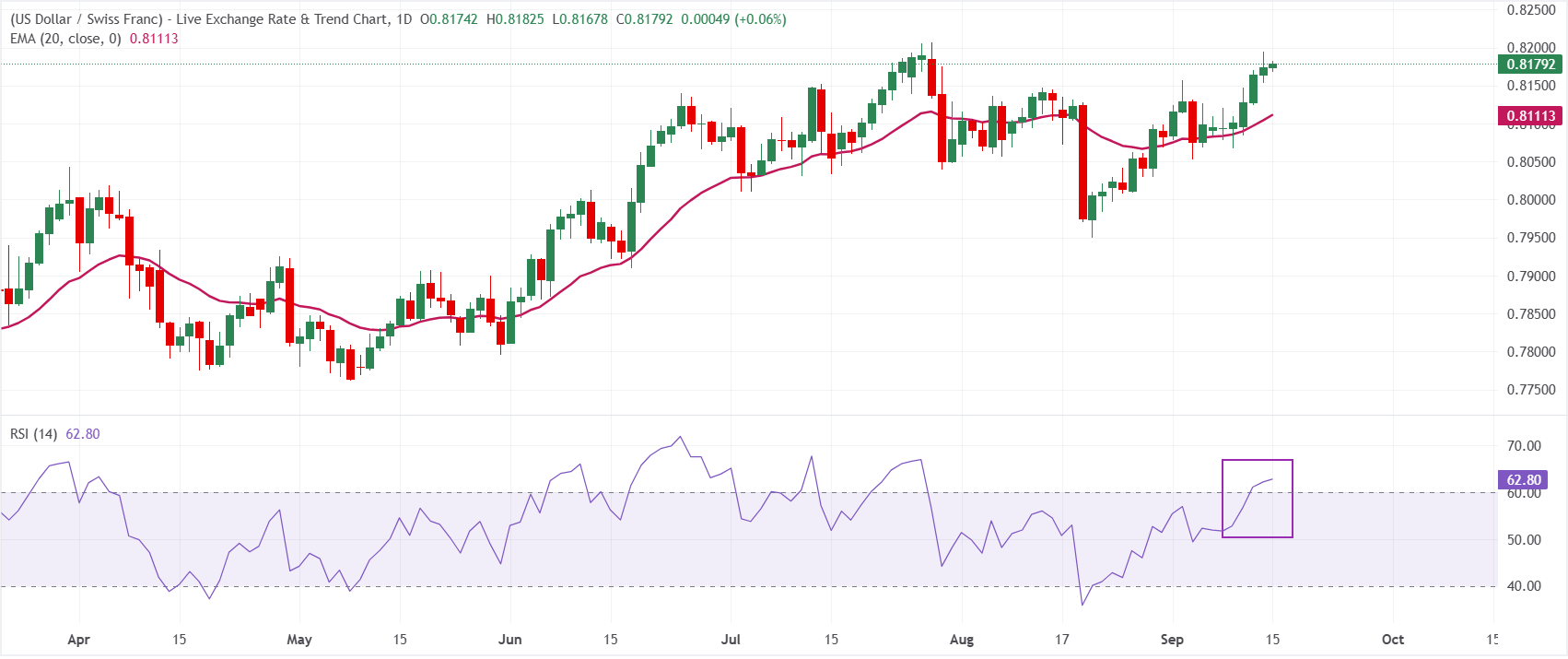
In the daily chart, USD/CHF trades at 0.8179. The pair holds above the 20-day exponential moving average (EMA) at 0.8111, keeping the short-term structure supported and hinting at a constructive bias while price consolidates over this dynamic floor. The Relative Strength Index (RSI) at about 63 remains in positive territory without yet signaling overbought conditions, suggesting that bullish momentum is intact but not overstretched.
On the downside, the 20-day EMA at 0.8111 is the first key support, and a daily close below this level would weaken the current constructive tone and expose a deeper pullback toward prior lows. As long as the pair holds above this moving average and RSI stays in the upper half of its range, dips are likely to find buyers, leaving the broader near-term bias tilted to the upside despite the absence of clearly defined overhead resistance levels nearby.
(The technical analysis of this story was written with the help of an AI tool. Know more.)
Fed FAQs
Monetary policy in the US is shaped by the Federal Reserve (Fed). The Fed has two mandates: to achieve price stability and foster full employment. Its primary tool to achieve these goals is by adjusting interest rates. When prices are rising too quickly and inflation is above the Fed’s 2% target, it raises interest rates, increasing borrowing costs throughout the economy. This results in a stronger US Dollar (USD) as it makes the US a more attractive place for international investors to park their money. When inflation falls below 2% or the Unemployment Rate is too high, the Fed may lower interest rates to encourage borrowing, which weighs on the Greenback.
The Federal Reserve (Fed) holds eight policy meetings a year, where the Federal Open Market Committee (FOMC) assesses economic conditions and makes monetary policy decisions. The FOMC is attended by twelve Fed officials – the seven members of the Board of Governors, the president of the Federal Reserve Bank of New York, and four of the remaining eleven regional Reserve Bank presidents, who serve one-year terms on a rotating basis.
In extreme situations, the Federal Reserve may resort to a policy named Quantitative Easing (QE). QE is the process by which the Fed substantially increases the flow of credit in a stuck financial system. It is a non-standard policy measure used during crises or when inflation is extremely low. It was the Fed’s weapon of choice during the Great Financial Crisis in 2008. It involves the Fed printing more Dollars and using them to buy high grade bonds from financial institutions. QE usually weakens the US Dollar.
Quantitative tightening (QT) is the reverse process of QE, whereby the Federal Reserve stops buying bonds from financial institutions and does not reinvest the principal from the bonds it holds maturing, to purchase new bonds. It is usually positive for the value of the US Dollar.
Author

Sagar Dua
FXStreet
Sagar Dua is associated with the financial markets from his college days. Along with pursuing post-graduation in Commerce in 2014, he started his markets training with chart analysis.