Gold slips below $4,000 despite risk-off mood as hawkish Fed expectations weigh
- Gold falls to its lowest level since July as hawkish Fed expectations keep sellers in control.
- AI spending concerns drive investors toward government bonds, pushing Treasury yields lower.
- XAU/USD remains below its main daily moving averages, with weak momentum leaving room for further losses.

Gold (XAU/USD) remains under pressure on Friday, slipping to $3,965 during Asian trading hours, its lowest level since July. The metal struggles despite a risk-off mood across markets, as expectations of further Federal Reserve (Fed) interest rate hikes continue to dominate price action, leaving Gold on track to end the month in negative territory. At the time of writing, XAU/USD trades around $3,979, down nearly 1% on the day.
Traders turn risk-averse as disappointing technology earnings renew concerns about heavy AI spending and whether those investments will generate sufficient returns. Investors move into government bonds, pushing US Treasury yields lower and dragging the US Dollar down.
The US Dollar Index (DXY), which tracks the Greenback’s value against a basket of six major currencies, trades around 101.65, extending losses for a third consecutive day.
Analysts at ING argue that positioning rather than fundamentals may be the key near-term driver for the Dollar, warning that “the main risk for the dollar today is some precautionary unwinding of net-long positions ahead of Tuesday’s US midterm elections.” They note that “a Democratic sweep is trading around 68% in prediction markets,” a scenario they see as “slightly negative for the US dollar from a few angles, from higher risk of government shutdown and gridlock on debt ceiling negotiations to potential damage to already shaky AI-related sentiment.”
Adding to the cautious mood, reports of a major security breach at cryptocurrency exchange Binance weigh on digital assets and further unsettle investors. Gold has so far failed to benefit from the risk-averse mood, as traders focus on rising Oil prices amid Middle East tensions and their resulting impact on inflation and interest rates.
Oil prices climb to their highest levels since May amid concerns that the US could resume military strikes against Iran after next week’s US midterm elections. West Texas Intermediate (WTI) trades above $103 a barrel, keeping energy-driven inflation risks in focus.
Higher energy costs risk keeping inflation above the Fed’s 2% target for longer. Data released on Thursday showed that September headline Personal Consumption Expenditures (PCE) inflation rose 0.5% MoM and 3.6% YoY, while the core measure increased 0.3% MoM and 3.1% YoY.
Traders price in around a 75% chance of a December rate hike, according to the CME FedWatch Tool, after the Fed left rates unchanged in October. Higher borrowing costs tend to weigh on Gold, as it offers no interest income.
Technical analysis: XAU/USD eyes deeper losses below $4000
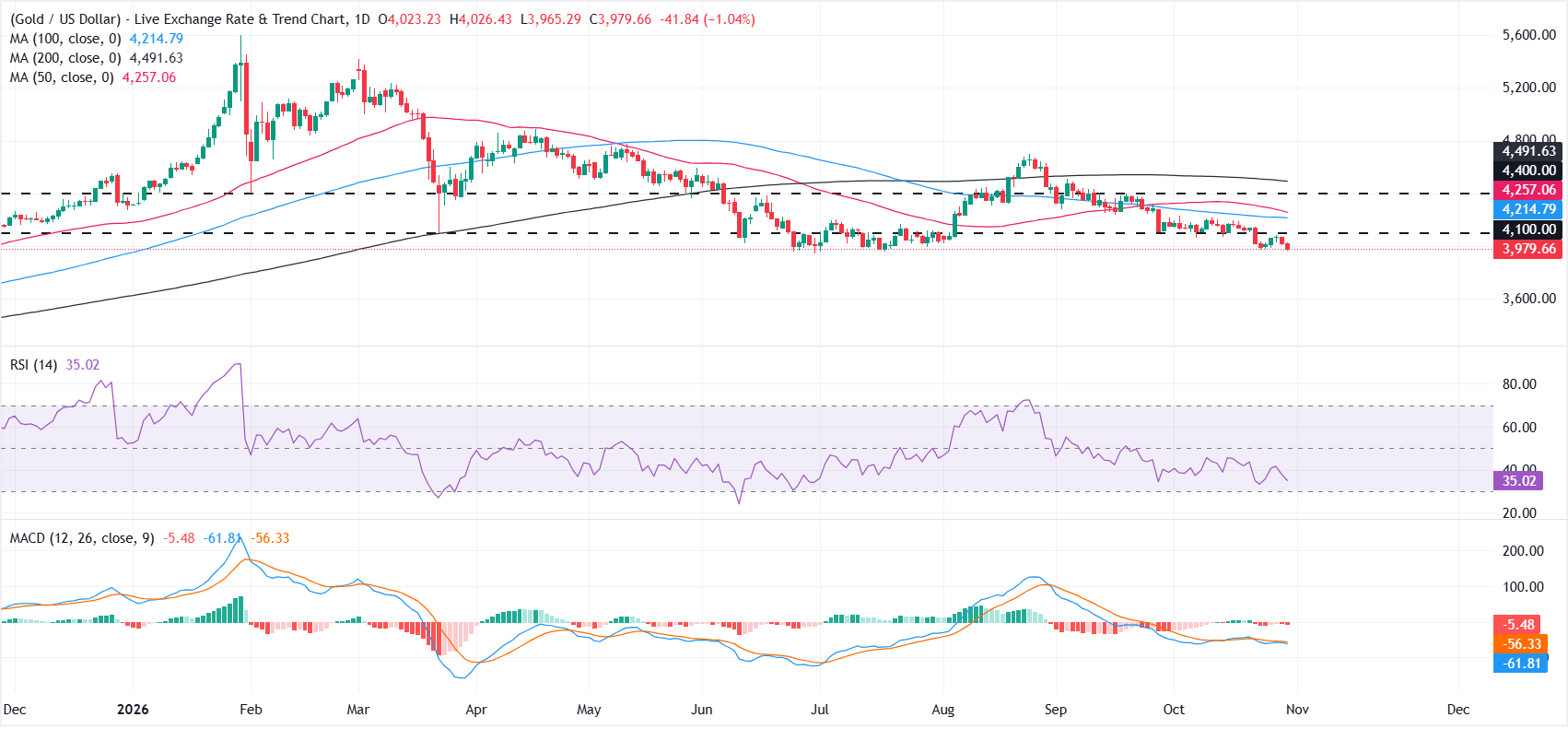
On the daily chart, XAU/USD has been making lower highs and lower lows since peaking near $4,700 in late August. The metal trades below the 50-day, 100-day and 200-day Simple Moving Averages (SMAs), keeping sellers in control. The Relative Strength Index (RSI) near 34 signals subdued buying interest, while the Moving Average Convergence Divergence (MACD) remains in negative territory, suggesting that downside pressure persists.
Initial resistance stands at $4,000, followed by $4,100, the 100-day SMA near $4,218 and the nearby 50-day SMA at $4,257. A stronger recovery could bring horizontal resistance at $4,400 into focus, followed by the 200-day SMA around $4,491.
With Gold already trading below $4,000, immediate support lies at $3,950, followed by the July low near $3,941. A decisive break below this area would open the door to further losses.
(The technical analysis of this story was written with the help of an AI tool. Know more.)
Gold FAQs
Gold has played a key role in human’s history as it has been widely used as a store of value and medium of exchange. Currently, apart from its shine and usage for jewelry, the precious metal is widely seen as a safe-haven asset, meaning that it is considered a good investment during turbulent times. Gold is also widely seen as a hedge against inflation and against depreciating currencies as it doesn’t rely on any specific issuer or government.
Central banks are the biggest Gold holders. In their aim to support their currencies in turbulent times, central banks tend to diversify their reserves and buy Gold to improve the perceived strength of the economy and the currency. High Gold reserves can be a source of trust for a country’s solvency. Central banks added 1,136 tonnes of Gold worth around $70 billion to their reserves in 2022, according to data from the World Gold Council. This is the highest yearly purchase since records began. Central banks from emerging economies such as China, India and Turkey are quickly increasing their Gold reserves.
Gold has an inverse correlation with the US Dollar and US Treasuries, which are both major reserve and safe-haven assets. When the Dollar depreciates, Gold tends to rise, enabling investors and central banks to diversify their assets in turbulent times. Gold is also inversely correlated with risk assets. A rally in the stock market tends to weaken Gold price, while sell-offs in riskier markets tend to favor the precious metal.
The price can move due to a wide range of factors. Geopolitical instability or fears of a deep recession can quickly make Gold price escalate due to its safe-haven status. As a yield-less asset, Gold tends to rise with lower interest rates, while higher cost of money usually weighs down on the yellow metal. Still, most moves depend on how the US Dollar (USD) behaves as the asset is priced in dollars (XAU/USD). A strong Dollar tends to keep the price of Gold controlled, whereas a weaker Dollar is likely to push Gold prices up.
Author

Vishal Chaturvedi
FXStreet
I am a macro-focused research analyst with over four years of experience covering forex and commodities market. I enjoy breaking down complex economic trends and turning them into clear, actionable insights that help traders stay ahead of the curve.