Stocks slip, as new phase of Iran war drags on, Tesla fails to impress with AI plans
- Tanker war stretches beyond the Strait of Hormuz for first time.
- No timeline to end the war.
- Optimism in shot supply.
- Tesla beats expectations, but higher capex spend causes stock to fall.
- Optimus plans need to be backed up by detail.
- Macro backdrop is not supportive of Musk’s dreams.

Stocks in Asia and futures markets in Europe and the US have been jolted by news that the US has intercepted three Iranian oil tankers in Asian waters, and is redirecting them away from positions near India, Malaysia and Sri Lanka. This is the first time the US’ naval blockade has reached beyond the Strait of Hormuz, and it comes after two container ships were stopped by Iranian forces as they tried to travel through the Strait. This will obviously make peace talks tricky, and it directly affects the flow of oil and trade around the world.
The Brent crude price is back above $100 a barrel and is currently trading above $103. The sharp rise in the oil price is hurting global equities, Asian stocks are a sea of red, and futures markets point to more losses for Europe, and US stocks are set to pull back from their recent record highs. Although there is a ceasefire in place between Iran and the US, it is looking less likely that peace talks will take place in the near term. JD Vance, the US vice president, has not committed to attend talks, and Iranian officials have called them a waste of time.
No timeline to end the war
The struggle between Iran and the US is now focusing on trade, and who controls the Strait of Hormuz. This suggests that oil prices will remain elevated, and it makes it hard for stock indices to sustain record highs. Before news broke about the US interception of tankers in Asian waters, the Nikkei and the South Korean Kospi both rose to record highs, following the US after the S&P 500 and the Nasdaq had done the same earlier on Wednesday. Markets have been trading on optimism that the US ceasefire would hold and that the Strait of Hormuz would reopen, as we move towards the end of the week, this optimism could be in short supply. The situation in the Strait of Hormuz is not sustainable, and if there is no improvement by the end of the week, volatility could spike once more.
Tesla boosts AI spending
Tesla will also be in focus today, after it reported earnings for Q1, and beat expectations for revenue and net income. Revenue was $22.38bn, up 15% YoY and higher than the $22.2bn forecast by analysts. Net income was stronger than expected at $1.45bn. The focus was on capex spending pledges. In Q4, Tesla stated that capex would be $20bn, but many analysts doubted that this would be enough to fund Elon Musk’s plans for Optimus, and driverless tech. Indeed it was not, and the company has boosted capex spending to $25bn to focus on AI.
Tesla EV business continues to struggle
Tesla shares initially jumped 4% on the earnings report but gave back all of the gains and ended post-market trading down 1%, after the increase in capex spending. The main details of the report suggest that the core auto business continues to struggle, as it comes up against tough Chinese competition. Its response to this extra competition is to make more affordable trims to the Model Y and Model 3. Although sales were up globally in the quarter, rising 6.3% from a year ago, it was still the second worst quarter for sales since 2022, and suggests that there remains an overhang from Musk’s foray into politics, which put consumers off the brand, even if sales growth in Europe has started to pick up again.
There was some good news in the report, subscriptions for its driverless technology rose 16% YoY to 1.28mn, this is a sign that Musk’s longer term pan to pivot away from actual vehicle sales and towards driverless technology could be working. The copmpay is also expanding its Robotaxi service around California and Texas and plans to expand to other US cities later this year including Phoenix, Miami and Las Vegas. Free cash flow was also positive last year, which beat analyst expectations who thought it would be negative, however, the boost in capex spending means that free cash flow will be negative for the rest of 2026.
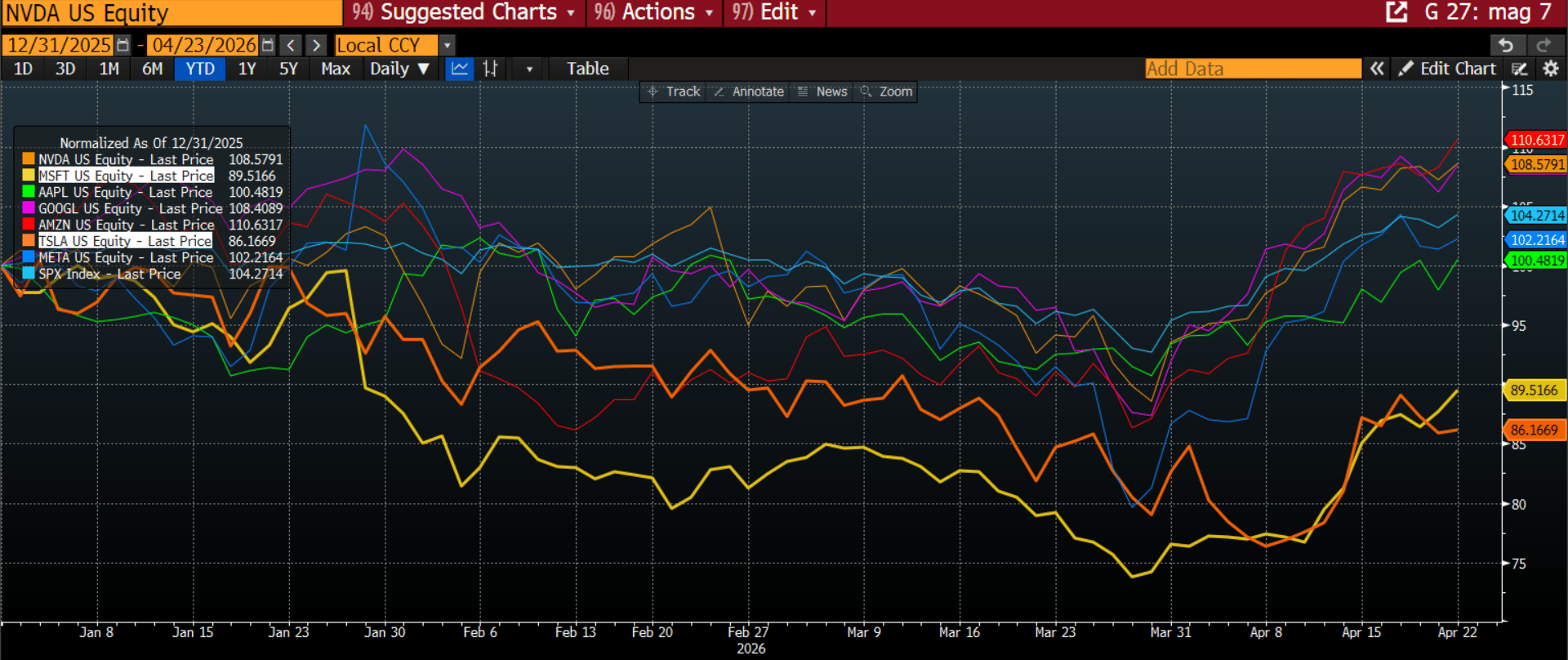
While robotaxis are seen as a key driver of future revenues, the company still needs to generate the bulk of revenue from its EV business, and that is where the weak spot lies, and why Tesla is falling behind its Magnificent 7 peers, as you can see in the chart below.
Optimus plans leave analysts flat
There were some other aspects of the Q1 results that may alarm investors and Elon Musk has yet to convince analysts that his big plans are going to hit their ambitious target dates. For example, plans to transform the company’s Fremont California factory to produce Optimus humanoid robots is expected to begin this quarter, and Musk said that first generation of these robots will hit 1 million. However, it is unclear if there is a demand for these robots, and whether the factory can produce Optimus at this scale. Rather than produce frame by frame analysis of Optimus now, Musk said that he would rather unveil the humanoid closer to the start of production, which means that analysts are left with scant details about its features, and this makes it hard to price in to Tesla’s share price. This is one reason why the share price eroded earlier gains and fell 1% while Musk was talking.
There was also some bad news for the battery business, which has been crucial for Tesla revenues in recent years. Its revenue fell 12% YoY to $2.4bn, which is also a sign that greater competition could be eating into its sales.
Geopolitics not supportive of Musk’s dreams
Overall, Tesla is the weakest performer in the Magnificent 7 this year, and its share price is lower by 15% YTD. We do not think that it will play catch up anytime soon, especially since this earnings report left more questions unanswered, and the overall geopolitical situation is not supportive of risk, or Elon Musk’s big dreams.
Chart 1: Magnificent 7, normalized to show how they perform together YTD
Author

Kathleen Brooks
XTB UK
Kathleen has nearly 15 years’ experience working with some of the leading retail trading and investment companies in the City of London.