United Kingdom CPI inflation eases to 2.6% YoY in June vs. 2.7% forecast

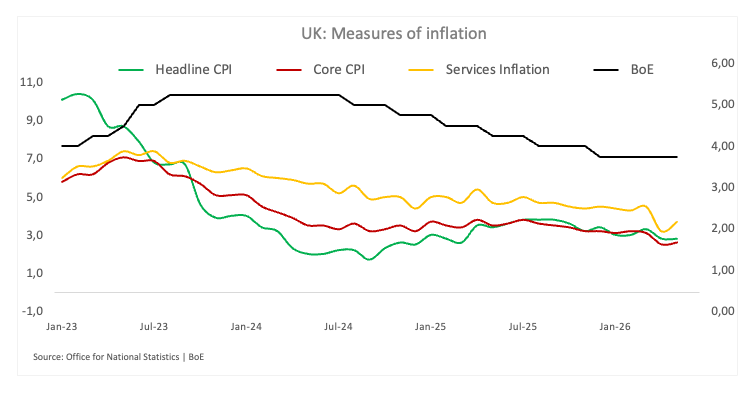
The United Kingdom (UK) headline Consumer Price Index (CPI) rose 2.6% over the year in June, compared to a rise of 2.8% in May, the data released by the Office for National Statistics (ONS) showed on Wednesday.
Markets predicted a 2.7% growth in the reported period. The UK inflation reading was well above the Bank of England’s (BoE) 2% inflation target.
The core CPI (excluding volatile food and energy items) climbed 2.6% year-over-year (YoY) in the same period, compared to May’s 2.6% print and came in hotter than the forecast of 2.5%.
Meanwhile, the monthly UK CPI arrived at 0.1% in June versus a rise of 0.2% reported in May, in line with the market consensus of 0.1%.
GBP/USD reaction to the UK CPI inflation data
The British Pound (GBP) edges slightly lower in an immediate reaction to the UK inflation report. At the time of writing, the GBP/USD pair is trading 0.03% higher on the day to trade at 1.3380.
Pound Sterling Price This week
The table below shows the percentage change of British Pound (GBP) against listed major currencies this week. British Pound was the strongest against the Canadian Dollar.
| USD | EUR | GBP | JPY | CAD | AUD | NZD | CHF | |
|---|---|---|---|---|---|---|---|---|
| USD | 0.15% | 0.49% | 0.46% | 0.61% | -0.46% | 0.17% | 0.49% | |
| EUR | -0.15% | 0.34% | 0.26% | 0.45% | -0.61% | 0.01% | 0.33% | |
| GBP | -0.49% | -0.34% | -0.11% | 0.13% | -0.94% | -0.32% | 0.04% | |
| JPY | -0.46% | -0.26% | 0.11% | 0.23% | -0.87% | -0.34% | 0.14% | |
| CAD | -0.61% | -0.45% | -0.13% | -0.23% | -1.02% | -0.57% | -0.07% | |
| AUD | 0.46% | 0.61% | 0.94% | 0.87% | 1.02% | 0.63% | 0.97% | |
| NZD | -0.17% | -0.01% | 0.32% | 0.34% | 0.57% | -0.63% | 0.36% | |
| CHF | -0.49% | -0.33% | -0.04% | -0.14% | 0.07% | -0.97% | -0.36% |
The heat map shows percentage changes of major currencies against each other. The base currency is picked from the left column, while the quote currency is picked from the top row. For example, if you pick the British Pound from the left column and move along the horizontal line to the US Dollar, the percentage change displayed in the box will represent GBP (base)/USD (quote).
This section below was published at 05:25 GMT as a preview of the UK Consumer Price Index (CPI) inflation data.
- The UK’s ONR Office publishes the June CPI data on Wednesday.
- The UK headline CPI is expected to ease toward 2.7% from a year earlier.
- Core inflation is also seen easing toward 2.5% over the last 12 months.
The UK Office for National Statistics (ONS) will release the June Consumer Price Index (CPI) figures on Wednesday at 06:00 GMT, a print that will matter for markets. Consensus expectations point to inflation pressures still above the Bank of England’s (BoE) target, although losing further momentum.
UK consumer inflation remains one of the most important inputs for the BoE and typically carries real weight for the British Pound (GBP). Following the latest cautious hold by the BoE on June 18, investors now favour a steady hand by the ‘Old Lady’ at its meeting on July 30.
What to expect from the next UK inflation report?
Headline UK CPI is expected to clock 2.7% in the year to June, a tad lower than the May reading. On a monthly basis, inflation is seen gaining 0.1%, adding to the 0.2% increase recorded the previous month.
Core inflation, which strips out the more volatile food and energy components and is therefore more closely watched by the BoE, is forecast at 2.5% on an annual basis, down a tenth of percent from May.
How will the UK CPI data affect GBP/USD?
The BoE met expectations and kept the bank rate unchanged at 3.75% on June 18. However, the 7–2 vote split carried a slightly more hawkish tone, with Megan Greene joining Huw Pill in supporting a 25-basis-point increase. But the larger message is patience, with policy still firmly in wait-and-see mode and market pricing that reflects that stance.
In his latest comments last week, Governor Andrew Bailey said the renewed hostilities in the Gulf highlighted the instability facing the global economy. Turning to the UK, he argued that the country was supported by both its fiscal framework and monetary policy, while stressing that the central challenge remained economic growth.
Bailey added that the UK’s core banking system was resilient and that debt levels were not overstretched. However, he warned that sustainable economic growth would not be possible without financial stability.
Implied rates currently suggest nearly 43 basis points of tightening by year-end, while consensus sees the central bank keeping its policy rate unchanged at its next gathering on July 30.
Back to technicals, Senior Analyst at FXStreet, Pablo Piovano, notes that the recent multi-week recovery in GBP/USD appears to have encountered some initial hurdle in the 1.3550-1.3560 band near the July tops. “In case bulls regain the upper hand, the next barrier emerges at the May top at 1.3653 (May 11), followed by the YTD ceiling at 1.3868 (January 27)," he adds.
On the downside, Piovano sees initial contention at current yearly lows near 1.3140 (June 24). “Further weakness from here could expose a move toward the November 2025 base at 1.3010 (November 5),” Piovano adds.
Piovano also points out that momentum indicators remain somewhat bullish for now as the Relative Strength Index (RSI) hovers just below 54, while the Average Directional Index (ADX) near 18 suggests the current trend lacks muscle.
Inflation FAQs
Inflation measures the rise in the price of a representative basket of goods and services. Headline inflation is usually expressed as a percentage change on a month-on-month (MoM) and year-on-year (YoY) basis. Core inflation excludes more volatile elements such as food and fuel which can fluctuate because of geopolitical and seasonal factors. Core inflation is the figure economists focus on and is the level targeted by central banks, which are mandated to keep inflation at a manageable level, usually around 2%.
The Consumer Price Index (CPI) measures the change in prices of a basket of goods and services over a period of time. It is usually expressed as a percentage change on a month-on-month (MoM) and year-on-year (YoY) basis. Core CPI is the figure targeted by central banks as it excludes volatile food and fuel inputs. When Core CPI rises above 2% it usually results in higher interest rates and vice versa when it falls below 2%. Since higher interest rates are positive for a currency, higher inflation usually results in a stronger currency. The opposite is true when inflation falls.
Although it may seem counter-intuitive, high inflation in a country pushes up the value of its currency and vice versa for lower inflation. This is because the central bank will normally raise interest rates to combat the higher inflation, which attract more global capital inflows from investors looking for a lucrative place to park their money.
Formerly, Gold was the asset investors turned to in times of high inflation because it preserved its value, and whilst investors will often still buy Gold for its safe-haven properties in times of extreme market turmoil, this is not the case most of the time. This is because when inflation is high, central banks will put up interest rates to combat it. Higher interest rates are negative for Gold because they increase the opportunity-cost of holding Gold vis-a-vis an interest-bearing asset or placing the money in a cash deposit account. On the flipside, lower inflation tends to be positive for Gold as it brings interest rates down, making the bright metal a more viable investment alternative.
Economic Indicator
Consumer Price Index (YoY)
The United Kingdom (UK) Consumer Price Index (CPI), released by the Office for National Statistics on a monthly basis, is a measure of consumer price inflation – the rate at which the prices of goods and services bought by households rise or fall – produced to international standards. It is the inflation measure used in the government’s target. The YoY reading compares prices in the reference month to a year earlier. Generally, a high reading is seen as bullish for the Pound Sterling (GBP), while a low reading is seen as bearish.
Read more.Last release: Wed Jun 17, 2026 06:00
Frequency: Monthly
Actual: 2.8%
Consensus: -
Previous: 2.8%
Source: Office for National Statistics
The Bank of England is tasked with keeping inflation, as measured by the headline Consumer Price Index (CPI) at around 2%, giving the monthly release its importance. An increase in inflation implies a quicker and sooner increase of interest rates or the reduction of bond-buying by the BOE, which means squeezing the supply of pounds. Conversely, a drop in the pace of price rises indicates looser monetary policy. A higher-than-expected result tends to be GBP bullish.
Author

FXStreet Team
FXStreet
Composed of a group of economic journalists and FX experts, the FXStreet content team produces and oversees all content published on FXStreet. It provides a purely journalistic approach to the Forex market.