US Dollar mid-year outlook: Exceptional currency, exceptional risks?
The US Dollar enters the second half of 2026 in a markedly different position from a year ago. The King currency has recovered, reflecting persistent US inflation, changing expectations for Fed policy, geopolitical tensions and renewed demand for defensive assets. Yet the Greenback remains expensive in real historical terms, while concerns over tariffs, fiscal sustainability and the institutional independence of the central bank are becoming harder to ignore.
After depreciating by 7.4% over 2025, the Federal Reserve’s broad trade-weighted dollar index, which is more representative of US trade exposure than the euro-heavy DXY, appreciated modestly during the first half of 2026.
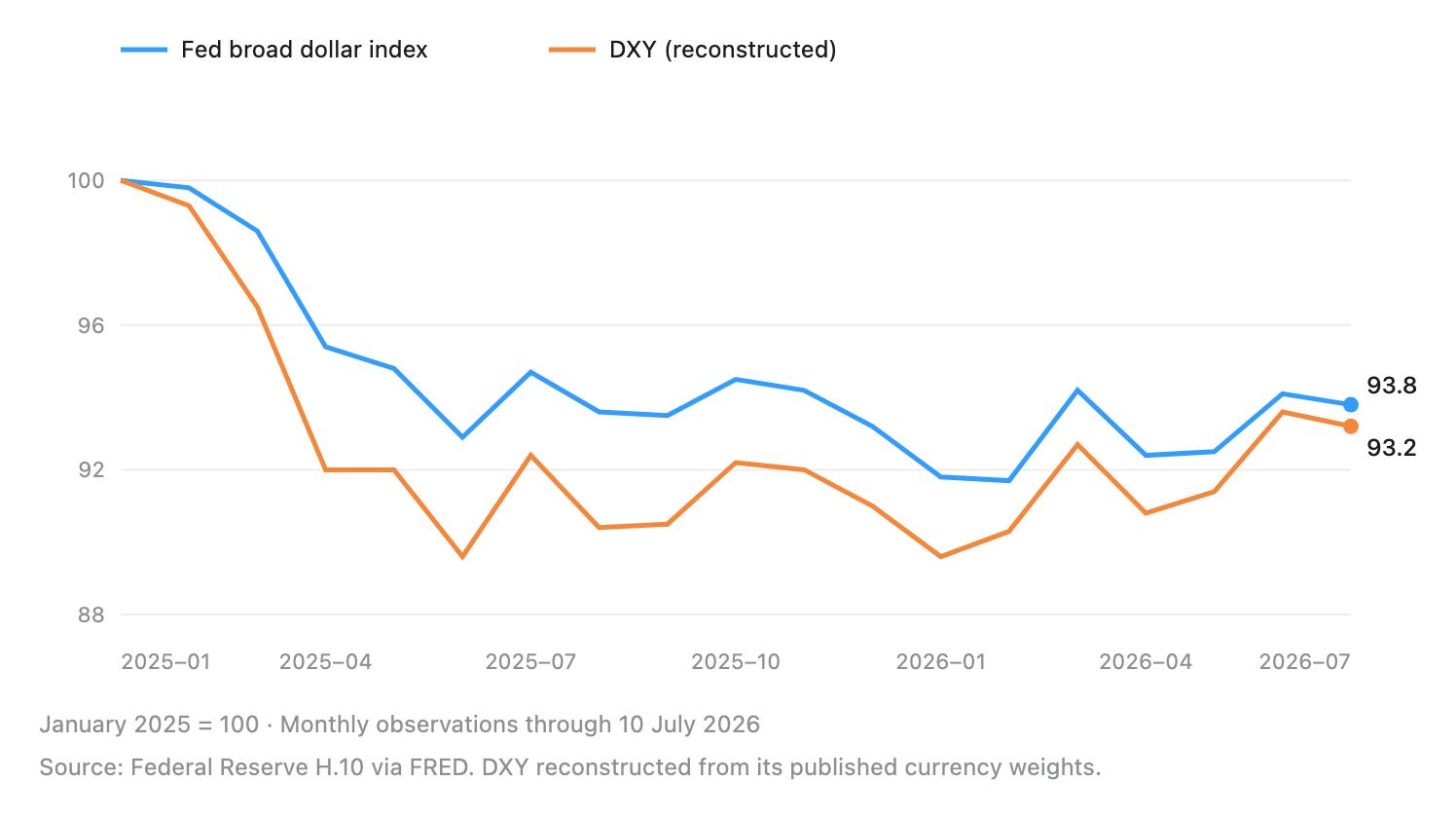
The central view is that these competing forces will produce a volatile but ultimately moderately softer currency over the remainder of the year. The US Dollar should continue to benefit from comparatively high US yields and periodic safe-haven demand. However, cooling employment, stretched speculative positioning, and a growing fiscal and institutional risk premium are likely to limit further appreciation.
The balance of risks is unusually wide: renewed inflation or geopolitical escalation could deliver another USD rally, while a sharper US slowdown or loss of confidence in American policymaking could trigger a more disorderly retreat.
De-dollarisation: Erosion, not displacement
Concerns about de-dollarisation intensified earlier in the year, supported by central bank Gold purchases, efforts to settle more bilateral trade in local currencies and the development of payment systems outside the dollar-based financial architecture. The use of financial sanctions has also resulted in some governments scaling back their exposure to US-controlled assets and infrastructure.
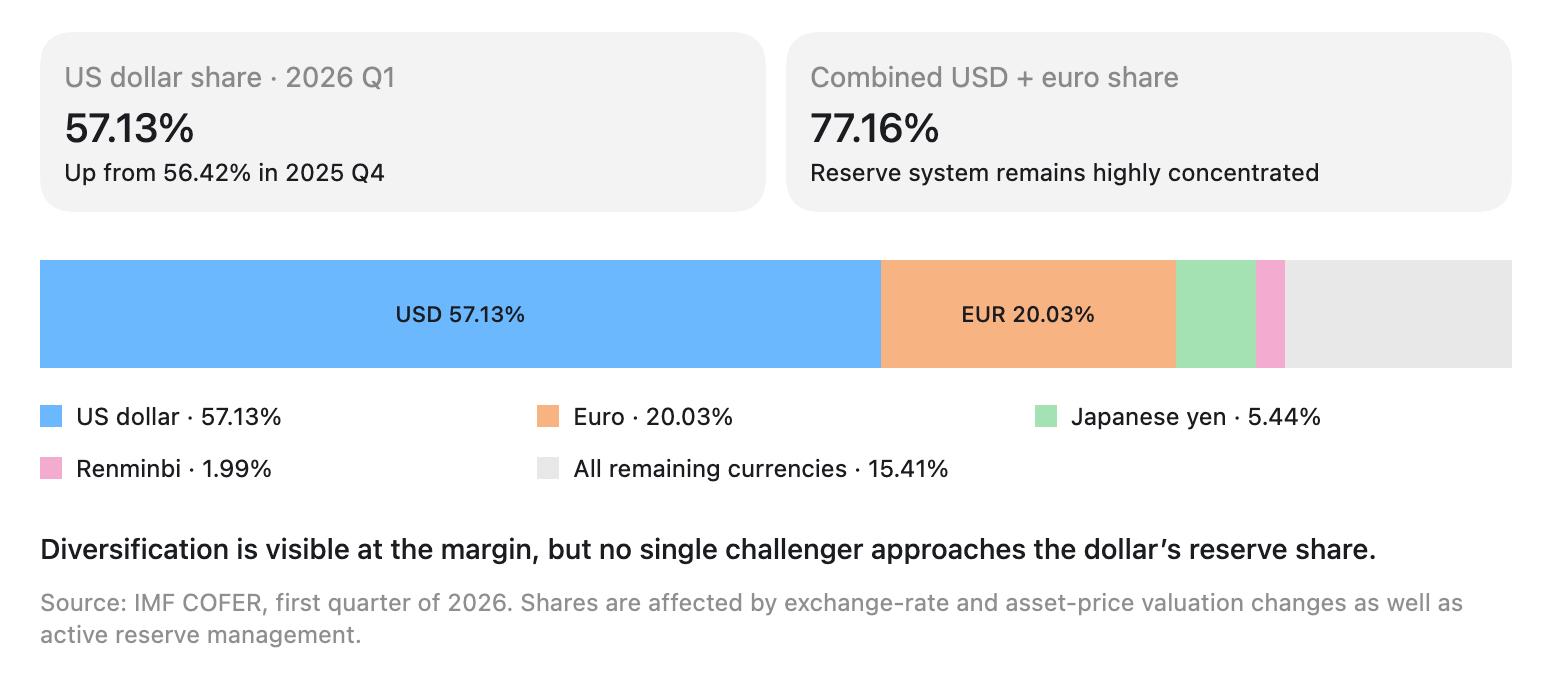
These are important developments but do not pose an immediate threat of eclipse of the Dollar. The IMF’s latest reserve data showed that the composition of global FX reserves was broadly stable in Q1 2026: the yellow metal may have surpassed US Treasuries as a proportion of official reserves during 2025, but the IMF notes that the shift was driven overwhelmingly by Gold-price valuation effects rather than central banks abandoning the Greenback.
A gradual diversification of reserves is nevertheless under way. The process is better understood as the development of a more fragmented monetary system than the replacement of one dominant currency by another.
Let’s not forget that no alternative currently combines the depth of US capital markets, the liquidity of the Treasury market, open access, legal infrastructure and global network effects offered by the Dollar. De-dollarisation is therefore a long-term headwind, but it is not yet the main cyclical driver of the exchange rate.
Tariffs complicate the inflation-growth trade-off
US tariffs have become a more immediate influence. Their initial effect has been to raise the domestic prices of some imported and import-competing goods. The Fed reports that tariff increases were already contributing to consumer-goods inflation during 2025, before the subsequent surge in energy prices added another supply shock this year.
Tariffs can initially support the Dollar if higher inflation keeps US interest rates above those in other economies. They can also be used to leverage companies into moving production and capital spending to the US. But the consequences become less Dollar-positive over time. Higher input costs are squeezing margins and household buying power, while retaliation is hurting exports and policy uncertainty is stalling investment. Trade diversion may also diminish the effectiveness of tariffs to improve the external balance.
The key issue for the second half is whether price increases remain concentrated in affected goods or whether they spread into wages, services, and inflation expectations. Limited pass-through would allow the Fed to look beyond a temporary price-level shock, but a broader pass-through would leave monetary policy caught between above-target inflation and deteriorating employment.
The new Fed and its reaction function
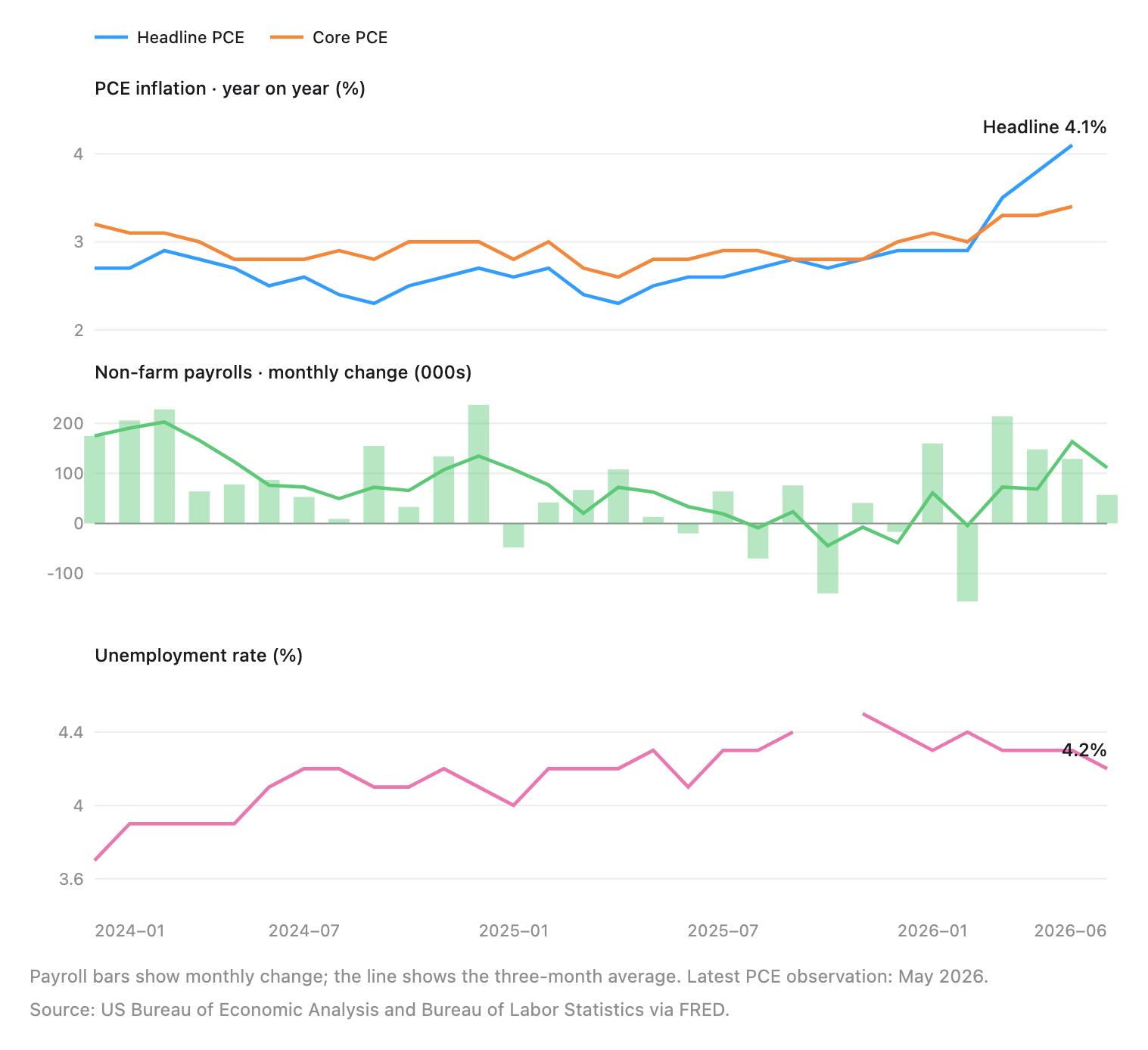
The new Fed inherits precisely this difficult combination. PCE inflation stood at 4.1% in the year to May, compared with 2.5% a year earlier, according to the July Monetary Policy Report.
At the same time, the labour market is no longer providing the same level of comfort. Nonfarm Payrolls increased by only 57K in June, while unemployment remained at 4.2%.
Employment conditions are not yet recessionary. Lay-offs remain subdued, vacancies have stabilised and productivity growth has been strong. But slower immigration, an ageing population and weaker labour-force participation make the payroll figures more difficult to interpret. A lower rate of job creation may now be consistent with labour-market balance, but it also leaves the economy with less protection against negative demand shocks.
For the Dollar, the distinction is critical. If productivity is allowing the economy to grow with fewer new workers, US exceptionalism remains intact and the Fed can concentrate on inflation. If employment weakness instead signals declining demand, expectations of monetary easing will return quickly.
The Fed’s communication under Kevin Warsh also appears likely to place less emphasis on detailed forward guidance. Markets may therefore respond more aggressively to individual data releases, increasing volatility around inflation, employment and activity indicators. A less predictable reaction function does not necessarily imply a weaker Dollar, but it raises the probability of abrupt repricing.
Politicisation and institutional risk
The debate over independence of the Fed cannot be divorced from the new leadership. The public clamouring for lower interest rates, the struggle over appointments and the effort to remake the central bank all give the impression that monetary policy may be more vulnerable to political priorities.
The immediate effect can be ambiguous: if investors believe political pressure will produce easier policy, the Dollar should weaken and inflation expectations should rise. But if the Fed responds by demonstrating its inflation-fighting credentials, short-term yields could remain high.
The more damaging risk is longer-term: investors may demand additional compensation to hold Dollar-denominated assets if confidence in the independence and credibility of US institutions deteriorates.
This institutional premium extends beyond the Fed. Unforeseen trade policy, disputes over economic statistics and perennial fiscal brinkmanship could slowly erode the notion that US assets are free of political risk. The question is no longer simply whether the US remains exceptional, but whether exceptional economic performance offsets exceptional policy uncertainty.
Fiscal policy and the term premium
Fiscal policy is arguably the most important missing link in the Dollar outlook. The Congressional Budget Office (CBO) projects a federal deficit of approximately $1.9 trillion in fiscal year 2026, with deficits rising further over the coming decade. Heavy Treasury issuance and growing interest costs are likely to keep upward pressure on long-term yields and the term premium.
At first, higher yields attract foreign capital and support the Greenback. But this relationship is not unlimited. If yields rise because growth prospects are improving, the currency normally benefits. But if they rise because investors are concerned about debt supply, inflation or fiscal credibility, the result may instead be a weaker currency alongside falling Treasury prices.
Foreign purchases of US securities must also be interpreted carefully. Hedged investment in Treasuries does not create the same Dollar demand as an unhedged allocation, while rising hedging ratios could weaken the traditional relationship between capital inflows and the exchange rate. Fiscal exceptionalism is therefore becoming an increasingly uncomfortable counterpart to economic exceptionalism.
Safe-haven demand and geopolitics
The Dollar continues to occupy a unique position in periods of global stress. The conflict between the US and Iran and the associated rise in energy prices have supported demand for liquid Dollar assets while weakening the growth outlook elsewhere. Further geopolitical escalation, disruption to energy supplies or a global deleveraging episode would probably generate renewed Dollar strength.
However, the safe-haven function is no longer automatic: the Dollar tends to perform best when the shock originates outside the US or creates a global shortage of Dollar liquidity. A shock centred on US fiscal governance, Fed independence or Treasury-market functioning could instead weaken both the currency and US bonds.
The “Dollar smile” captures this distinction: the currency can appreciate when the US economy substantially outperforms and when the global economy experiences severe stress. It tends to weaken in the middle, when US growth slows but global conditions remain resilient enough for investors to seek returns elsewhere.
Speculative positioning: Support becomes vulnerability
The development of speculative US Dollar positioning this year has unfolded in three distinct phases:
The year began with investors holding a modest net short USD position, reflecting the widespread expectation that the Fed would eventually begin easing policy. Through January and February, positioning remained relatively light, with speculative accounts showing little conviction in either direction as markets reassessed the outlook for US growth and inflation.
That changed during the second quarter. As US economic data consistently surprised to the upside and inflation proved more persistent than expected, speculative investors steadily rebuilt long Dollar exposure. Net longs hit their highest level since March 2025 in mid-June, a clear sign that sentiment towards the Greenback is improving.
Importantly, however, this increase was never accompanied by an aggressive build-up in exposure. Both the Net Position Percentile and the Speculative Exposure Percentile remained close to the middle of their respective 5-year ranges, indicating that positioning became more constructive without turning crowded.
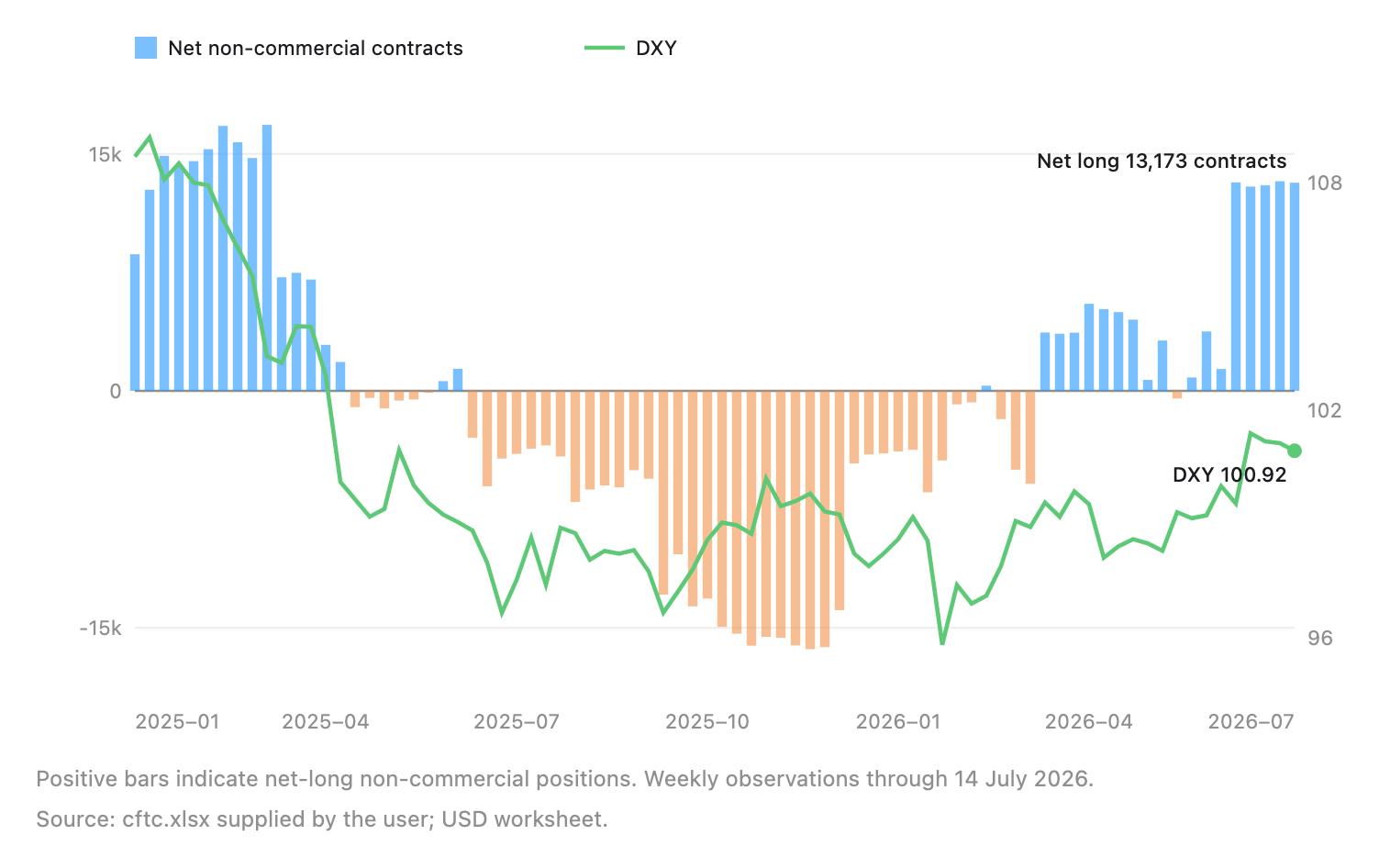
More recently, that rebuilding phase has lost momentum. Since mid-June, net longs have stabilised around the 13K-contract mark, while weekly flows have remained broadly neutral. The latest report for the week ending July 14 shows virtually no change in speculative exposure, suggesting investors are comfortable maintaining existing Dollar longs but are waiting for fresh macroeconomic catalysts before committing additional capital.
Forward-looking view
From a positioning perspective, the US Dollar remains in a favourable position.
Non-commercial investors have already shifted back to a modest net long stance, yet historical measures indicate the trade is far from crowded. Both the Net Position Percentile and Speculative Exposure Percentile are near their historical average levels, which leaves plenty of room for more accumulation should US data continue to outperform or the Fed stay hawkish on interest rates.
Importantly, the lack of stretched positioning also constrains the possibility of a positioning-driven correction. Absent a marked deterioration in the macro backdrop, current CFTC data suggest the Dollar is in a better position to see a gradual re-building of bullish exposure than a large-scale unwinding of existing longs. The positioning backdrop remains supportive for the Greenback, even if the pace of accumulation has slowed recently.
CFTC data cover only part of the global FX market and should not be treated as a complete measure of investor exposure. Even so, they suggest that prices already reflect a meaningful amount of good news for the Dollar.
Second-half outlook: Three scenarios
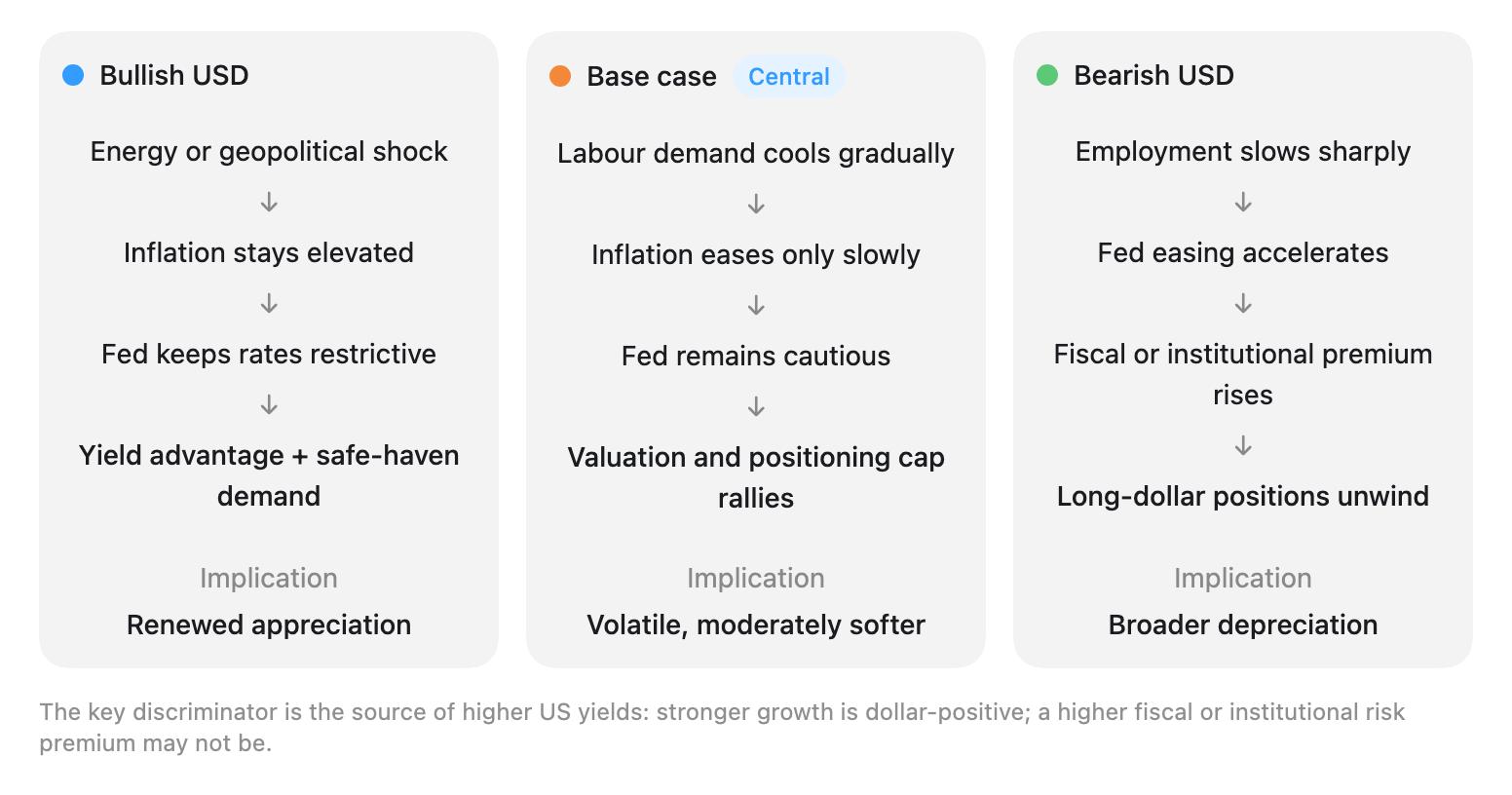
The base case is for the Dollar to trade unevenly before weakening moderately towards year-end. Cooling labour demand, expensive valuations and stretched positioning should eventually outweigh the support from current yield differentials. Persistent inflation, subdued growth outside the United States and the dollar’s continuing defensive role are likely to contain the decline.
The bullish scenario would combine renewed energy inflation, resilient US activity and geopolitical escalation. This would postpone monetary easing, preserve the US yield advantage and reinforce safe-haven demand.
The bearish scenario would involve a sharper labour-market slowdown alongside declining inflation, allowing the Fed to ease even as fiscal and institutional concerns raise questions about the quality of US assets. In that environment, higher long-term yields might no longer protect the currency.
The central tension for the remainder of 2026 is consequently not whether the Dollar has lost its global role. It has not. It is whether investors will continue rewarding the US for its exceptional growth and financial depth or begin demanding greater compensation for its increasingly exceptional risks.
Author

Pablo Piovano
FXStreet
Born and bred in Argentina, Pablo has been carrying on with his passion for FX markets and trading since his first college years.
















