|

S&P500 three week bear flag consolidation near complete
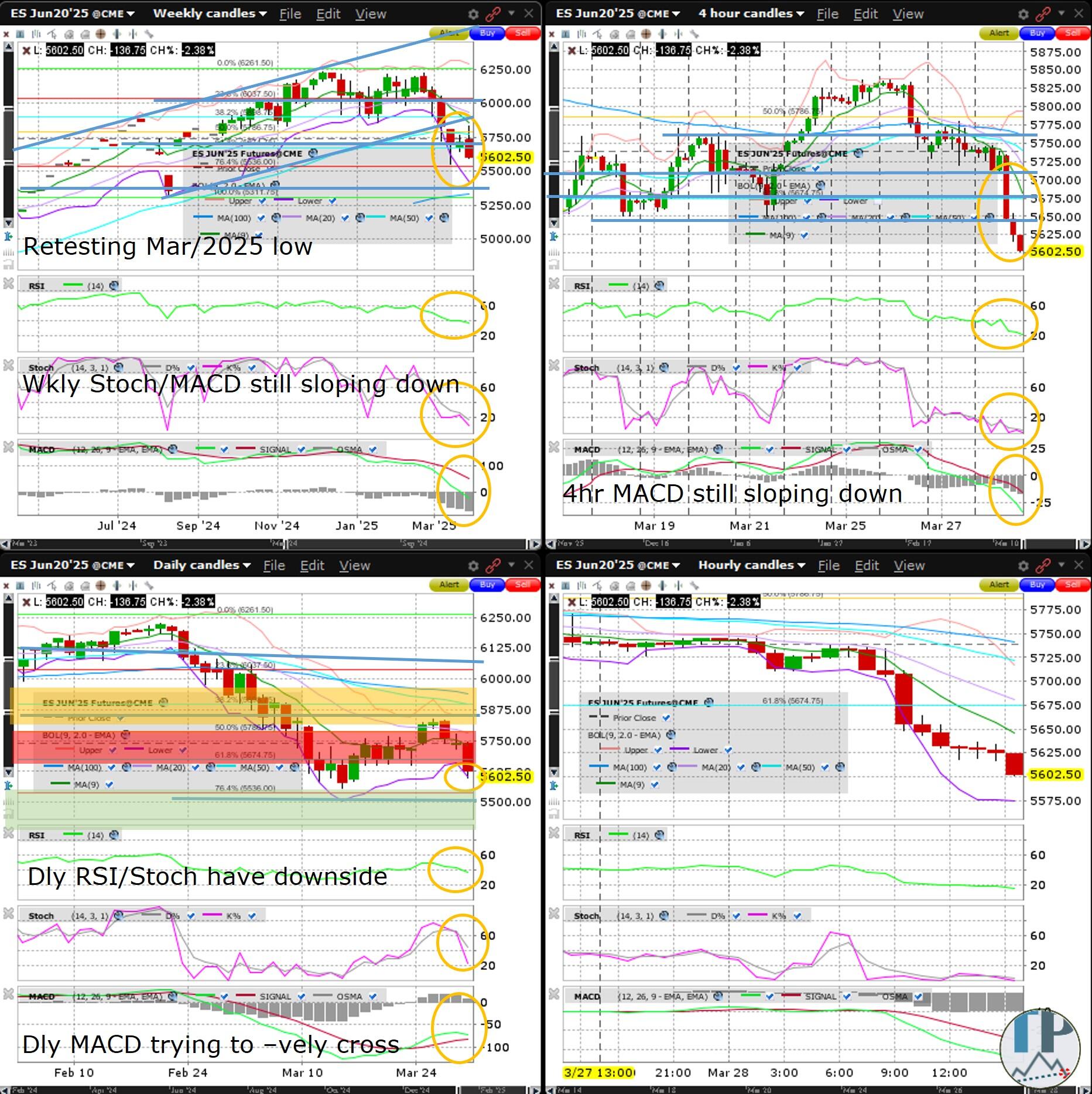
The S&P500 (ES) slid nearly 2.5% Friday, closing just above the 2025 low formed mid March.  Last week’s red weekly candle bearishly engulfed the prior green weekly candle, suggesting an end to the Bear Flag consolidation of the past 3 weeks. Odds are elevated for an extension of the Bear Flag this week to a fresh 2025 low.  The March high and low will be lower than the February high and low which were in turn, lower than the December equivalents. 

The powerful Bull Market extension from October 2022 has ended, as seen easier with the long March red candle body and the monthly MACD trying to negatively cross. Bearishly for the rest of 2025, the 3 month MACD histogram is tilting lower with the MACD blue line flattening. Regardless, bears should not rule out some short covering as early as Tuesday with the US ISM Manufacturing PMI, JOLTS job openings or Wednesday with the US ADP Non-Farm employment change. 

By Thursday, odds rise again for heightened volatility with the US unemployment claims, ISM Services PMI and Friday with the highly anticipated US average earnings, non-farm employment change, unemployment rate and Fed Chair Powell comments.

The weekly and daily RSI, Stochastics and MACD are tiring or steadily sloping down. I am looking to enter short in the red zone (of the daily chart), targeting the green zone for Friday.  The amber/yellow zone is where I might place a stop if I was a swing trader (although in my personal account with which I seldom hold overnight I sometimes set my stops tighter).  

Weekly/daily/4hr
Author

Darren Chu, CFA

Darren Chu, CFA

Tradable Patterns

Darren Chu, CFA, ex-Intercontinental Exchange | NYSE Liffe, TMX Group, CMC Markets, is the founder of Tradable Patterns – a publisher of futures/FX technical analysis on Bloomberg, LSEG (Refinitiv) and Factset.


More from Darren Chu, CFA
Share:

Editor's Picks

AUD/USD sits at two-month lows near 0.6950 after Australian CPI data

AUD/USD is sitting at two-month lows near 0.6950 in the Asian session on Wednesday, as below-expectations August Australian underlying CPI data pours cold water on expectations for further RBA interest rate hikes. Chinese PMI data also fail to inspire the Australian Dollar, despite a pause in the US Dollar advance.

USD/JPY stays weak below 157.00 amid Japanese intervention risks

USD/JPY keeps losses below 157.00 in the Asian session on Wednesday, as hawkish BoJ expectations, along with intervention risks, underpin the Japanese Yen, countering dismal domestic factory output and retail sales data. Meanwhile, a broad US Dollar retreat also collaborates to the pair's downside.

Gold eyes US PCE inflation data for next move

Gold is consolidating the previous rebound from an eight-week low of $4,110 in Asia on Wednesday, although it remains below $4,200 ahead of the US ADP jobs report and core Personal Consumption Expenditures Price Index data.   


Bitcoin, Ethereum, and Ripple pause near recent highs as bullish momentum moderates

Bitcoin, Ethereum, and Ripple are showing signs of slowing bullish momentum mid-week after slight pullbacks from their recent highs. BTC faces resistance near $85,000, with ETH hovering around $2,674 and XRP holding near $1.500, as traders assess whether these top three cryptocurrencies can resume their recent rallies.

Warning: The RBI's October rate hike may be too late as oil risks mount
The Indian Rupee (INR) is one of the worst-performing Asian currencies in 2026, down about 6.5% year-to-date against the US Dollar (USD) and trading near historic lows ahead of the October 5–7 Reserve Bank of India (RBI) meeting. Economists expect the RBI to raise its repo rate by 25 basis points (bps) next month and follow up with another increase in December to counter rising retail inflation.
Silver is more volatile than Gold ahead of PCE and NFP. This chart shows the positioning gap
The market’s attention is focused on American data this week, but there’s something only those with a trained eye may be looking at: Gold and Silver positioning gap. Financial markets are moving on fears, mostly related to persistently high energy prices driven by the Middle East war. Sure, the US Dollar (USD) is strong, but at what cost?