|

S&P500 Elliott Wave: Searching for matching fourth wave

Executive summary

Bullish trend: SPX continues in the 3rd wave higher.

Potential target: $7,000 using Fibonacci extension and round number resistance.

Wave count: Still no sight of wave 4 decline.

Current Elliott Wave analysis

The SPX chart follows an incomplete Elliott Wave impulse pattern as the market continues its climb in wave ((iii)). 
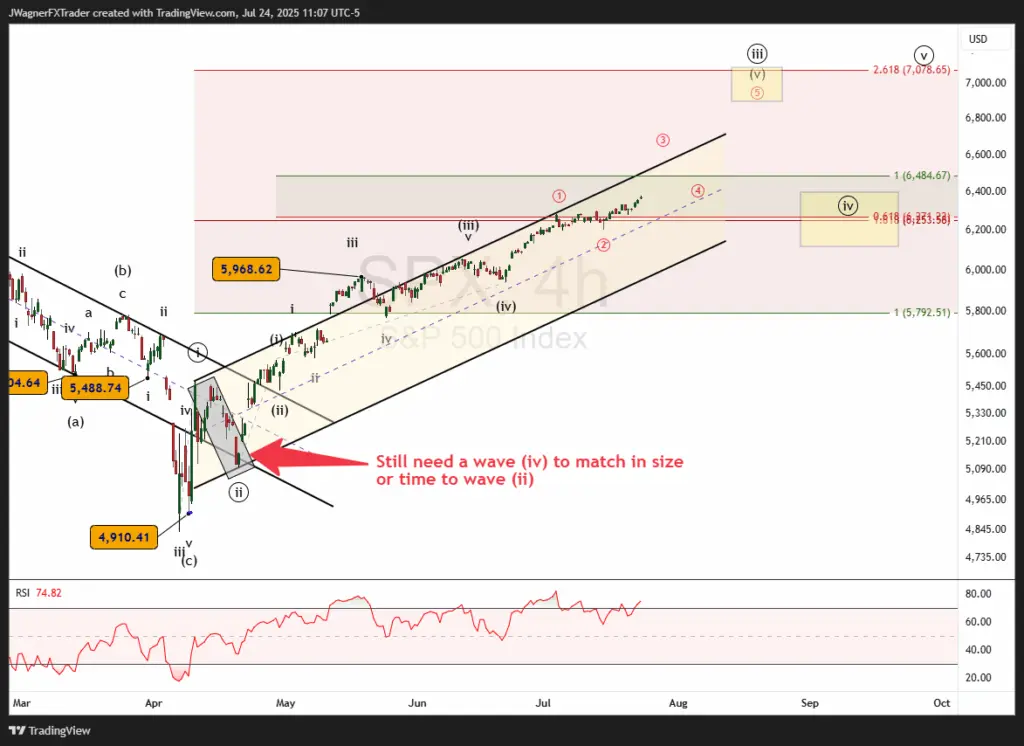
It appears SPX is still working higher in wave (v) of ((iii)). We can feel confident about this wave labeling because within an impulse, waves 2 & 4 are cousin waves. They tend to experience similar depths.

Once SPX bottomed in April, the largest interruption of the rally was wave 2 at 7 days long and about 7% in price.

Since April 21, the next largest decline was 3.5% or about half of the depth of what the market experienced in April. Therefore, we can confidently conclude that the cousin wave to wave ((ii)) has not arrived yet.

With some reverse engineering, we can then conclude that the recent rally is still simply wave ((iii)). When the next decline arrives, anticipate about a 5-8% haircut and we’ll label that as wave ((iv)) so it can match up with wave ((ii)).

How high might the current rally travel?

There is a wave relationship up near $7,000 where wave ((iii)) is a 2.618 Fibonacci extension of wave ((i)). Additionally, there exists round number resistance. Therefore, we are forecasting a wave ((iii)) top within the next 10%.

Once the wave ((iii)) top is in place, then wave ((iv)) likely travels to 6,300-6,650.

Bottom line

SPX remains in a strong bullish uptrend labeled wave ((iii)). The bullish pattern remains incomplete and may carry up to $7,000 with the next decline, wave (iv) anticipated to remain soft at 5-7%. 

Author

Zorrays Junaid

Zorrays Junaid

Alchemy Markets

Zorrays Junaid has extensive combined experience in the financial markets as a portfolio manager and trading coach. More recently, he is an Analyst with Alchemy Markets, and has contributed to DailyFX and Elliott Wave Forecast in the past.


More from Zorrays Junaid
Share:

Editor's Picks

EUR/USD flirts with daily highs, retargets 1.1900

EUR/USD regains upside traction, returning to the 1.1880 zone and refocusing its attention to the key 1.1900 barrier. The pair’s slight gains comes against the backdrop of a humble decline in the US Dollar as investors continue to assess the latest US CPI readings and the potential Fed’s rate path.

GBP/USD remains well bid around 1.3650

GBP/USD maintains its upside momentum in place, hovering around daily highs near 1.3650 and setting aside part of the recent three-day drop. Cable’s improved sentiment comes on the back of the Greenback’s  irresolute price action, while recent hawkish comments from the BoE’s Pill also collaborate with the uptick.

Gold clings to gains just above $5,000/oz

Gold is reclaiming part of the ground lost on Wednesday’s marked decline, as bargain-hunters keep piling up and lifting prices past the key $5,000 per troy ounce. The precious metal’s move higher is also underpinned by the slight pullback in the US Dollar and declining US Treasury yields across the curve.

Crypto Today: Bitcoin, Ethereum, XRP in choppy price action, weighed down by falling institutional interest 

Bitcoin's upside remains largely constrained amid weak technicals and declining institutional interest. Ethereum trades sideways above $1,900 support with the upside capped below $2,000 amid ETF outflows.

Week ahead – Data blitz, Fed Minutes and RBNZ decision in the spotlight

US GDP and PCE inflation are main highlights, plus the Fed minutes. UK and Japan have busy calendars too with focus on CPI. Flash PMIs for February will also be doing the rounds. RBNZ meets, is unlikely to follow RBA’s hawkish path.

Ripple Price Forecast: XRP potential bottom could be in sight

Ripple edges up above the intraday low of $1.35 at the time of writing on Friday amid mixed price actions across the crypto market. The remittance token failed to hold support at $1.40 the previous day, reflecting risk-off sentiment amid a decline in retail and institutional sentiment.













