S&P 500 Forecast: SPX clings to bottom trendline support
- S&P 500 is currently sitting directly on a significant support level.
- Economic data this week needs to ensure that inflation is not picking up.
- Major earnings results from Target, Salesforce and Kroger are in store.

The S&P 500 (SPX) is at a make-or-break juncture this week. Monday saw the index end 0.3% higher at 3,982, but price action dropped throughout the session and left SPX once again stranded on its bottom trendline. If that trendline snaps this week, it would likely send the index down nearly 5% to 3,800.
The S&P 500 index will respond to multiple economic indicators this week as well as several significant industry events. In regard to economic data, the S&P/Case-Shiller Home Price Index for December comes out Tuesday before the bell. Then the ISM Manufacturing PMI arrives on Wednesday, and initial jobless claims for February will be reported on Thursday. Friday gives Wall Street the ISM Services PMI.
Tesla (TSLA) will hold an investor day presentation on Wednesday, where CEO Elon Musk is expected to showcase the company's Austin, Texas factory. Goldman Sachs (GS) and Chevron (CVX) will also hold investor day events on Tuesday. Earnings from Target (TGT), Rivian (RIVN), Salesforce (CRM), Kroger (KR), Broadcom (AVGO) and Dell (DELL) could also make waves.
All the major US indices were on their front foot on Monday. The NASDAQ 100 finished up 0.7%, and the Dow Jones Industrial Average closed a more conservative 0.2%. This would appear to show us that growth stocks are back on the table this week after a poor showing last week. On Tuesday, the futures market shows stocks slightly up, but this time it favors blue chips narrowly. Dow futures are ahead 0.2% in the premarket, while S&P 500 and NASDAQ futures are up 0.1%.
S&P 500 news: Economic data a mixed bag, but Tesla could help
While the markets were initially still melancholy following last week's hot PCE inflation data, Monday's release of the US Durable Goods Orders for January dropped -4.5%. This was a stronger fall than the -4% consensus figure. On the other hand, Pending Home Sales rose 8.1% MoM in January, much higher than the expectation for 1%. This makes the first day of the week a mixed bag for equities.
The S&P/Case-Shiller Home Price Index for December came in lower than expected on Tuesday morning. Prices in December were up 4.6% YoY rather than the 6.1% expected, which shows that the Fed's interest rate hikes seem to be working for housing if not for inflation proper.
Tesla's investor day on Wednesday will become a real focal point for the week. A big announcement could spur enough bullish energy to push up the entire S&P 500. Rumors have already emerged that Elon Musk may unveil the company's "generation 3" platform, which is supposed to greatly decrease the cost of manufacturing and allow for a much cheaper mass-market Tesla. There are also expectations for more clarity surrounding Tesla's capital structure and even the possibility of an announced stock buyback policy.
The ISM Manufacturing PMI is projected at 48, and Friday's Services PMI holds the consensus at 54.5. This latter data point is the most significant of the week since much of the current inflation is tied to the services sector rather than goods. Initial jobless claims for the week of February 24 are projected at 197,000.
Expect earnings to lead sentiment for SPX
Earnings from major stocks in the S&P 500 will likely have a great affect on the week's trajectory. First, on Tuesday is Target. The retailer is expected to unveil quarterly earnings of $1.40 per share on revenue of $30.73 billion. Wall Street expects Salesforce on Wednesday to spit out adjusted EPS of $1.36 on revenue of $7.99 billion.
On Friday consensus has Kroger (KR), in the midst of its announced takeover of Albertson's, reporting GAAP EPS of $0.91 on revenue of $34.89 billion.
US stocks bearish, says Rob Arnott
Rob Arnott, Chairman of Research Associates, shares his bearish call on the US market with Bloomberg's Tom Keene on Monday:
“The most serious mistakes investors make are performance chasing and focusing strictly on domestic opportunities. I'm not bearish when things are cheap. Stocks outside the US are reasonably cheap. Value stocks outside the US are very cheap. [...] The US is priced at twice the valuation multiples of non-US stocks.”
S&P 500 technical analysis
The S&P 500 is narrowly clinging to a five-month bottom trendline. That trendline began on October 13 of last year and again worked as support on five occasions between the end of December and the first week of the new year. Since last Thursday, SPX has again been hugging this trendline. This time it comes in the midst of a harsh pullback from January's raucous rally. The 9-day moving average crossed below the 21-day moving average back on February 22, and the Moving Average Convergence Divergence (MACD) also shows the bearish pattern.
Friday's intraday price action actually saw a break below the trendline, which was pretty severe since it also momentarily broke below the 3,950 support level. However, price action again pushes SPX back up to the trendline to end the week. SPX desperately needs a rally to begin this week in order to leave this trendline behind. Otherwise, expect a break here to send the stock through the 3,950 short-term support level and down to 3,800. The latter level is where SPX found support in the final week of 2022. SPX needs to overtake the 9-day moving average, now at 4,045, in order to regain a bullish trend.
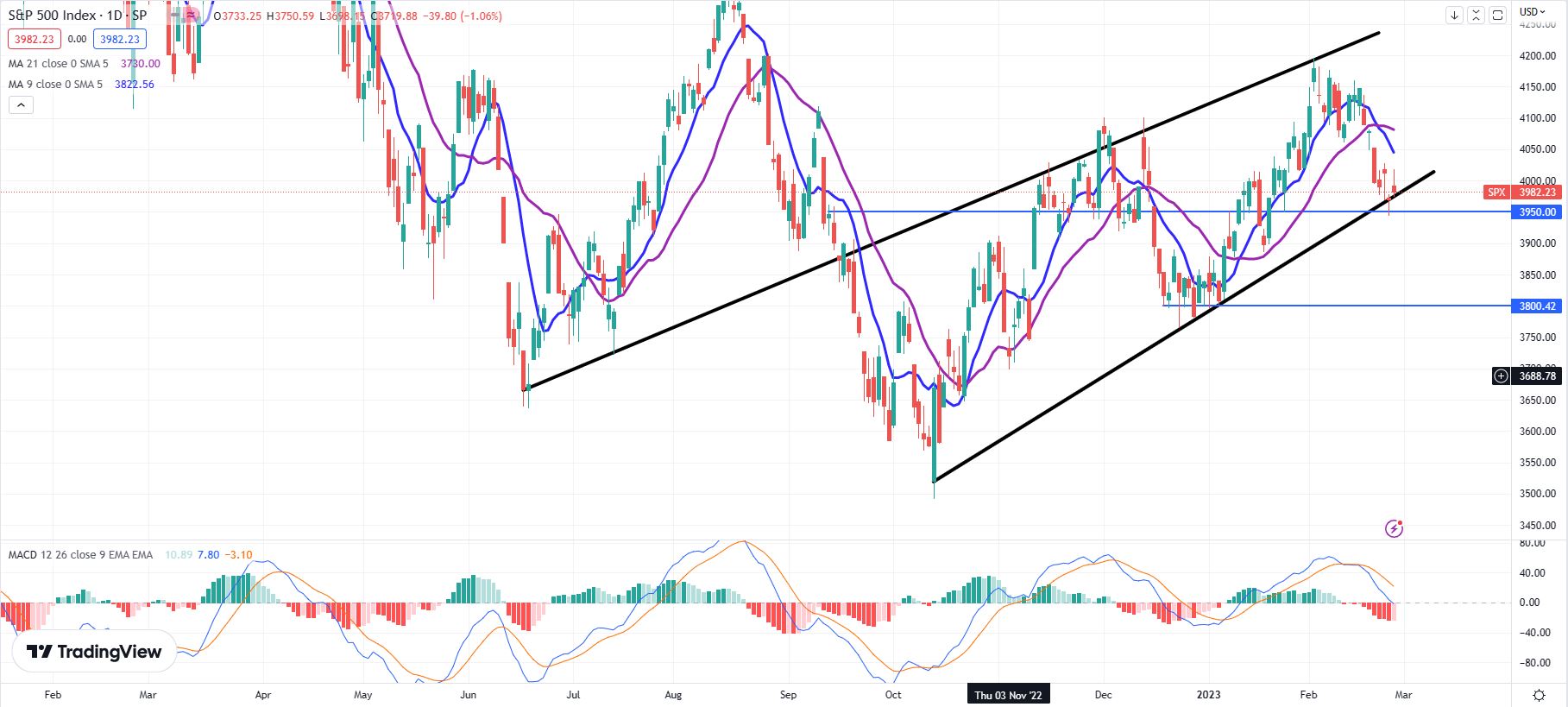
SPX 1-day chart
Author

Clay Webster
FXStreet
Clay Webster grew up in the US outside Buffalo, New York and Lancaster, Pennsylvania. He began investing after college following the 2008 financial crisis.