|

SNDL Stock News: Sundial Growers Inc gains as optimism buds on recent capital raise

  • NASDAQ:SNDL adds 5.52% amidst another turbulent day for the markets.
  • Sundial has raised millions in capital during its recent surge, and investors are starting to like it.
  • Sundial hopes to expand operations with its recent investment in Indiva. 

NASDAQ:SNDL continued its tumultuous week on Friday, as the small-cap Canadian cannabis company continues to be a retail investor favourite, despite financials that are not too impressive. On Friday, Sundial added 5.52% after starting the morning in the red and closed the trading week at $1.53. Considering the stock is maintaining its current price levels for now, it is impressive to think that just a year ago, this stock could be had for just a few pennies per share. 

The recent popularity of the stock has allowed management to continue to raise capital through stock offerings and other instruments. Investors seem to have come around on the offerings as long-term capital raising is usually beneficial for firms that are in rapid growth mode. The potential for organic growth and even targeting smaller players as acquisitions can really bolster a company’s outlook, especially in an industry like cannabis that has near unlimited potential in the long-term. The Canadian cannabis sector is about to get a bit of a shakeup as well when industry giants Tilray (NASDAQ:TLRY) and Aphria (NASDAQ:APHA) merge in the second quarter of 2021. How this will affect smaller firms like Sundial is yet to be seen.

SNDL stock forecast
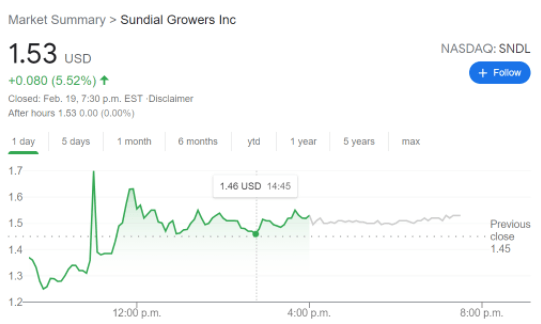
SNDL stock price chart

Sundial has already scaled up on its acquisitions as it recently acquired a small Canadian edibles company called Indiva. This gives Sundial just another foot in the rapidly expanding edibles market, where products such as candies, gummies, chocolate, and other food products are infused with CBD, THC, or sometimes even both. 

Author

More from Stocks Reporter
Share:

Editor's Picks

AUD/USD turns lower toward 0.7000 after mixed Australian jobs data

AUD/USD is losing ground toward 0.7000 in the Asian session on Thursday, following the release of the Australian August jobs report, which showed that the Unemployment Rate rose to 4.6% versus 4.5% expected, while Employment Change beat estimates, arriving at 39.5K. Traders also remain unnerved ahead of the critical Trump-Xi meeting.

USD/JPY keeps the red near 158.00 as Japanese Yen firms up

USD/JPY retreats from three-week highs and holds losses near 158.00 in the Asian session on Thursday. Surging Japanese bond yields lift the Yen amid looming intervention risks, while the US Dollar preserves overnight gains to a two-month high amid hawkish Fed bets and elevated US bond yields.

Gold bounces off lows, still below $4,300

Gold builds on Wednesday’s retracement, briefly slipping back below $4,250 per troy ounce to attempt a lacklustre rebound afterwards. The better tone in the US Dollar, rising US Treasury yields and expectation of extra rate hikes by the Fed continue to weigh on the precious metal in the latter part of Thursday’s NA session.

XRP is flashing three bullish signals heading into a historically weak October
XRP (XRP) is still flashing 3 bullish signals across its holders, derivatives, and ETF data. These signals come as the token gave back part of its September gains on Thursday. The token traded near $1.50 at press time, down about 6.3% over 24 hours, according to BeInCrypto Markets data. The pullback still leaves XRP up over 15.6% on the week, a gain that tracks a broader market rally.
Advanced economies: From one example of resilience to another
History tends to repeat itself in advanced economies. Once again, growth ultimately fell short of expectations by only a small margin in the first half of 2026, despite the conflict in Iran. As early as 2025, the impact of tariffs was less severe than feared.
BoJ Recap: Not as hawkish as expected

The Bank of Japan (BoJ) raised its short-term interest-rate target to 1.25% from 1.00% in a 7-2 vote, marking another step in the normalisation of monetary policy and widely matching what everyone has been expecting for weeks.