SNDL Stock Forecast: Sundial is a way to get high, but it is way too high
- Sundial shares are strongly favoured by retail investors.
- Cannabis stocks are one of the sectors in vogue as the US cannabis market steadily legalizes.
- SNDL shares are volatile as the balance sheet has cash but features too much dilution.


SNDL shares are unusually steady for the last few sessions as evidence of retail fizz dampens somewhat. The cannabis sector has been on a charge over the last number of months. The new US administration is seen as more open to cannabis legislation, and a growing (excuse the pun!) number of US states have legalized recreational use. Retail investors have seized on this development to push many cannabis shares higher.
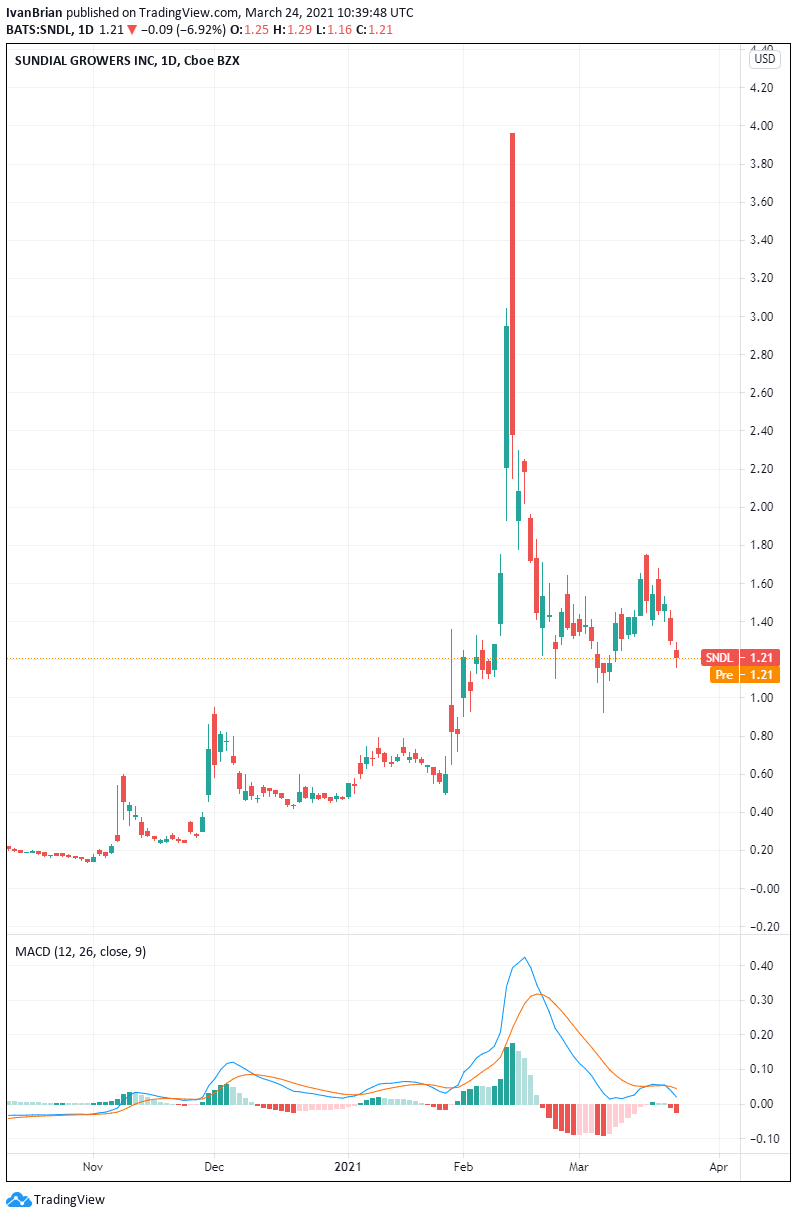
Sundial closed out December 2020 at sub $0.50 but by mid-February had reached nearly $4. It may be nice to get high, but this was too much, man! SNDL shares have retreated to sub $2 for most of March, trading in the $1.20-$1.80 range.
Just in case you missed it, Sundial is a Canadian cannabis company headquartered in Alberta and listed on the Nasdaq.
SNDL stock news
Sundial announced on Monday, March 15 that it will form a 50/50 joint venture with SAF Opportunities LP (part of SAF Group). According to the statement released by Sundial earlier on Monday, the JV will look to generate opportunities in the cannabis industry.
Most catching for retail investors is the venture could lead to the formation of a special opportunities fund with a potential Canadian SPAC in the pipeline. As we know from the Churchill Lucid SPAC deal, retail investor interest in the SPAC sector is currently at a fever pitch, and this development from Sundial will likely find favour with retail investors. SNDL shares spiked 14% on the news.
Sundial has been raising and spending cash. On February 4 SNDL announced the closing of a registered offering for $74.5 million, before deducting for underwriting and offering expenses. After the raise, Sundial has unrestricted cash of approximately $610 million, not counting securities and loans receivable of approximately $61 million.
This marks a remarkable improvement from 2020. In late 2020, SNDL announced it had become debt-free.
"While many cannabis companies have significant debt burdens, Sundial is proud to announce that we are now debt-free," said Zach George, Sundial's CEO.
On March 17 Sundial announced mixed Q4 2020 results. Revenue did grow 10%, but the company still posted a sizeable loss of C$64 million. Sundial is valued at a market cap of $2.4 billion, which given its revenue and lack of profitability is quite high.
Given that Sundial has been raising cash through dilutive share issuances, it is not an investible option for me personally. As recently as Monday, Sundial said it may offer and sell further shares up to a value of $800 million, according to Reuters. This would further dilute existing shareholders.
SNDL has embarked on a number of cash-raising initiatives. Yes, it now has plenty of cash on its balance sheet for expansion or partnership acquisitions, but SNDL needs to put this cash to use. Companies have to take advantage of favourable market conditions, but repeatedly diluting shareholders is not good for a long-term investment thesis in my opinion unless the cash is used to increase shareholder returns. So far there is not enough evidence for me despite some of the partnerships. On Dec 21, 2020, Sundial had 840 million shares outstanding. But by February 4, 2021, it had 1.56 billion shares outstanding.
Every effort has been made to accurately report the appropriate dollar currency US$ or CAD$. But readers must exercise caution as Sundial is a Canadian company reporting in CAD, listed in the US Nasdaq exchange, but news providers typically convert into $US for earnings comparisons. In some cases, it is not clear in reports from news providers and Sundial which dollar CAD or US is being reported as just the $ symbol is used. For the most part, Sundial does specify CAD$ in press releases unless otherwise stated and this assumption is used in statements above re cash reserves.
The author has no position in any stock mentioned in this article and no business relationship with any company mentioned. The author has not received compensation for writing this article, other than from FXStreet.
This article is for information purposes only. The author and FXStreet are not registered investment advisors and nothing in this article is intended to be investment advice. It is important to perform your own research before making any investment and take independent advice from a registered investment advisor.
FXStreet and the author do not provide personalized recommendations. The author makes no representations as to accuracy, completeness, or the suitability of this information. FXStreet and the author will not be liable for any errors, omissions or any losses, injuries or damages arising from this information and its display or use. The author will not be held responsible for information that is found at the end of links posted on this page.
Errors and omissions excepted.
Premium
You have reached your limit of 3 free articles for this month.
Start your subscription and get access to all our original articles.
Author
Ivan Brian
FXStreet
Ivan Brian started his career with AIB Bank in corporate finance and then worked for seven years at Baxter. He started as a macro analyst before becoming Head of Research and then CFO.

















