Silver’s bearish bias intact, gradual move towards 200DMA near $24.00 likely
- Spot silver is consolidating in the low $25.00s in Monday ahead of key risk events later in the week.
- Technically speaking, the precious metal’s technical bias remains bearish with a move towards the 200DMA near $24.00 likely.


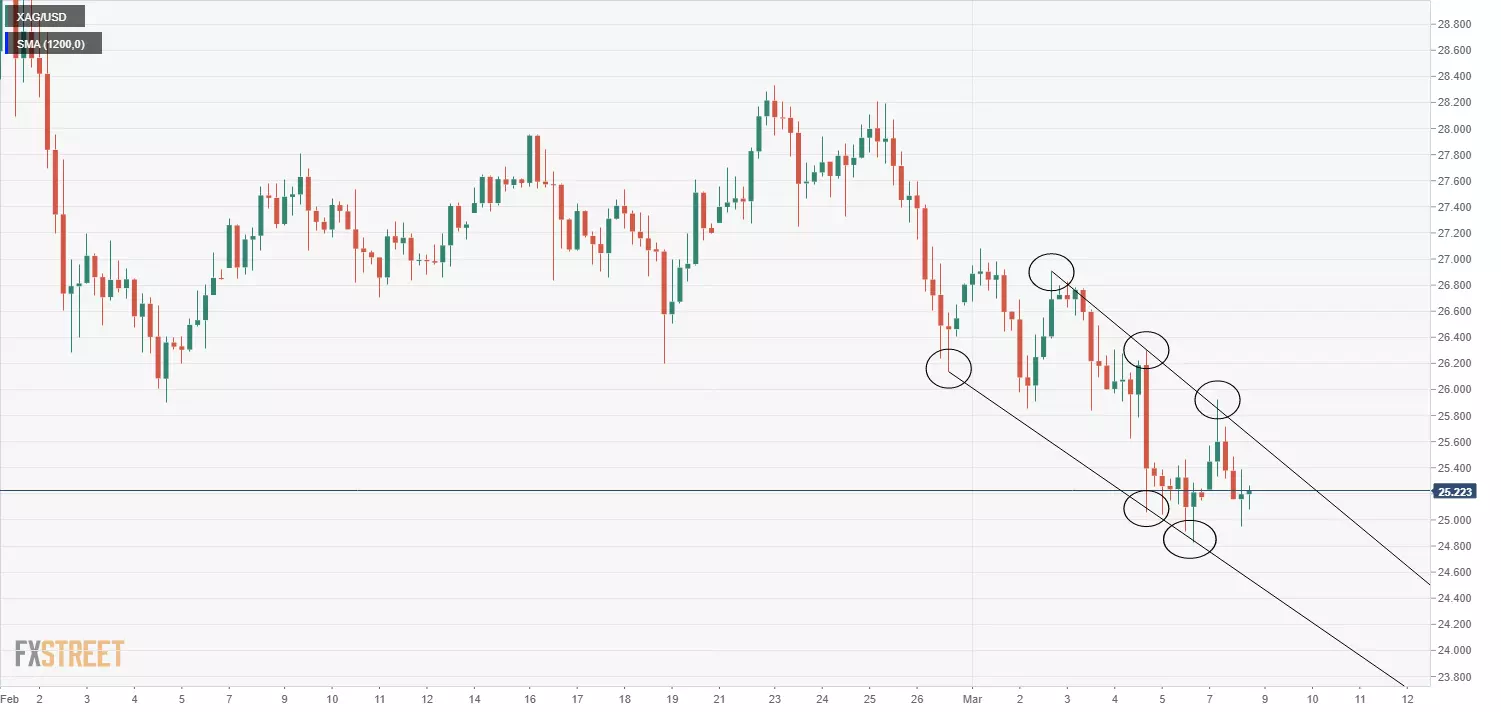
Spot silver prices (XAG/USD) continue to consolidate just to the north of the $25.00 level, as they have since the start of US trade. The precious metal’s recent negative bias appears intact, however, given Monday morning’s price action. XAG/USD is trading within a descending trend channel, the lower bounds of which link the 26 February, 4 and 5 March lows and the upper bounds of which link the 2, 3 and now 8 March highs. Should silver continue to edge lower within the bounds of this trend channel, it seems likely a break below the $25.00 level is in store and then eventually a move on towards the precious metal’s 200-day moving average at just above the $24.00.
Driving the day
Neither stronger than forecast US Wholesale Trade Sales numbers for January (up 4.3% on the month versus expectations for a 1.4% increase) nor an improvement in the US Conference Board’s Employment Trends Index to 101.01 in February from 99.69 in January has been enough to stir the pot for the US dollar, precious metals or markets more broadly.
Consolidative trade is somewhat unsurprising on Monday given incoming risk events later in the week that could really shake things up; Wednesday sees the release of the US Consumer Price Inflation report for February – markets expect a jump in the YoY rate of inflation to 1.7% (and then to go above 2.0% in the months ahead) and a stronger than expected print could give US bond yields further reason to rally (this could be bad for precious metals). Also on Wednesday; the next US government 10-year note auction – if the auction was to go badly, would be another reason for yields to rally. Meanwhile, US Weekly Jobless Claims on Thursday and Producer Price Inflation and Michigan Consumer Sentiment on Friday will both also be in the spotlight.
XAG/USD four hour chart
Author
Joel Frank
Independent Analyst
Joel Frank is an economics graduate from the University of Birmingham and has worked as a full-time financial market analyst since 2018, specialising in the coverage of how developments in the global economy impact financial asset