Silver Price Forecast: XAG/USD climbs steadily and tests the $22.00 mark
- Silver (XAG/USD) modestly advances but faces strong resistance around $22.00; so far is up 1.25% in the week.
- Risk-aversion keeps precious metals buoyant while the greenback and US Treasury yields fall.
- Silver Price Forecast (XAG/USD): A daily close above $22.00 would open the door for further gains; otherwise, the downtrend would resume.

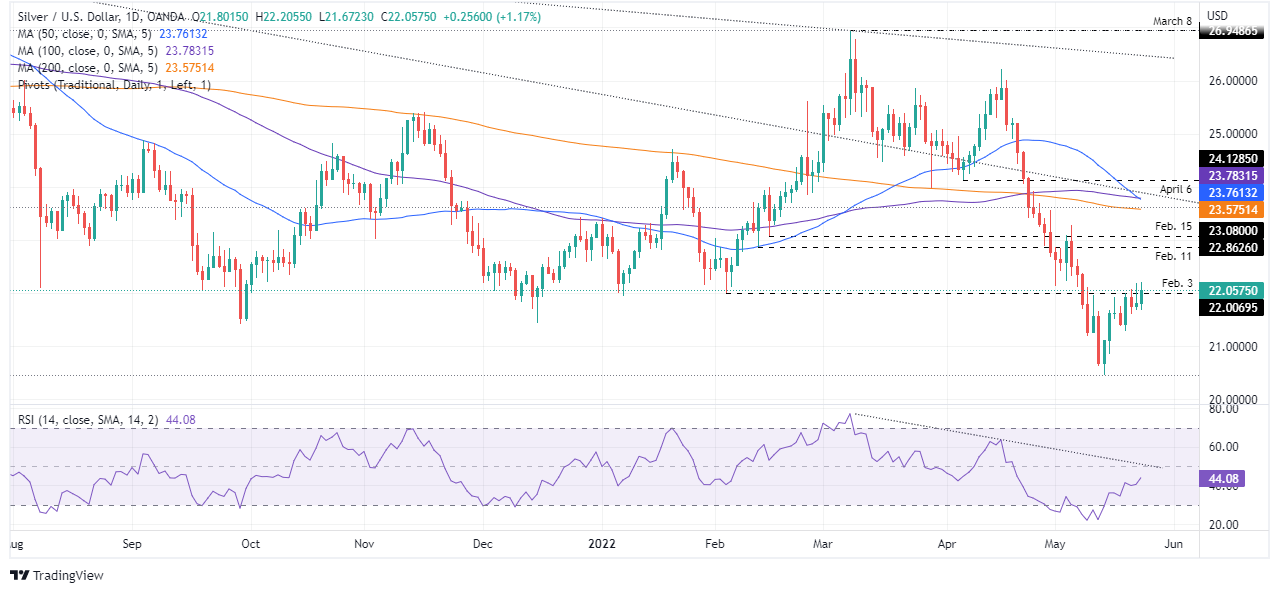
Silver (XAG/USD) registers gains but appears to be glued to the $22.00 mark, as XAG/USD bulls failed to record a daily close above the $22.00 area for four consecutive days, albeit a dampened market mood. At the time of writing, the XAG/USD is trading at $22.05.
Precious metals climb on the US weaker economic outlook
US equities keep illustrating a dampened market mood in tone with the Asian and European sessions. S&P Global PMIs revealed that Europe and the US presented mixed results, increasing investors’ concerns that Europe and the US might suffer a possible economic slowdown. The supply chain issues continue, and higher costs from raw materials would keep inflationary pressures elevated.
Given the backdrop that the Federal Reserve is tightening monetary conditions in the US and is about to hike 50-bps in the June and July meetings, concerns about the US central bank achieving a soft or “softish landing,” as Fed Chair Powell said, look far to be done. That’s why market players keep the US stock market downward pressured and the US dollar softer.
The US Dollar Index, a gauge of the greenback’s value against a basket of its rivals, slides 0.24% and is down at 101.850. Failure to reclaim the 102.000 mark would open the door for a retest of April 21 swing low at 99.818. On the same note, the 10-year US Treasury yield grinds lower and loses almost ten basis points (bps), sitting at 2.761%, a tailwind for Silver prices.
Elsewhere, Atlanta’s Fed President Raphael Bostic crossed the wires, though he sounded less “hawkish” than usually. Bostic said that rate hikes won’t cause a recession and that the central bank can hike rates to deal with overly high inflation without sending the US economy into recession. He stated that the US central bank could pause rate increases in September to review how the economy performs.
Macroeconomic-wise, the US docket featured the US S&P Global PMIs for May, which illustrated mixed results, with the Services and Composite Indexes missing expectations while the Manufacturing PMI was unchanged. Furthermore, Richmond’s Fed Manufacturing Index plunged to -14 vs. 15 foreseen, adding to the Fed regional manufacturing reports showing deceleration or contraction.
Silver Price Forecast (XAG/USD): Technical outlook
XAG/USD is still downward biased, despite recording gains for the third day out of the last four. However, it’s important that XAG/USD traders, need to be aware that Silver has struggled at the $22.00 mark. Failure at the previously mentioned would resume the downtrend and open the door for further losses.
If that scenario plays out, the XAG/USD’s first support would be the May 19 pivot low at $21.28. Break below would expose the May 16 daily low at $20.84, followed by the YTD low at $20.45. However, if XAG/USD’s bulls accomplish a daily close above the $22.00 mark, that could allow further gains. The XAG/USD first resistance would be the psychological $23.00 mark. Once cleared, the next supply zones would be the May 5 swing high at $23.28, followed by a test of the 200-DMA at $23.57.
Author

Christian Borjon Valencia
FXStreet
Markets analyst, news editor, and trading instructor with over 14 years of experience across FX, commodities, US equity indices, and global macro markets.
















