|

Silver Price Analysis: XAG/USD drifts lower in a multi-week-old trading range, below 200-day SMA

  • Silver remains under some selling pressure for the second successive day on Tuesday.
  • The formation of a rectangle points to indecision over the next leg of a directional move.
  • The technical setup favours bearish traders and supports prospects for additional losses.

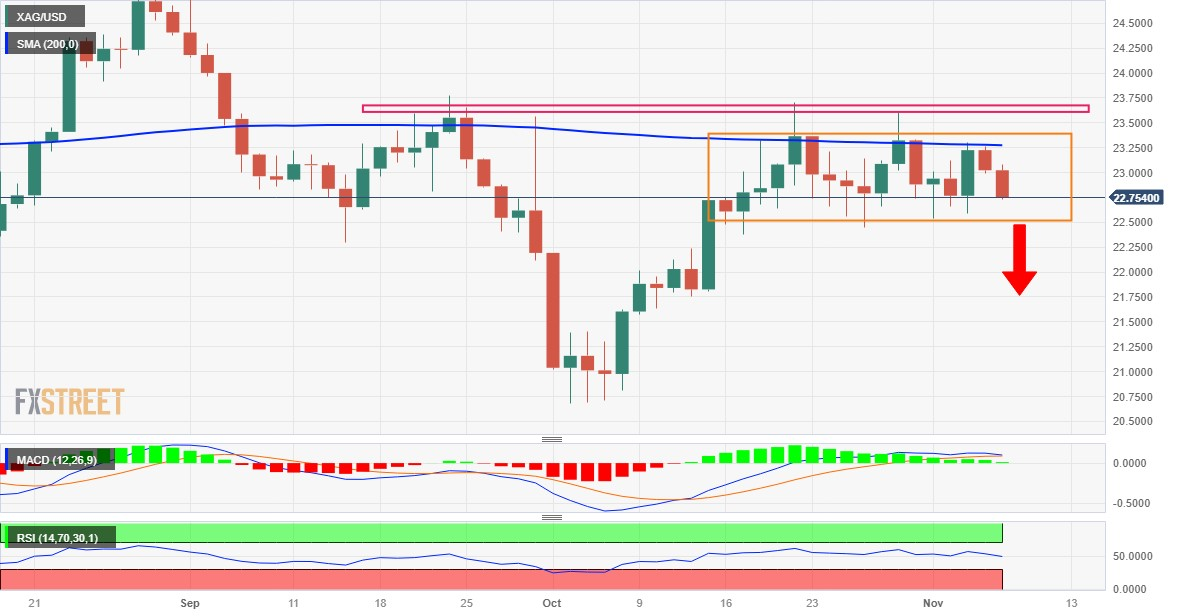
Silver (XAG/USD) extends the previous day's rejection slide from the very important 200-day Simple Moving Average (SMA) and continues losing ground for the second successive day on Tuesday. The downward trajectory picks up pace during the early part of the European session and drags the white metal to a two-day low, around the $22.75-$22.70 region in the last hour.

Looking at the broader picture, the XAG/USD has been oscillating in a familiar range over the past three weeks or so, forming a rectangle on the daily chart. This, in turn, points to indecision among traders over the next leg of a directional move. That said, the recent repeated failures to find acceptance above a technically significant 200-day SMA and rejections near the $23.60-$23.70 supply zone favour bearish traders.

Moreover, technical indicators on the daily chart have again started gaining negative traction, suggesting that the path of least resistance for the XAG/USD is to the downside. That said, it will still be prudent to wait for some follow-through selling below the $22.50 support zone before positioning for additional losses. The XAG/USD might then accelerate the fall to the $22.00 mark before dropping to the $21.70 horizontal support zone.

The downward trajectory could get extended further and drag the XAG/USD to the next relevant support near the $21.35-$21.30 region en route to the $21.00 mark. Bearish traders might then aim to challenge a seven-month low, around the $20.70-$20.65 area touched in October.

On the flip side, the $23.00  mark now seems to cap the immediate upside ahead of the 200-day SMA, currently pegged near the $23.25 region. This is followed by the $23.60-$23.70 supply zone, which should act as a key pivotal point for short-term traders. A sustained breakout through will negate the negative outlook and shift the near-term bias in favour of bullish traders, paving the way for a move towards the $24.00 mark.

Some follow-through buying has the potential to lift the XAG/USD beyond the $24.20-$24.25 intermediate resistance and make a fresh attempt to conquer the $25.00 psychological mark.

Silver daily chart
fxsoriginal

Technical levels to watch

XAG/USD

Overview
Today last price22.74
Today Daily Change-0.28
Today Daily Change %-1.22
Today daily open23.02
 
Trends
Daily SMA2022.8
Daily SMA5022.86
Daily SMA10023.19
Daily SMA20023.28
 
Levels
Previous Daily High23.26
Previous Daily Low22.99
Previous Weekly High23.61
Previous Weekly Low22.54
Previous Monthly High23.7
Previous Monthly Low20.68
Daily Fibonacci 38.2%23.09
Daily Fibonacci 61.8%23.16
Daily Pivot Point S122.92
Daily Pivot Point S222.82
Daily Pivot Point S322.65
Daily Pivot Point R123.19
Daily Pivot Point R223.36
Daily Pivot Point R323.46

Author

Haresh Menghani

Haresh Menghani is a detail-oriented professional with 10+ years of extensive experience in analysing the global financial markets.


More from Haresh Menghani
Share:

Editor's Picks

AUD/USD pulls back from monthly high but holds above 0.7000

AUD/USD retreats from the monthly high set earlier this Thursday, sliding back to 0.7000 during the Asian session as a further escalation of tensions in the Middle East undermines the risk-sensitive Aussie. However, recent hawkish comments from RBA officials could support the Australian Dollar. Furthermore, the prevailing US Dollar selling bias, despite Fed hike bets and geopolitical uncertainties, could limit losses for the pair.

USD/JPY declines to a one-week low; eyes trading range support near 157.50 on weaker USD

USD/JPY drops to a one-week low during Thursday’s Asian session, with bears now awaiting a break below multi-week range support near mid-157.00s before placing fresh bets amid a broadly weaker US Dollar. Despite bets for a December Fed rate hike and Middle East jitters, the recent decline in US bond yields keeps USD depressed near a three-week low. Moreover, hawkish BoJ expectations and intervention risks underpin the Japanese Yen, further weighing on the currency pair.

Gold bounces off monthly low as USD selling remains unabated amid falling bond yields

Gold pares heavy intraday losses to the monthly trough, though it retains an intraday bearish tone below $4,100 during Thursday’s early European session. The US Dollar selling bias remains unabated as Federal Reserve officials recently signaled there is no urgency to raise interest rates at the upcoming October 27–28 meeting. Furthermore, US bond yields extend their retracement slide from multi-year highs, keeping USD bulls on the back foot and offering some support to the precious metal.

Dogecoin stays weak despite whales and new deal

Dogecoin price remains under pressure, trading below $0.081 despite a modest rebound earlier this week. Santiment data shows signs of accumulation, and Wednesday’s announcement of a Dogecoin Labs partnership with the Dogecoin Foundation adds a mildly bullish sentiment. Meanwhile, mixed derivatives metrics and weakening momentum indicators continue to limit the meme coin recovery.

Dow Jones Industrial Average climbs with the AI trade, led by a bank

The Dow Jones Industrial Average got most of its share of Wednesday's artificial intelligence (AI) rally from a bank and a bulldozer maker. The index closed near 52,800, its highest close since early September. SpaceX (SPCX) reported 161% revenue growth and the Nasdaq Composite rose more than 1%, but under price weighting the gains that counted most belonged to Goldman Sachs (GS) and Caterpillar (CAT).

The US Dollar fell. Gold didn't rally. That tells you everything
Gold (XAU/USD) is struggling to capitalize on a weaker US Dollar (USD), after repeatedly failing to establish itself above the $4,200 level. The precious metal remains confined to a relatively narrow trading range despite a combination of developments that would normally support higher prices.