|

Silver Miners ETF (SIL) rides strong bullish wave

The Global X Silver Miners ETF (SIL), launched in April 2010, tracks the Solactive Global Silver Miners Total Return Index, offering exposure to silver mining companies like Wheaton Precious Metals and Pan American Silver. With over $1 billion in assets, SIL provides a volatile yet targeted investment option for those seeking to capitalize on silver price movements through mining equities. Below we will look at the Elliott Wave path of the instrument.

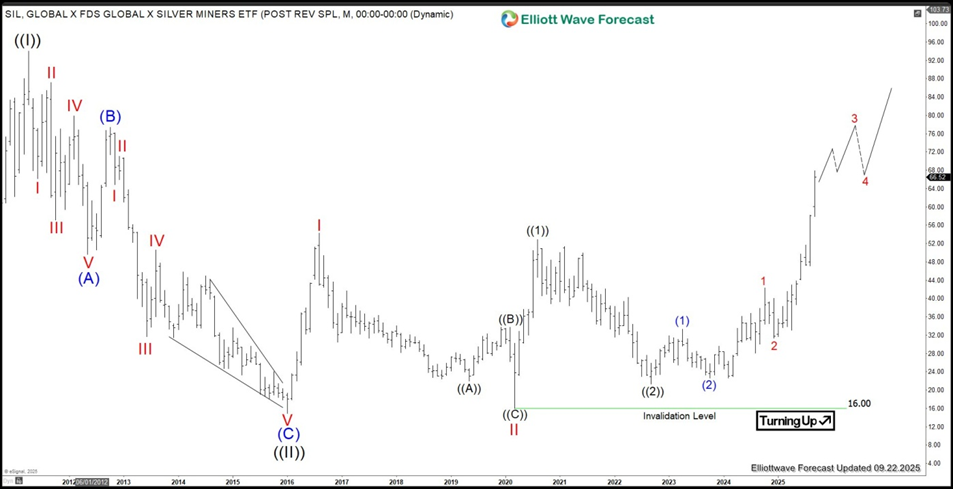
SIL (Silver Miners ETF) monthly Elliott Wave chart
Chart

The monthly Elliott Wave chart indicates that the Silver Miners Junior ETF (SIL) formed a Grand Super Cycle wave ((II)) low at $14.94 in January 2016. Since then, it has rallied strongly in a nested impulse structure. From the wave ((II)) low, wave I peaked at $54.34, followed by a wave II pullback to $16. Wave III is currently unfolding as another impulse. The rally from the wave II low completed wave ((1)) at $52.87. A subsequent dip in wave ((2)) concluded at $21.26. As long as the $16 pivot low holds, the ETF is expected to continue its upward trajectory.

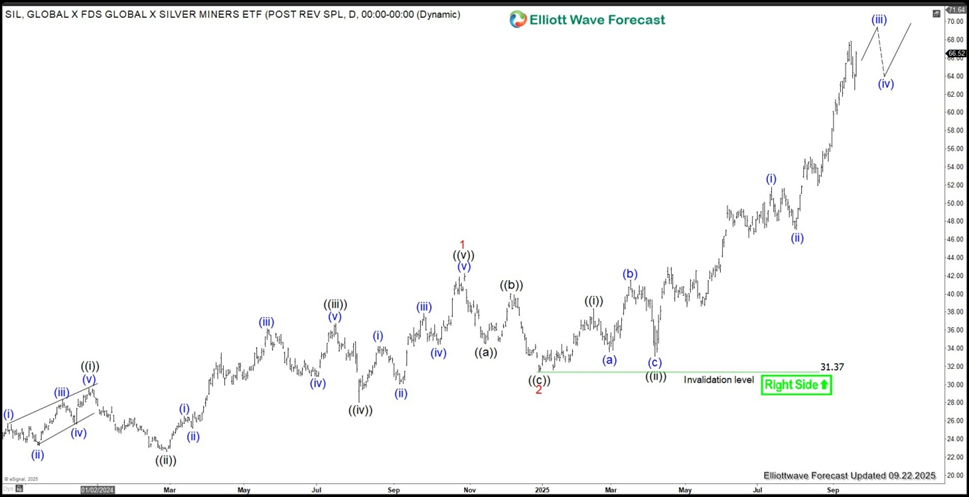
Silver Miners ETF daily Elliott Wave chart
Chart

The daily chart for the Global X Silver Miners ETF (SIL) shows a rally from the September 1, 2022 low is unfolding as a nested impulse structure. From this low, wave (1) peaked at $33.24, followed by a wave (2) pullback to $22.57. The ETF then extended higher in wave (3), structured as another impulse. Within wave (3), wave 1 concluded at $42.29, with a wave 2 pullback ending at $31.37. In the near term, as long as the $31.37 pivot low remains intact, the ETF should continue its upward trend.

Author

Elliott Wave Forecast Team

Elliott Wave Forecast Team

ElliottWave-Forecast.com

More from Elliott Wave Forecast Team
Share:

Editor's Picks

GBP/USD keeps the firm tone above 1.3600

GBP/USD clings to its daily gains, although it gives back some of them and recedes toward the 1.3630-1.3620 band on Thursday. Cable’s uptick comes despite the modest bounce in the Greenback, while investors gear up for key data releases on the UK calendar on Friday.

EUR/USD treads water near 1.1670

EUR/USD gives away all its initial gains and receded to the sub-1.1700 region. The US Dollar’s late recovery has dragged the pair lower, leaving it practically unchanged following the NA session on Thursday. In the meantime, investors gear up for the release of preliminary S&P Global Manufacturing and Services PMIs on both sides of the Atlantic on Friday.

Gold trims losses, back above $4,500

Gold manages to regain some composure and reclaim the area beyond the key $4,500 mark per troy ounce on Thursday. The yellow metal’s daily decline comes amid the humble improvement in the US Dollar while US Treasury yields remain on the rise following Wednesday’s marked retracement across the curve.

XRP extends rally as bullish technical signals underpin breakout attempt

Ripple holds in bullish hands, as price action extends above $1.16 at the time of writing on Thursday. Since Monday, the cross-border remittance token has surged by more than 20%, reflecting a steady growth in risk-on sentiment. The broader crypto market sentiment is on an upward roll at 62 in the Greed territory on Thursday, up from 46 the previous day, according to the Fear & Greed Index.

Why long bonds have repriced the cost of money
The 30-year Treasury is 12 basis points below its highest level since before the financial crisis. Not its highest since 2023, or since the tightening cycle, but since June 12, 2007, the last time the longest bond in the world's deepest market yielded what it yields on Thursday. Getting there took two attempts and most of the year.
$20 billion offered, $2 billion taken: Why Treasury doubled its buyback cap

The US Treasury moved off its own calendar on Wednesday, and that is the part worth sitting with. At 12:32 GMT, the department said it would at least double the size of liquidity support buyback operations in the 10-year to 20-year and 20-year to 30-year sectors, lifting the maximum from $2 billion per operation to at least $4 billion, effective September 9 and running to November 4.















