Silver consolidates near 14-year high as weak NFP data boosts Fed cut bets
- Silver consolidates near $41.00, holding just below its 14-year peak with bullish structure intact.
- US NFP miss fuels Fed cut bets, dragging the US Dollar and Treasury yields lower.
- Markets price in 88% chance of a 25 bps Fed cut and 12% odds of a larger 50 bps move this month.

Silver (XAG/USD) is holding firm around $41.00 on Friday after retesting multi-year highs in the wake of soft US Nonfarm Payrolls (NFP) data. The metal peaked at $41.47 on Wednesday, its strongest level since September 2011, before easing slightly on Thursday. A broadly weaker US Dollar (USD) and falling Treasury yields after the disappointing jobs report are fueling fresh buying interest, with markets now increasingly convinced the Federal Reserve (Fed) will cut rates later this month.
The US economy added just 22K jobs in August, far below the 75K forecast, while the Unemployment Rate climbed to 4.3%, its highest since late 2021. Wage growth held steady at 0.3% MoM and 3.7% YoY. The weak report confirmed the labor market is cooling, echoing earlier signs from slowing ADP payrolls, falling JOLTS Job Openings, rising Initial Jobless Claims, and ISM employment gauges stuck in contraction.
Before the data, traders were fully pricing in a 25 basis point (bps) cut at the Fed’s September 16-17 meeting. Following the weak NFP release, markets are now assigning about a 12% chance of a larger 50 bps move, up from zero previously, while the probability of a 25 bps cut remains near 88%. The repricing weighed heavily on the Greenback with the US Dollar Index (DXY) falling to its lowest level since 28 July before stabilizing somewhat above 97.50.
The data also aligns with comments from Fed Chair Jerome Powell at the Jackson Hole symposium in late August, where he cautioned that labor market risks were rising and the Fed’s dual mandate was under pressure. Powell emphasized that inflation and employment were “poised to move in opposite directions,” signaling that policymakers were prepared to prioritize job stability and adjust policy more aggressively if employment conditions weakened further.
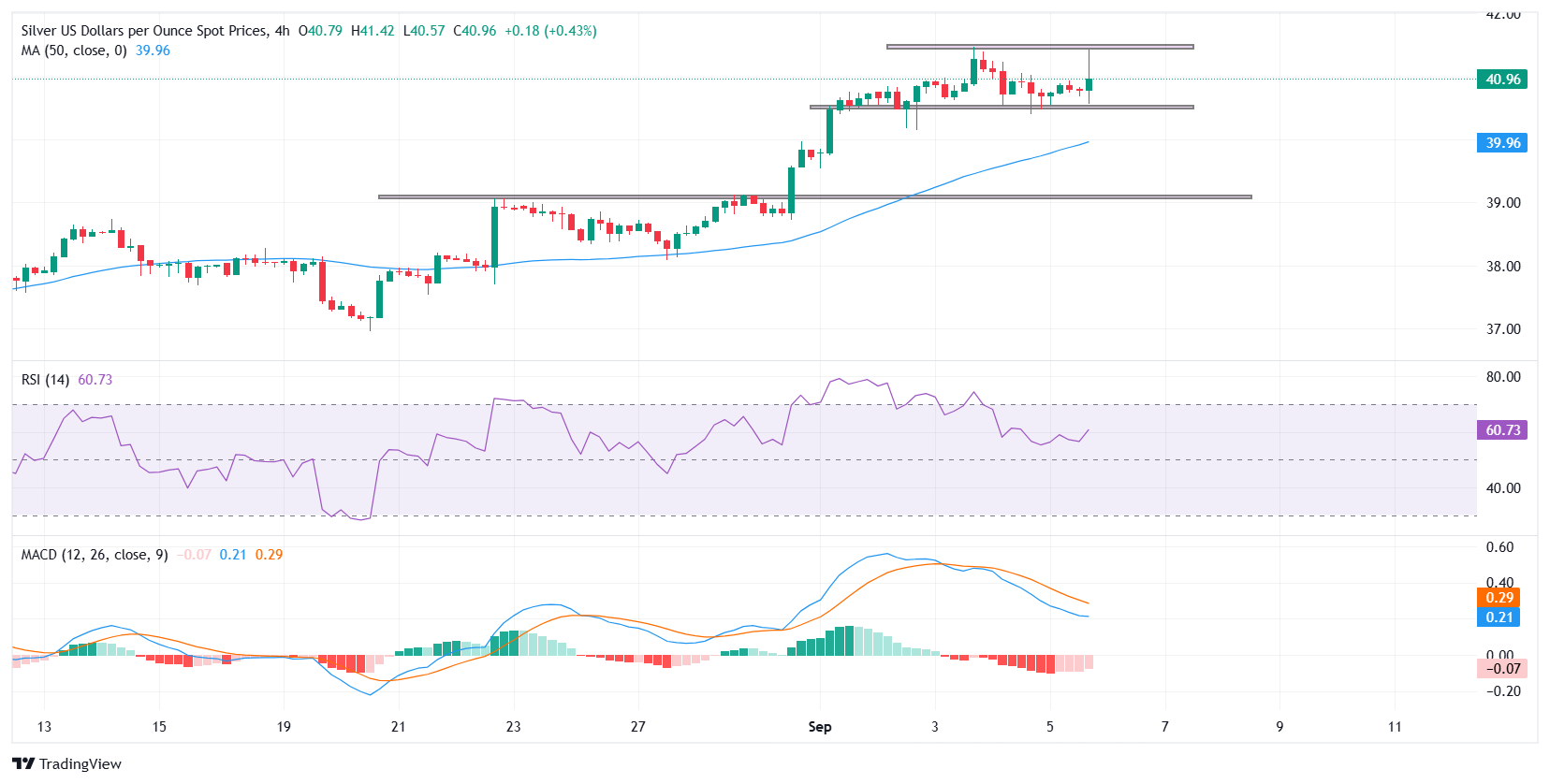
From a technical perspective, Silver is consolidating just below its recent 14-year peak of $41.47, keeping its bullish structure intact. Immediate support is seen at $40.50, while stronger support lies at the 50-period Simple Moving Average (SMA) on the 4-hour chart near $39.96. A further floor is established around the $39.00 breakout zone. On the upside, resistance is aligned at $41.50, followed by the psychological $42.00 level.
The Relative Strength Index (RSI) is hovering near 60, suggesting conditions are positive but not overbought, leaving room for further gains. The Moving Average Convergence Divergence (MACD) remains in positive territory, though narrowing histogram bars signal slowing momentum in the near term. Overall, as long as Silver holds above $40.50, dips are likely to attract buyers, with focus on a break above $41.50 that could open the path toward the $42.00 level.
Silver FAQs
Silver is a precious metal highly traded among investors. It has been historically used as a store of value and a medium of exchange. Although less popular than Gold, traders may turn to Silver to diversify their investment portfolio, for its intrinsic value or as a potential hedge during high-inflation periods. Investors can buy physical Silver, in coins or in bars, or trade it through vehicles such as Exchange Traded Funds, which track its price on international markets.
Silver prices can move due to a wide range of factors. Geopolitical instability or fears of a deep recession can make Silver price escalate due to its safe-haven status, although to a lesser extent than Gold's. As a yieldless asset, Silver tends to rise with lower interest rates. Its moves also depend on how the US Dollar (USD) behaves as the asset is priced in dollars (XAG/USD). A strong Dollar tends to keep the price of Silver at bay, whereas a weaker Dollar is likely to propel prices up. Other factors such as investment demand, mining supply – Silver is much more abundant than Gold – and recycling rates can also affect prices.
Silver is widely used in industry, particularly in sectors such as electronics or solar energy, as it has one of the highest electric conductivity of all metals – more than Copper and Gold. A surge in demand can increase prices, while a decline tends to lower them. Dynamics in the US, Chinese and Indian economies can also contribute to price swings: for the US and particularly China, their big industrial sectors use Silver in various processes; in India, consumers’ demand for the precious metal for jewellery also plays a key role in setting prices.
Silver prices tend to follow Gold's moves. When Gold prices rise, Silver typically follows suit, as their status as safe-haven assets is similar. The Gold/Silver ratio, which shows the number of ounces of Silver needed to equal the value of one ounce of Gold, may help to determine the relative valuation between both metals. Some investors may consider a high ratio as an indicator that Silver is undervalued, or Gold is overvalued. On the contrary, a low ratio might suggest that Gold is undervalued relative to Silver.
Author

Vishal Chaturvedi
FXStreet
I am a macro-focused research analyst with over four years of experience covering forex and commodities market. I enjoy breaking down complex economic trends and turning them into clear, actionable insights that help traders stay ahead of the curve.
















