Relax, the bubble fails to burst (again)
- Valuations not a concern for big tech.
- Fundamentals remain strong enough to support this rally.
- Signs of stabilization for the labour market.


US stocks have opened higher today and the sell off from GTuesday has failed to develop into something more sinister. In early trading during the US session the US tech sector does not look like it is on the cusp of bursting, and the Nasdaq is higher by 0.4% so far on Wednesday.
This does not mean that tech is off the hook, some tech stocks clearly have valuations that are too high to justify. Palantir is one such company, although it has huge potential for the future, and its stock is down by another 4% today.
Valuations not a concern for big tech
However, the selloff has not broadened out to many of the biggest names in the tech sector. We believe that the reason for this is that they do not look expensive compared to history, for example Amazon, Meta, Tesla, AMD and Nvidia all have lower P/E ratios than their 10-year average.
Valuation concerns do not tend to cause a sell off by themselves, but high valuations can exacerbate a sell off, which is what we saw on Tuesday. However, the question investors want to know is whether an AI bubble is forming and if it will burst. We would say no, for a few reasons.
Fundamentals remain strong enough to support this rally
The price to earnings ratio for the S&P 500 is 25, and for the Nasdaq 100 it is 31. This is above 5-year averages, but it is not so high that it could generate a sell off based on valuations alone. Added to this, both the Nasdaq 100 and the S&P 500 have strong gross margins. The average gross margin for the Nasdaq 100 is 52%, and the average gross margin for the S&P 500 is 38%. This compares with 31% for the Russell 2000.
Also, the majority of the biggest blue chip companies in the US are generating revenue. 94% of companies have positive earnings in the S&P 500, with only 6% of companies having negative earnings. In the most recent quarter, all sectors have posted positive sales surprises and only the communications sector posted a negative earnings surprise in Q3.
The Fed is also supportive for stocks
This suggests that the fundamental backdrop is strong for US blue chips, and it neutralizes the argument that a bubble is about to burst. The policy backdrop is also positive. For example, there is a 67% chance of another rate cut before the end of the year, and in total four more cuts between now and April next year.
Signs of stabilization for the labour market
Added to this, the labour market does not appear to be falling off a cliff, as far as we can see. While we still don’t have NFP labour market data, the ADP private sector payrolls report for October was slightly stronger than expected at 42k vs. 30k expected and a decline of 29k in September. This data suggests that the labour market data could do with more help from the Fed, but it is not falling off a cliff.
This is important for stocks, for example, the Magnificent 7 will rely on a strong US economy to sell iPhones and AI-infused products. The stabilization of the US labour market is also important for consumer discretionary companies, who also took a hit during the sell off earlier this week.
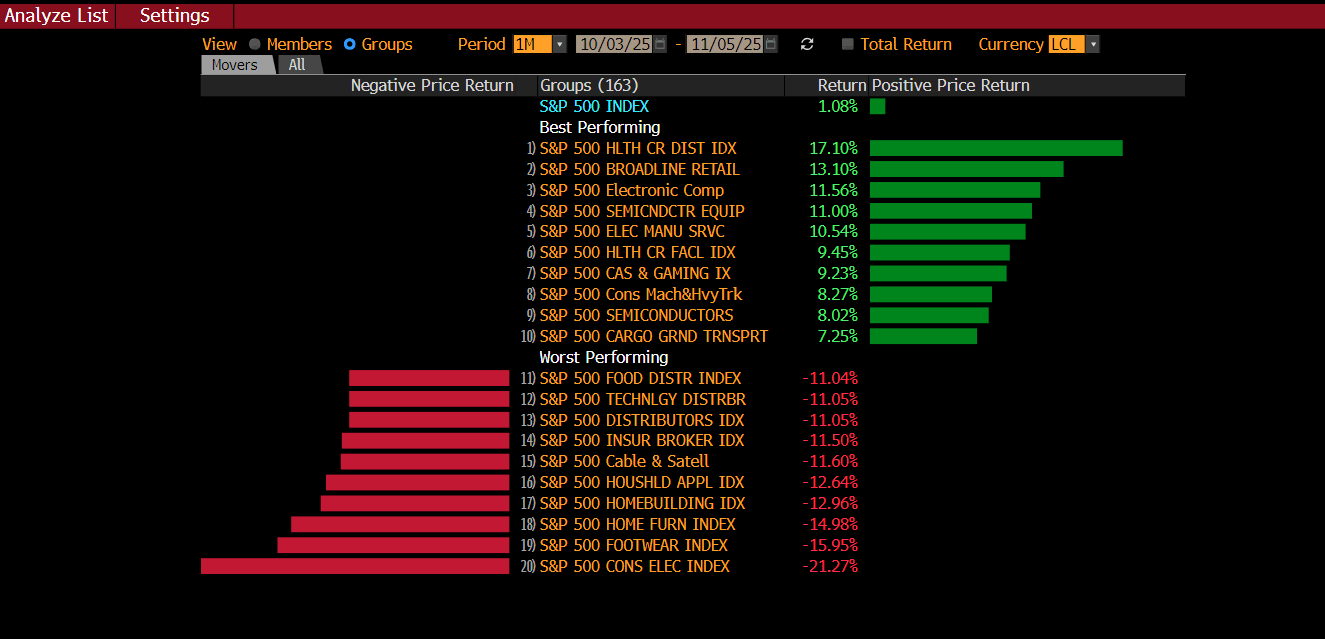
Over the past month, the weakest performing sectors on the S&P 500 are linked to the consumer. For example, auto retail, paper and plastic, insurance, homebuilders, home furnishings, footwear and consumer electronics, are all down more than 10% in the past month, as you can see below. However, a Fed rate cut, and a stabilizing labour market could give these unloved sectors a boost into year end.
The future is bright for this glass half full optimist, but Tuesday is a warning sign. If you capitulate to the bearish narrative, then there could be an opportunity cost.
Chart 1: S&P 500 performance by sector over the past month
Author
Kathleen Brooks
XTB UK
Kathleen has nearly 15 years’ experience working with some of the leading retail trading and investment companies in the City of London.

















