Procter & Gamble stock makes headway despite market trending lower on tariff worries
- Procter & Gamble stock leads the Dow Jones index on Wednesday.
- PG stock rotated 1.8% higher as much of US stock receded on tariff worries.
- Donald Trump said he did not want to see "too many" tariff exemptions.
- Dow Jones, NASDAQ move lower as Nvidia sinks over 5%.
Procter & Gamble (PG) stock led the field among Dow Jones Industrial Average (DJIA) stocks on Wednesday. Worries over United States (US) tariffs have led to a sharp sell-off in tech stocks, while many traders plough into safer blue chips like Procter & Gamble. PG shares have gained 1.8% at the time of writing.
The Dow Jones is the odd man out on Wednesday. Despite Nvidia (NVDA) breaking more than 5% lower, the Dow has lost just 0.1% at the time of writing near lunchtime. The tech-focused NASDAQ, however, has given up more than 1.6%.
Equity investors were frazzled a bit by US President Donald Trump’s statement that he doesn’t want “too many” exemptions on tariffs being rolled out next week on April 2, an event his administration has termed Liberation Day.
Procter & Gamble stock news
Rarely in the news, Procter & Gamble is a manufacturer and distributor of consumer staples. As such, the market views it as a safer bet in times of uncertainty. While consumer spending and the overall US economy are trending less favorably of late, consumers typically don’t change their spending habits as drastically when it comes to necessities.
Procter & Gamble offers five segments — Beauty, Grooming, Health Care, Fabric & Home Care, and Baby, Feminine & Family Care. The company has a strong hold on many retail outlets as products like Gillette, Oral-B, Downy, Charmin, Crest and Pepto-Bismol are household names.
The only thing of note lately among observers is the theory that makers of dental products might momentarily see growth in the product segment's usually flaccid sales. This is because, in just the past week, Utah has become the first US state to ban fluoride in drinking water. Banning fluoride in drinking water may become a trend since the head of the US Department of Health & Human Services, Robert F. Kennedy, Jr., has called fluoride a dangerous chemical.
Fluoride has been used in the US for over 100 years due to its ability to reduce cavities. Without fluoride in the drinking water, health and dental experts expect to see a larger sample of patients with tooth decay.
Likewise, a greater consumer focus on dental hygiene among consumers will become more necessary, especially those brands of toothpaste like Crest that offer fluoride options. Other analysts project that makers of flu medication like Procter & Gamble might see an incremental gains in sales this quarter since the Centers for Disease Control (CDC) reports a stark increase in flu cases this spring.
Procter & Gamble stock chart
Procter & Gamble has lifted off Tuesday's close at $162.85. The rally is strong enough for some traders to believe this is the start of a move back toward the all-time highs near $180.
Unfortunately for bulls, however, the retest of resistance at $180 earlier this month joins with the top near there from November 2024. That means PG stock could be looking at a bearish modified Double Top pattern. If that is the case, then PG investors could expect a rotation back to the $140 level.
As it appears on Wednesday, though, the move to safety could push PG stock back above the 200-day Simple Moving Average (SMA), now at $169, until worries about the Double Top pattern subside. Bulls would need to push the share price back above $180, though, to put an end to anxiety over that technical structure.
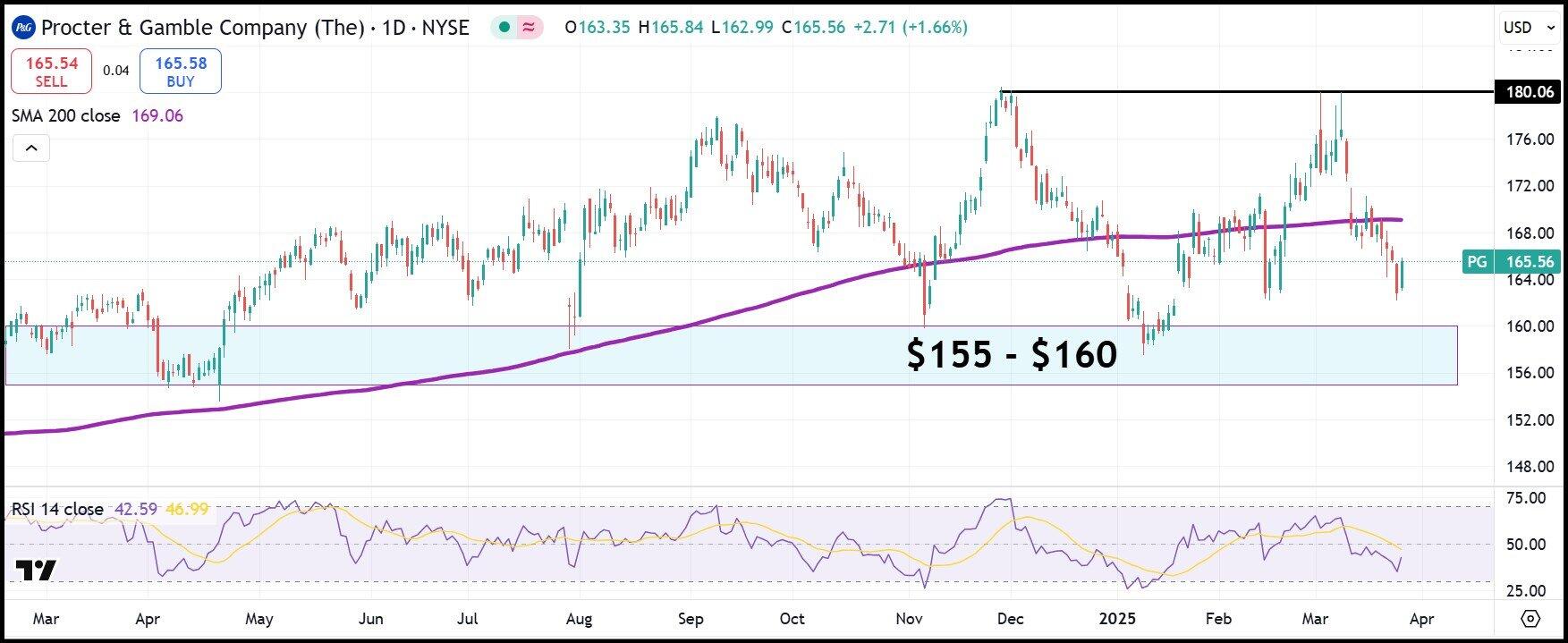
PG daily stock chart
Author

Clay Webster
FXStreet
Clay Webster grew up in the US outside Buffalo, New York and Lancaster, Pennsylvania. He began investing after college following the 2008 financial crisis.